
It is probably something you hardly think about until you step in it, or if you’re lucky, sidestep it on the sidewalk, street or trail.
Dog feces that does not get picked up and disposed of is not only unsightly, it can be a big health problem.
Cue a group of intrepid, problem-solving 10- to 12-year-old local kids who are working to help decontaminate dog feces that could pose a threat to Juneau’s drinking water.
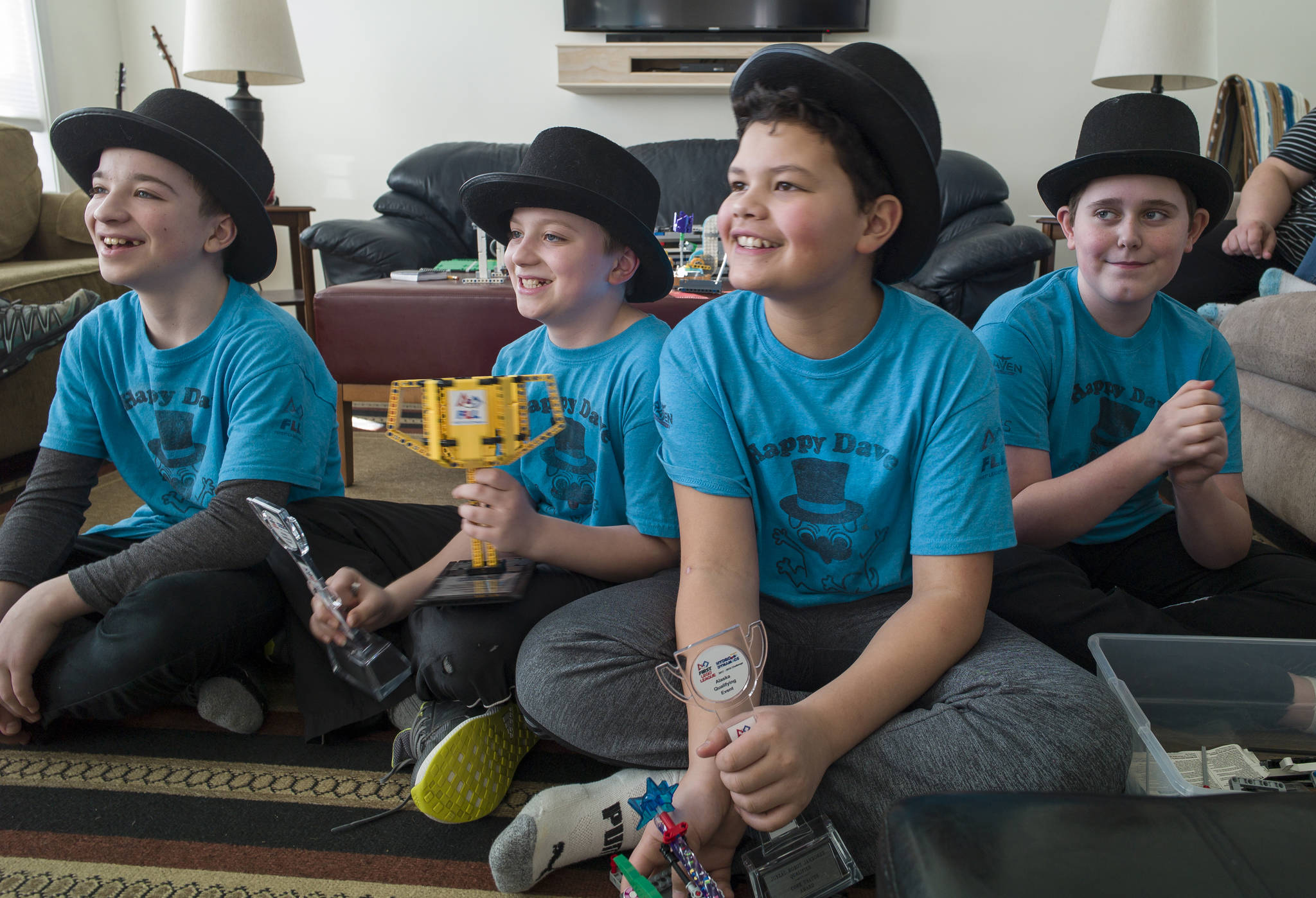
Raven Homeschoolers Sione Tupou, 11, Stig Cunningham, 12, Aiden Pietan, 12, and Kajson Cunningham, 10, are members of the First Lego League team, “Happy Dave.” They decided to tackle this issue after a recent school field trip to the Salmon Creek Water Treatment facility.
“We asked what one of the main problems with water is,” Tupou, a sixth-grader, said. ‘They said it was dog poop.”
Facility staff informed the group of kids that dog poop on streets can wash down drains and into the water, contaminating it. Dog feces can carry various diseaseas from hookworms, roundworms, tapeworms and others.
So the group, plus their parent-teacher coaches, partnered with BIO-CAT, a bio-chemical research and development company based out of Troy, Virginia, to take on the “dog poop problem” in Juneau.
The group’s goal was to start at their homes and begin to decontaminate the dog feces in their neighborhoods as a trial. Their goal is to be a part of the development of a product that can decontaminate the feces before it washes down drains. Eventually, they would like to see their product be sold commercially.
To start, the group initially tried using a powder form of a decontamination solution but coach and parent-teacher Amy Cunningham said BIO-CAT told them the powder could be an irritant, especially for those with asthma. That led the team to start looking for a liquid substance instead.
The next step, and where the group currently stands, is working with liquids and oil-based products by using a product already commercially available called “Septaid,” which currently is used for septic tanks and drain maintenance, according to a product information sheet sent from BIO-CAT to the Empire. One can spray “Septaid” directly onto dog feces and decontaminate it before it washes down the drain.
But the group has encountered some bumps in the road with this product. One problem was with the first batch of testing.
“We would spray it on and the product and it would evaporate before it would have time to do anything,” Stig Cunningham, a 7th-grader, said. “So we had to move on to super-saturation and oil-based liquids.”
Super-saturating the dog feces means soaking down the matter with enough product so it has time to break down and decontaminate. Even with this process, the group still faced a problem.
“It would freeze outside,” Tupou said.
The group then decided to bring the product inside. Bobbi Epperly, one of the homeschool parent-teachers, decided to take on the task.
“Somebody had to take the dog poop in their house,” Epplerly said.
At first, the product was put in a plastic bag and sealed with the feces. This allowed the product to break down the fecal matter, but it was not a true representation of how the product would be used in everyday life. The next step involved taking the sample, putting it a plastic bag, but not sealing it shut. Even though it would not have outside elements, it would give the group the closest example of how the product should work.
The current product takes about one to two weeks, depending on outside elements. That may not seem great, but untreated dog feces takes a year to go away if untouched, the group explained. They were told that the amount of rain in Juneau helps, but it can still be a problem. Septaid, a brown-ish colored product, has natural bio-enzymes, like citrus, that help take care of contaminants.
“The bio-enzymes break the poop down,” Tupou said. “They eat it like Pac-Man.”
The group is hoping to advance their knowledge by March 28. That’s the deadline to submit an essay discussing what they are doing and its intended results, for consideration at the Global Innovation Award in San Diego, California, in June. The group will know by April 17 if they have qualified. If the group does win the Global Innovation award for their essay and problem solution, the reward is $20,000 that must be used to advance the current project.
“We need to get a toxicity test,” Tupou said. “That can be really expensive.”
Epperly said she was told the testing can cost as much as $50,000, so the award money would be extremely helpful.
Even if they do not advance that far, they all believe they have learned something about working together.
“We really have fun being a team,” Stig Cunningham said.
• Contact reporter Gregory Philson at gphilson@juneauempire.com or call at 523-2265. Follow him on Twitter at @GTPhilson.
