
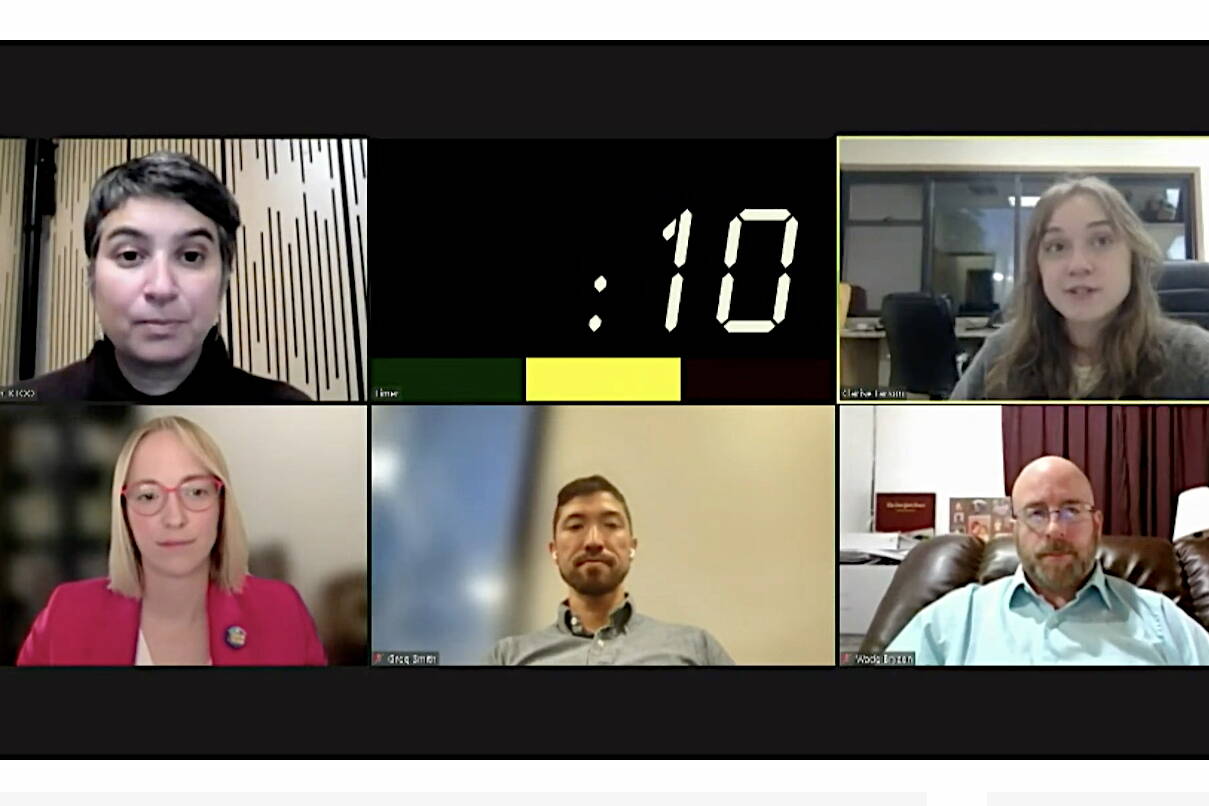
Since the question wasn’t “who should I vote for” and barely “what ballot measures should I vote for,” a forum of unopposed Juneau Assembly and school board candidates Wednesday were largely asked about what local officials see as priorities they’ll be focusing on in the next few years.
Housing, child care and youth programs, zoning involving environmental and avalanche areas, policies to entice workers, and funding to enable continued economic recovery from the lows of the COVID-19 pandemic were among the most-discussed issues during the-hour long forum. Three Assembly candidates (Carole Triem, Greg Smith and Wade Bryson) spoke during the first half, followed by two Juneau School District Board of Education candidates (Emil Mackey and Deedie Sorensen) during the second half.
[WATCH: Candidates field questions ahead of Oct. 4 municipal election]
The forum was entirely virtual with all participants appearing by video from remote locations. The two moderators were journalists with the Juneau Empire and KTOO.
Assembly candidates
The pace was rapid-fire with candidates limited to 55-second statements, so there was little political polish and soundbiting (and a few technical streaming glitches). But Bryson got his comments started by answering the first two questions of the evening — about retaining older residents and attracting a younger workforce — with the same three-words: “housing, housing and housing.”
“Employees of the medical field need to have a place to live so we can recruit people to Juneau,” he said, touching on both demographics. He said a local tax abatement for a senior center scheduled to open next year and city assistance for child care businesses are examples of actions by the Assembly to lower living costs.
Triem said more discussion of reducing or eliminating sales taxes on items such as utilities and food may help reduce senior and low-income living costs, while Smith also advocated for further child care incentives as well as boosting recreational and other quality-of-life offerings.
Tied to housing are numerous development and zoning issues, which the three candidates agreed have posed heightened challenges due to changing needs and environmental conditions in recent years.
Triem said she, like many residents, is surprised to see a gas station being built in wetlands near Juneau International Airport. While “it seems like an odd investment choice for 2022,” a previous Assembly that approved changing the zoning of the area to industrial was concerned there wasn’t enough such land to meet development demands.
“They were probably making the best choice with the information they had at the time,” she said. “Looking at the comprehensive plan going forward we need to ask ’Do we have the same needs now?’”
Current Assembly members “have since discovered we don’t need as much industrial land,” Bryson said, although “it’s a complicated issue and it’s controversial every time it comes up.” Smith said he’s inclined to take a conservative approach when considering changes to existing zoning classifications.
“We designate certain lands in a certain zone for a reason, so I think we need to look at a rezone carefully,” he said.
Zoning to protect property from avalanches, floods and other disasters presents a different set of challenges. Smith said he doesn’t agree all of the area classified as avalanche hazards are exposing people to danger, plus “the intensity of some of our weather events are changing the field.”
“I believe there’s more work to do in terms of working with local experts,” he said.
The biggest problem Bryson said he sees is “the prevention of development” due to avalanche classifications, in part due to the extensive local bureaucratic processes involved when development related to such areas are proposed.
Triem, in a rare departure from general agreement among the Assembly members during the forum, said she’s far more concerned about the potential hazards of natural disasters in the wake of recent events.
“Fatal landslides in Sitka and Haines have really shaken me to my core,” she said. “I want to move forward in ways that keep residents as safe as possible. Also, homeowners have a really invested interest in their homes. I think what it’s going to require is a lot of public process and a lot of information before we get to any decision making.”
Disagreement was also voiced by the three candidates about which of the four local ballot propositions is of greatest interest. Bryson named a bond to fund about $35 million of the estimated $41 million cost to build a new City Hall, a project he has advocated for during his past term because he calls paying $1 million in annual rent for the current outdated facility is costly and detrimental to efficient service.
“I truly believe we came out with the best outcome that will produce the best (facility) life for the most Juneau residents,” he said.
A measure providing other funding related to a new City Hall, an extension of a “temporary” 1% sales tax that’s been approved by voters every five years for the past four decades, was cited by Smith. He said in addition to improvements to the parking garage adjacent to the new City Hall site, funds from the tax are designated for deferred maintenance, energy efficiency programs, child care, recreation and other projects.
Triem, returning to the initially discussed issue of housing, said a measure repealing a mandatory disclosure of real estate purchase prices by buyers is of most interest and “is the one that’s going to be the most unpredictable.”
“I think there’s a lot of misinformation out there,” she said, arguing mandatory disclosures help low- and middle-income residents by having a true sense of local property values rather than having them “kept secret by experts who will dole that out when they feel.”
School board candidates
In the wake of pandemic-imposed shutdowns, the focus of the two school board candidates was largely on improvements outside the classroom.
Those improvements begin with money, which Mackey said is problematic “after roughly 15 years of essentially flat funding,” and Sorensen said is now “60 cents on the dollar the state is providing us.” As for where to direct resources, both candidates referred to apprenticeships and partnerships with local businesses as ways to promote a young workforce.
“Career and technical education has slowly been building back up,” Sorensen said, “It suffered a dramatic collapse probably 25 years ago when the attitude was that the only thing that was important for being a students was to be prepared for college. That has certainly has come back to bite us. Apprenticeships are incredibly important, as is our work with the university.”
Mackey said a locally missing opportunity is an ROTC program for high school students, even if it’s not a desired option for everybody.
“Not only is it a missing element that is available in most other urban school districts, it is one of the greatest vocational education programs in the world,” he said.
A question about retaining teachers also saw the candidates pivot to further outside-the-classroom opportunities for students, along with technology investments.
Mackey said “skill recovery” programs for students who fell behind during the pandemic are essential, including during the summer, since “that’s going to haunt us for the next 12 to 15 years, but it’s just a reality we’re going to have to adjust for and we need the budget for it.”
Sorensen said while federal COVID-19 funds were used to help reduce class sizes, more needs to be done there in addition to investing in technical equipment for thing such as reading programs and maintaining items such as laptops for students acquired during the pandemic.
• Contact reporter Mark Sabbatini at mark.sabbatini@juneauempire.com
