
Eight years before she died, Tlingit elder Helen Watkins began making videos about traditional ways to harvest and process food and medicine. She narrated, directed and even filmed some of the movies herself with a handheld video camera, with help from her husband and others.
The films were meant for her family: three kids, eight grandkids, seven great grandkids and generations beyond.
“I hope someone in my family will continue with everything that’s on here,” Watkins said about the films before she passed. “If you got questions, I hope you can pick up a video, and you can see how it’s done.”
Watkins’ desire to keep her audience limited changed last summer, when her doctor told her she only had about a year to live. She reached out to a friend, filmmaker Sarah Betcher.
“She told me because she had limited time to live, she would allow me to make a film for public release,” Betcher said. “I had been doing video work for several years, and Helen had never allowed me to produce any videos on her.”
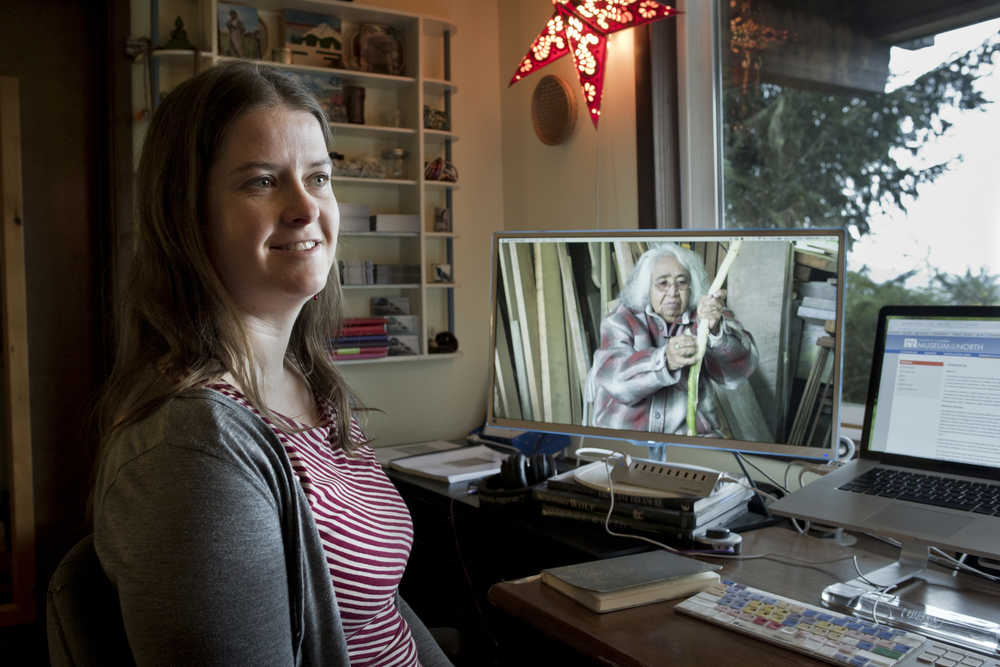
Last June, Betcher — who had just received a grant from the National Science Foundation to make a short film series on ethnobotany, the scientific study of the relationship between people and plants — started filming Watkins.
Betcher followed Watkins around Douglas Island, where Watkins lived, as she harvested and processed devil’s club, a thorny plant that covers the forests of Southeast Alaska.
Since Watkins’ death in February, Betcher has finished turning the footage into a 22-minute short instructional film, “Devil’s Club: Tlingit Traditions of Helen Watkins.” It’s the first installment for Betcher’s film series, “Ties to Alaska’s Wild Plants.”
Betcher put the video up online this week.
“I felt like I’d been given a gift to be the one to do (this) for her and help preserve her knowledge,” she said.
Tribal leader
Helen Anna Abbott Watkins was born in Haines on November 16, 1939, raised in Haines and Klukwan, and spent her adult life in Juneau. She was a Chilkat Eagle Tlingit of the Shangukeidi Clan from the Thunderbird House, Kaawdiyaayi Hit in Klukwan. She died Feb. 9 from pulmonary fibrosis.
“She was one of the ones among us that grew up in a very traditional way with her mother and her grandparents, as well as her aunts,” Thunderbird Clan leader David Katzeek said. He called Watkins his tribal sister.
He said Watkins’ knowledge on the art of processing natural resources was endless. Her areas of expertise included red seaweed, smoked salmon, salmon caviar, aged salmon heads, soapberry meringue, salmon berries, raspberries, blueberries, currants, huckleberries, high bush cranberries, thimbleberries, hooligan oil, seal oil and seal meat.
“Because we used all the parts of the animal, she’d use the sealskin to make seal moccasins,” Katzeek said.
Katzeek noted that Watkins’ kindness, appreciation and respect for natural resources extended to people.
“She was a person who appreciated human beings and worked with them and complimented them and enjoyed watching who they were,” he added.
As an adult, Watkins often gave presentations in the Juneau school district, throughout the community and helped with different cultural camps to share her traditional knowledge. She spent many years with Tlingit and Haida Head Start as a cook and a teacher, later worked at REACH and volunteered at the Glory Hole Shelter and Soup Kitchen.
“When she passed away, a lot of her food that she processed the previous year was served at the Church of Christ after the memorial service. The food was totally consumed. That included the hooligan oil and the seal oil,” Katzeek said.
Close friend Leona Santiago said Watkins was extremely generous and continued to make homemade crafts even as her eyesight deteriorated in recent years. The two had known each other since 1972.
“She was so talented in her ways, and she would give beautiful things as gifts to people,” Santiago said. “Last summer she could barely see but she made me a pair moccasins, and I proudly wear them when I dance.”
Devil’s club
Ethnobotany has long been a passion for filmmaker Sarah Betcher and was the reason she reached out to Watkins eight years ago when Betcher was working in Glacier Bay National Park.
“Someone suggested I meet with her, so I called her over the phone and we had a nice chat,” Betcher said.
The friendship first developed over the phone, then in person.
“Every time I went through Juneau, I would meet up with Helen and we would talk mostly about plants and fish. We both really enjoyed hanging out together because we had the same interests,” Betcher said in an interview this week from her Juneau home.
Once the filming process began last summer, the two saw each other much more frequently, from twice a year to about four times a month. Between last June and into the fall and winter, Watkins’ health worsened and she eventually needed a breathing machine. Filming times would be intermittent, sometimes in 15-minute time chunks, sometimes only five.
“In the summer when we were outside and were harvesting, she was feeling better and she wasn’t on the breathing machine yet, but once winter hit, it was much shorter segments of time,” Betcher said. When they weren’t filming, Watkins was on her breathing machine, eating a snack or taking a nap, and Betcher enjoyed just hanging out.
Almost the entire film that Betcher created takes place at Watkins’ house on Douglas Island.
For part of it, Watkins sat outside, wearing a thick red, grey and white flannel shirt and heavy gloves. Using a butter knife, she scraped the needles off a thick devil’s club branch down to the green bark, the part of the plant she was after.
Watkins said on screen that it’s better to remove the bark in the spring. “The green comes off easier. It peels like a banana,” she said.
She used her nails and teeth to peel off long strips of bark.
Later in the film, Watkins is shown standing over her stove inside her kitchen. She explained how to make salve and oil infused with the bark.
Watkins explained the healing powers of the plant.
“You get the medicine out of the bark, and it goes into the oil. Makes you feel good and it heals your wounds. All-around good medicine. I put it on my face and hands. I don’t want to waste it,” Watkins said in the film, as she rubbed her hands together and inhaled through her nose. “Smells so good.”
Going public
All the videos that Watkins made herself over the last decade of her life will become public as well, Betcher said — eventually.
“We talked about if she would want them to be available for people outside of her family once she passes and she said yes. We talked about them being available in schools and in libraries,” Betcher said.
On her own time, Betcher has gone through several hours of Watkins’ footage. They’re categorized into nine different topics, including gumboots, soapberries, salmon eggs and salmon.
“The film quality isn’t high quality, but the content is amazing, and she was really amazing at narrating everything that she was doing and explaining it and who taught her,” Betcher said.
Betcher is looking for grant funding to allow her to finish editing Watkins’ videos.
“I’m glad she made those videos because now my youngest can see them,” said Tonya Howard, 34, Watkins’ oldest granddaughter. “That’s the biggest fear that my grandma had was that my 3-year-old is never going to remember her.”
Growing up in Juneau, Howard spent the majority of her childhood at her grandmother’s house. She often participated in traditional activities, like going to fish camp in Klukwan where her grandmother taught her how to cut and smoke salmon.
As an adult who is raising children and working, though, Howard said she unfortunately doesn’t have time to practice as much. The videos will help her as well, she said.
“There was just so much stuff, there’s no way I could’ve learned all of it,” Howard said.
Lasting legacy
At Watkins’ memorial in Juneau on Feb. 13, Betcher shared a six-and-a-half-minute video that she just filmed in December, just six weeks before Watkins passed.
In the footage, Watkins sat in a living room chair and looked at the camera. She thanked family members who helped her with the videos.
She thanked her husband of 35 years, local carver Ray Watkins, for being there during every project.
“Everything we did with clam digging in winter and picking berries, cutting up branches of herring eggs when they came in. He would pick a lot of berries for me. He’d go fishing for me,” Watkins is seen saying. “And there was a time when I could show him how to do it; now he knows everything that I know. He can do all of it.”
She shared memories of catching and smoking salmon at fish camp. She talked about loving her family. She reminisced about collecting red seaweed in Haines.
“I used to take two gunny sacks and go down to the beach and fill them both up. Not lightly. I had to push them all down and then shake it down, pick more, fill it ‘till I could only grab the top. I’d fill two bags up and carry them up the beach, get two more bags and go back down the beach and this happened about three or four days,” Watkins said.
Her final memory in the video surrounds clamming with a friend.
“I had on my boots, my big pants, my coat, my hat, I had a bucket and had a rack, and I came down the stairs and I was singing, ‘Here she comes, Miss Alaska.’”
Watkins’ singing trailed off in laughter, “I wish I had a photo of that.”
• Contact reporter Lisa Phu at 523-2246 or lisa.phu@juneauempire.com.
“Devil’s Club: Tlingit Traditions of Helen Watkins” was made available this week on Sarah Betcher’s website, www.farthestnorthfilms.com. It’s also on the University of Alaska Museum of the North’s website, www.uaf.edu/museum/collections/herb/ethnobotany/.
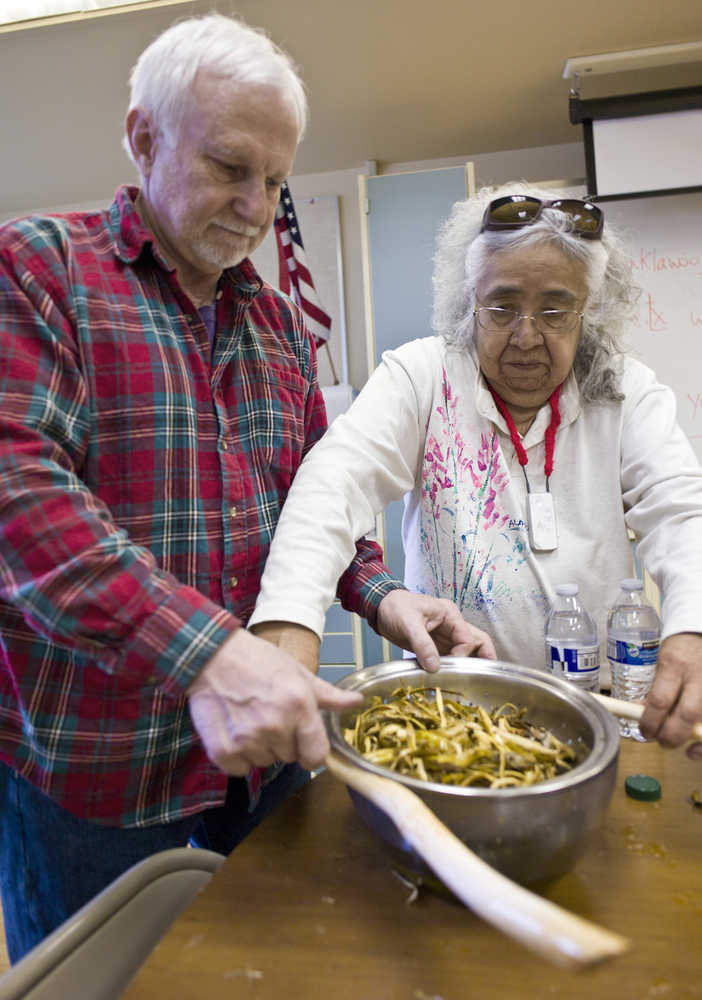
Helen Watkins is helped by her husband, Ray, as they prepare Devil’s Club ointment for a class at Yaakoosge Daakahidi Alternative High School in April 2015.
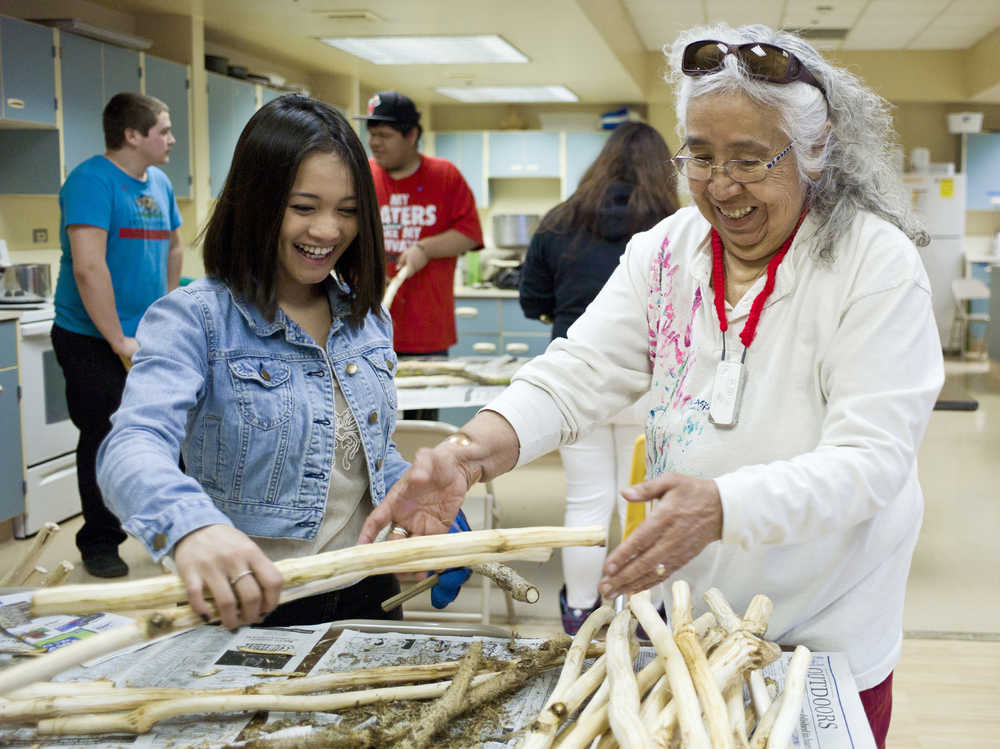
Tlingit elder Helen Watkins helps freshman Charity Lumba move shaved Devil’s Club stocks as she teaches students how to make an ointment at Yaakoosge Daakahidi Alternative High School in April 2015.
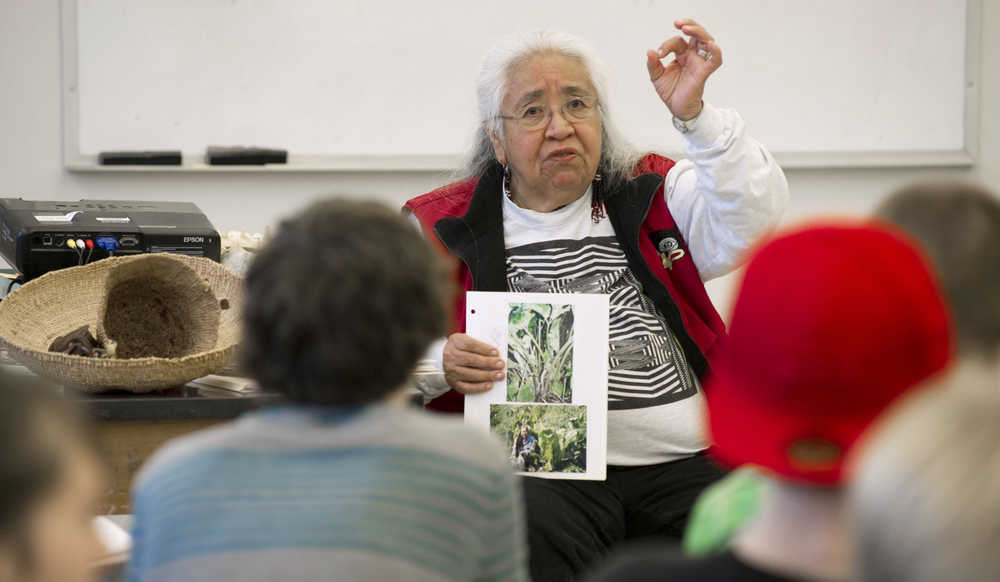
Helen Watkins talks to biolog teacher Henry Hopkins’ freshman class at Juneau-Douglas High School in October 2010 about her Tlingit food gathering and resource utilization.
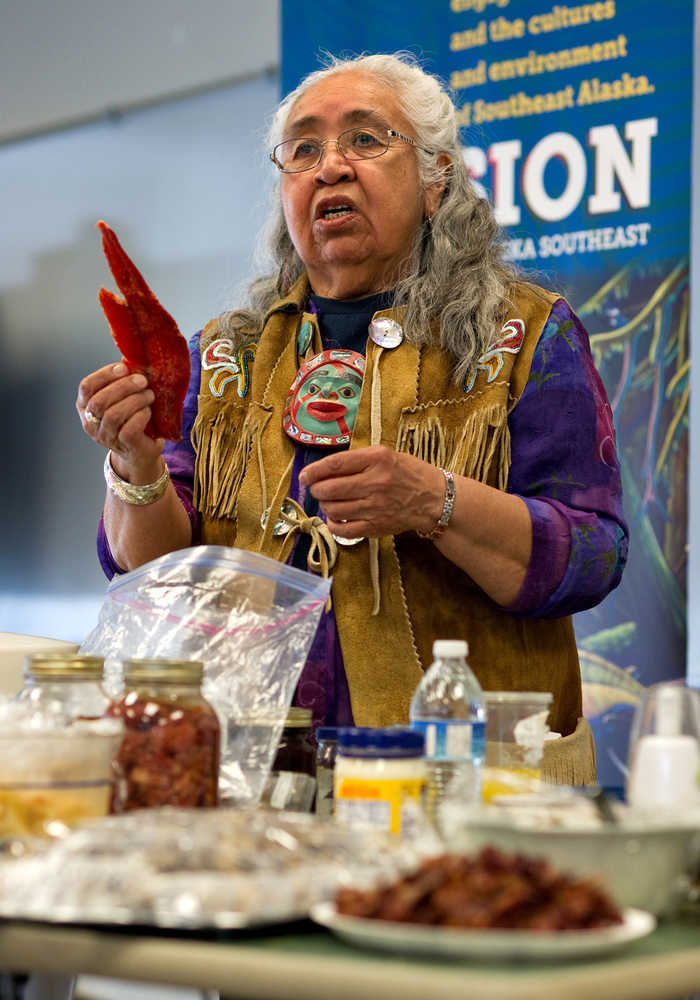
Helen Watkins shares her knowledge of seal, salmon and seaweed during the 2013 Edible Art of Place at the University of Alaska Southeast April 2013.
