
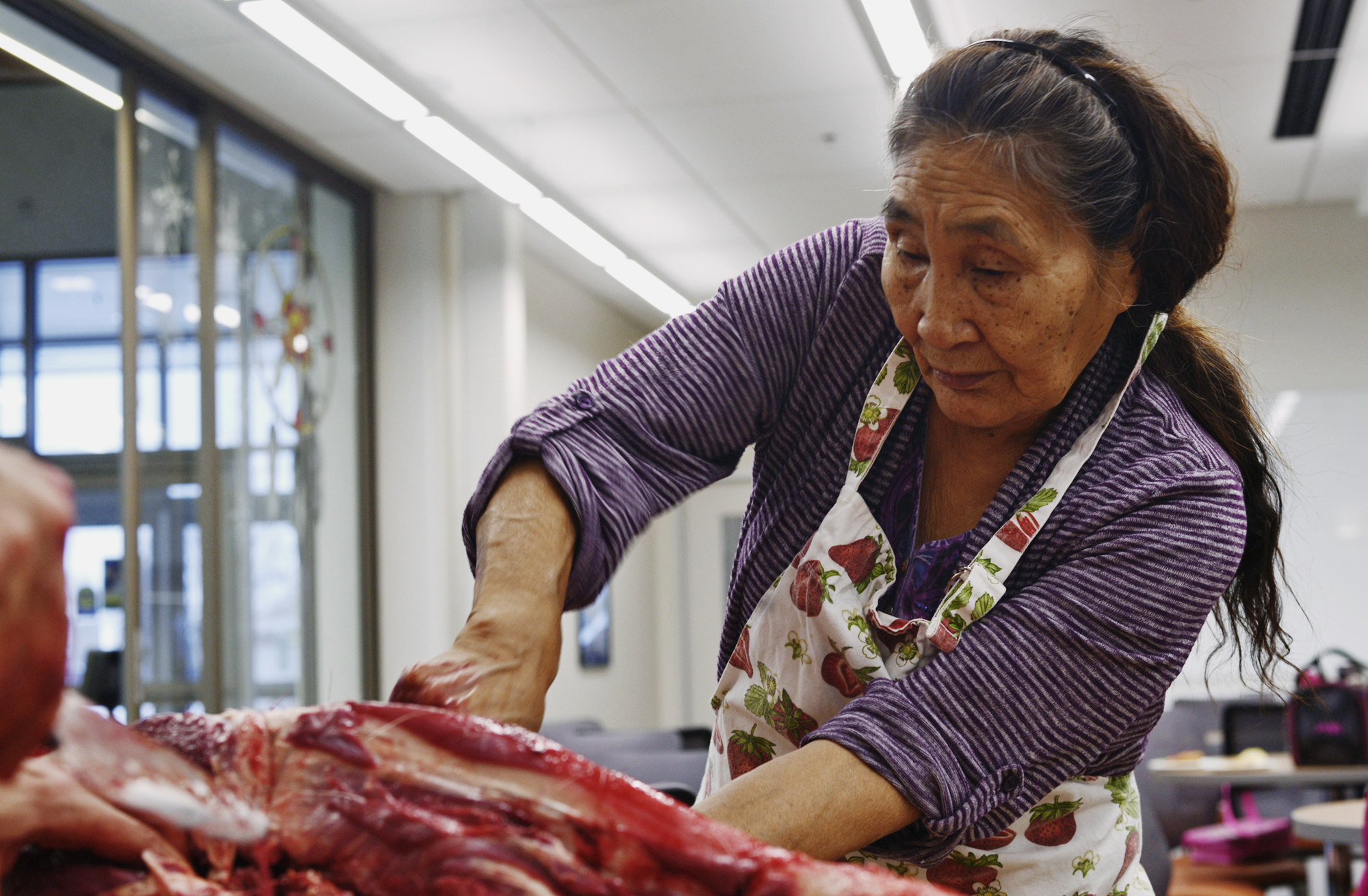
KENAI — During Sharon Isaak’s childhood in Soldotna, butchering and processing moose meat was a regular family activity.
Though the old bone saws are still in the family and still doing their job, the way she uses the moose has changed. Isaak, a member of the Kenaitze Indian Tribe, said her family butchered moose strictly for meat. But since meeting Dena’ina elder Helen Dick in 2011, they’ve learned traditional ways to use what they’d previously discarded — tanning the skins with brain, making needles from the bones and storage sacks from the dried membrane around the animal’s heart.
“It’s like we’re rich, because of what we’ve learned to do with every part of the moose,” Isaak said.
Sharon Isaak’s son Joel Isaak, a manager of the Kenaitze’s Language and Cultural Revitalization Program, demonstrated one way to use this wealth. With Dick’s aid and supervision, he showed how to turn the head of a moose killed in a vehicle collision into chewy boiled meat, children’s boots and a traditional food called headcheese, reported the Peninsula Clarion.
“Basically you’re boiling it (the moose’s skull and tissue), and extracting the gelatin from the bones and the marrow,” Isaak said of headcheese. “Those nutrients come out, and then the cartilage that’s in the head is also what you’re cooking down. Then you pour it into a mold — traditionally a basket, like a birch-bark basket or a carved wood form, but we’re using pans. Basically it sets like gelatin does, then you can slice it off like cheese. That’s why it’s called headcheese today.”
With tribal members watching in the Dena’ina Wellness Center’s demonstration kitchen, he began by cutting off the softer tissue of the moose’s nose. The tender nose meat is considered a delicacy, Isaak said, usually reserved for elders. Cut into strips and boiled, it has a consistency that Isaak described as similar to calamari.
The ears were next.
“The nice thing is about the ears is the hair doesn’t slip — that is, it doesn’t come out,” Isaak said. “The deer family tends to have hair that slips, like caribou or moose or deer or elk — the hair doesn’t want to stay in, while other fur-bearing animals like beaver or mink, their hair stays in well. But this part of the moose, the hair stays attached to the skin and doesn’t fall out as easily as the neck of the moose for example.”
After some cutting and hard pulling, Isaak, Dick and traditional healer Estelle Thomson managed to peel from the ears two large flaps of fur, which were tacked to a piece of cardboard to dry without shrinking. The two pieces can be sewn together with an additional piece of moose hide to make small boots for toddlers learning to walk. With each boot sewn from two ears, a pair of moose heads make a pair of child’s boots.
After the head was skinned and the jaw tendons cut, Dick and Isaak sawed the head into quarters, keeping the brains for curing hide. Isaak attempted to save time by boiling the head pieces down in a modern pressure cooker. After pouring out the liquid from the pressure cooker and mixing the gelatin with other pre-cooked chunks of head meat, Isaak let the mixture set overnight.
Like nose meat, headcheese is traditionally a food for elders.
“It’s a nutrient-dense food, so you don’t have to eat as much of it,” Isaak said. “It’s very high in calcium, and as you get older your bones need calcium and it helps fight that. It helps with maintaining strong and healthy joints, and as you age you need more of that. So specifically from a nutritional standpoint it targets those two things, because of what it’s made from.”
Isaak himself hadn’t eaten headcheese before.
“It’s just like meat suspended in a jelly,” he said.
The moose head demonstration is part of a series of practical education events the Kenaitze Language and Culture Revitalization Program is planning for tribal members, in addition to its weekly Dena’ina language lessons for tribal staff. Upcoming events include a hat-sewing workshop in February and a fish-skin processing and sewing lesson in March.
“Everything we do will have a language and cultural component,” Isaak said. “Language may not be the sole focus of it, but there will be language involved.”
Isaak said the Dena’ina language and the practical activities of its traditional culture are deeply tied to one another — Dena’ina is a very verb-based language, he said, loading information in its verbs that Western languages would express with nouns. One way to learn the language is by acting these verbs.
“There’s a lot of different verb stems for the action of cutting,” Isaak said. “So you have to think about what you’re doing. Are you slicing? Are you using a sharp tool to do the action? Are you cutting something into strips, a continuous action? Or it could be cutting something into small pieces as a finite action. It really illustrates the complexity and descriptive nature of the verb, and how it comes together in the mental model of Dena’ina, how to interact and view the world around us.”
