
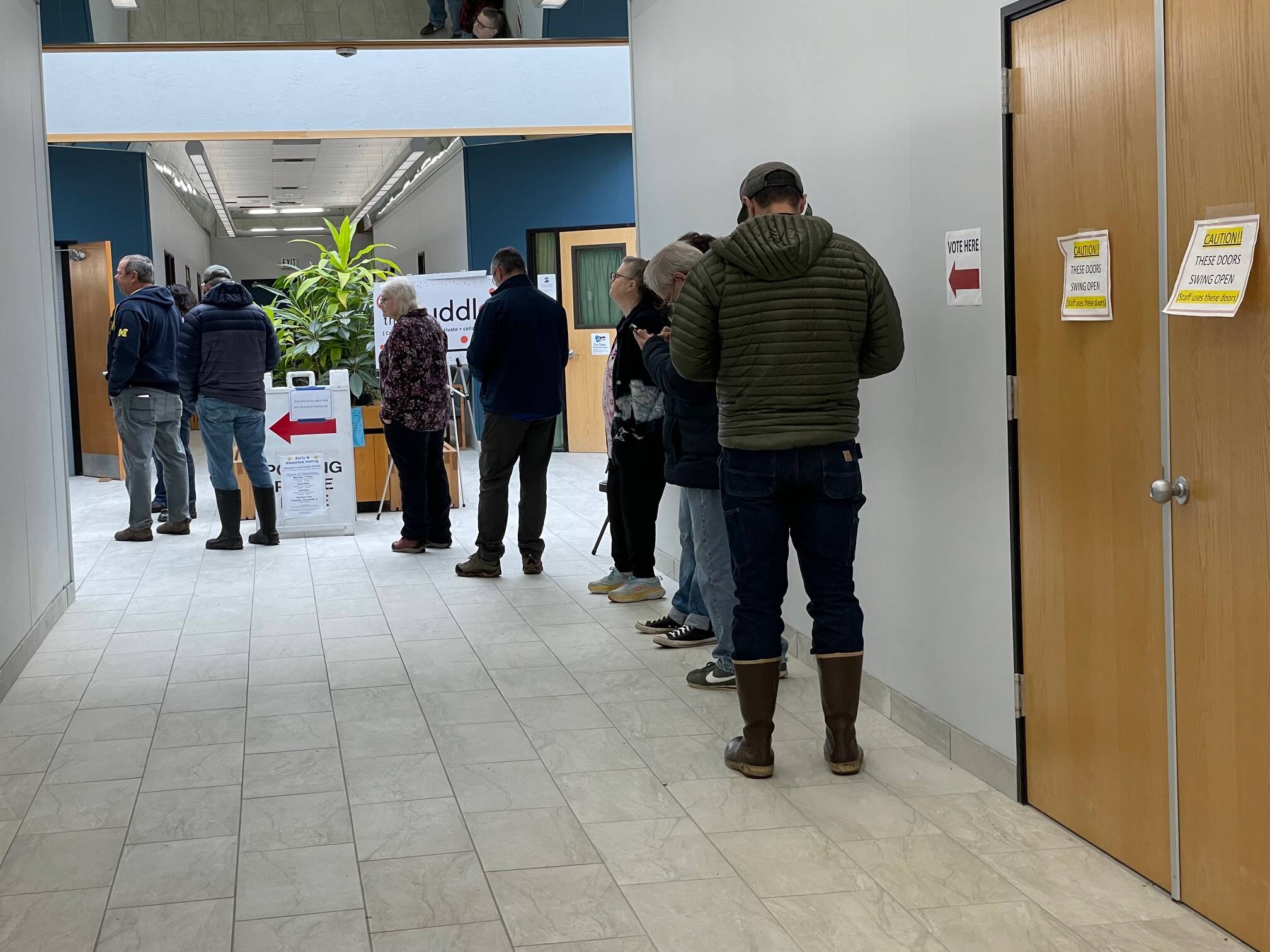
None of Juneau’s legislators are in contested races and the two major U.S. House candidates in a toss-up race have made a single campaign stop here between them since the August primary leading up to Tuesday’s general election.
But local voters are among those turning out at a record pace statewide to fill out ballots that also include a presidential race full of apocalyptic descriptors, repealing Alaska’s ranked choice voting and open primaries, and increasing the state’s minimum wage. More than 80,000 early in-person ballots and absentee ballots had been received as of Wednesday, according to the state Division of Elections.
Early in-person voting in Juneau is taking place at the State Office Building from 8 a.m.-5 p.m. weekdays, and Mendenhall Mall annex from 8 a.m.-5 p.m. weekdays, 10 a.m.-4 p.m. Saturday and noon-4 p.m. Sunday. Polling locations throughout Juneau will be open from 7 a.m. to 8 p.m. Tuesday.
The presidential race, considered too close to call nationally, isn’t expected to be contested in Alaska since Republicans have prevailed in every election since statehood except in 1964. But Alaska’s lone U.S. seat could be pivotal in how successful either Democratic Vice President Kamala Harris or former Republican President Donald Trump is at implementing an agenda, since Republicans currently hold a tiny leadership margin.
Democrat Rep. Mary Peltola, seeking a full two-year term, is in a rematch against Republican Nick Begich III in a race the Cook Political Report rates as a “toss-up.” Both candidates are waging fierce campaigns with a lot of out-of-state help — although Peltola has raised and spent far more than Begich — but mostly bypassing Juneau aside from the respective efforts by their campaign staff and volunteers.
Begich made a single campaign visit to Juneau on Oct. 12 that included a meet-and-greet at a Mendenhall Valley real estate office before attending the annual Greater Juneau Chamber of Commerce gala at Centennial Hall. Peltola was scheduled to visit Juneau on Thursday for Halloween events at the Mendenhall Mall and across the street at Bullwinkle’s Pizza, but canceled due to travel complications getting out of Ketchikan.
Both candidates and their campaigns have said that doesn’t mean Alaska’s capital city — which is off the road system and fewer than 32,000 of Alaska’s 737,000 residents — isn’t important in this election cycle.
“There’s a lot of people here who are independents and Republicans, even though this tends to be a more Democrat town,” Begich said during his visit. “There’s still a lot of Republicans here and every vote counts to us. And this is sort of the nerve center of Southeast.”

Nick Begich, center, the Republican candidate for Alaska’s lone U.S. House seat, talks with supporters during a meet-and-greet Oct. 12 at the Southeast Alaska Real Estate office near the Nugget Mall. (Mark Sabbatini / Juneau Empire file photo)
Shannon Mason, a spokesperson for Peltola’s campaign, stated in an email Friday afternoon the congresswoman has made nine stops in Juneau since January of 2024 that included campaign-related activities — all before the primary. Peltola has also visited Juneau in recent months an in official capacity, including a tour of areas affected by record flooding from Suicide Basin in August, which Peltola and other members of Alaska’s congressional delegation sought federal assistance for.
Begich, during his campaign visit, said he’s familiar with protective measures being discussed such as a levee but notes “there’s a lot of regulatory red tape” in implementing many of the potential long-range measures since the basin is on U.S. Forest Service land. While that difficulty has been noted by Peltola and other officials regarding Suicide Basin, it’s also a common theme on a broader range of issues that represents one of key differences between the two major House candidates.
Both candidates have expressed support for natural resources activity including additional drilling on the North Slope, opposing President Joe Biden’s restoration of the so-called Roadless Rule in the Tongass National Forest, and supporting the state’s sagging fishing industry. But Begich says Biden’s policies have been overrestrictive to the detriment of Alaska’s economy and workers, while Peltola has stated her opposition to some projects — including a bill to permanently cancel the Pebble mine in Western Alaska — are based on protecting fish and other natural resources local communities depend on.
The two House candidates have each encountered awkward situations about their party’s presidential nominee, with Peltola endorsing Biden early and then declining to do the same when he dropped out — following a disastrous debate performance that raised questions about his cognitive abilities — and Harris replaced him.
“It’s a secret ballot,” Peltola said during a televised debate Oct. 10. “Much of the concern that we have will be around — who are they choosing as their senior advisers? And again, I think both candidates are flawed, and I don’t know why I would use up any of my gas on a race I don’t have any control over.”

U.S. Rep. Mary Peltola, a Democrat seeking a second full term as Alaska’s lone House representative, talks with Fu Bao Hartle, a participant in and spokesperson for local Special Olympics events, during a campaign meet-and-greet on Jan. 27 at the Crystal Saloon. (Mark Sabbatini / Juneau Empire file photo)
Meanwhile Begich is among many Republicans questioning the legitimacy of the 2020 election — in his case questioning processes and rule changes rather than saying it was stolen outright — while getting questions about whether his support of Trump extends to actions and statements former top aides have recently called fascist and otherwise extreme. Begich’s visit to Juneau, for example, occurred shortly after Trump said “a lot of bad genes in our country” due to migrants and claimed Haitian immigrants were eating pets in Ohio.
“I’ve never said anything like that and I will never say anything like that,” Begich said when asked what he considers to be the boundary of acceptable remarks. “That’s not something I believe. So if that rhetoric is out there that’s too far.”
Two other candidates for the seat aren’t considered serious contenders, but both could prove pivotal to the outcome due to what some pundits are calling a dead-even race between Peltola and Begich. John Wayne Howe, chair of the Alaskan Independence Party, could draw conservative voters; while Eric Hafner — a federal prisoner in New York who has never set foot in Alaska, yet is on the ballot as a Democrat — could draw a handful of crucial votes away from Peltola.
The three Democratic members of Juneau’s state legislative delegation — state Sen. Jesse Kiehl, and Reps. Andi Story and Sara Hannan — are unopposed and thus focusing their efforts on turnout efforts and other races. All three are listed as participants in get-out-the-vote efforts on behalf of Peltola this weekend.
Ballot Measure 1: Minimum wage increase
Alaska’s minimum wage is $11.83 an hour. Ballot Measure 1 would increase that to $13 in 2025, $14 in 2026 and $15 in 2027, with annual increases for inflation in subsequent years.
“The minimum wage would always be at least $2 above the federal minimum wage,” the ballot language states. “Tips and gifts do not count toward minimum wage.”
The measure also requires sick leave of one hour accumulated for every 30 hours worked by employees, with some exceptions. Entities with 15 or more employees would be required to allow up to 56 hours of paid sick leave per year, with 40 hours of sick leave a year for smaller employers.
“This act would prohibit employers from making their employees attend meetings about religious or political issues,” the ballot language states. “These issues include whether or not to join or support a religious, political, or labor organization. Some employers would be exempt and all employers could still communicate about issues required by law or related to the workplace.”
Two coalitions with a multitude of small businesses among their ranks have formed to support and oppose the measure. In favor is Better Jobs for Alaska, which argues higher minimum wages will improve employee retention and consumer spending. Opposed is Protect Our Small Businesses & Jobs, which states the measure will impose harmful extra costs and burdens on businesses.
Ballot Measure 2: Repeal ranked choice voting and open primaries
Alaska’s first ranked choice elections in 2022, following open primaries where the top four candidates made the general election ballot regardless of party, got nationwide attention. But while some other states have ballot measures to implement similar voting systems, Alaskans are voting on repealing the one here.
Polling suggests Alaskans are bitterly divided on Ballot Measure 2, despite a campaign where opponents of the measure are outspending proponents by roughly a 100-to-1 ratio, according to campaign finance reports. Some of the acrimony from supporters is that a broad range of what’s seen as the “mainstream” political power structure — inside and outside the state — are opposing the repeal.
Ranked choice voting and open primaries were credited with helping elect a more moderate slate of candidates in 2022, including Peltola and U.S. Sen. Lisa Murkowski, who both were facing conservative Republican challengers in the general election. In Peltola’s case there were two such challengers — Begich and former Gov. Sarah Palin — and opponents of ranked choice voting said that resulted in a split vote between the challengers that allowed Peltola to prevail.
A key factor in that split vote was many people who ranked one of the Republicans as their first choice failed to rank the other Republican as their second choice. So while Palin had the second most first-choice votes, there’s weren’t enough second-choice votes from Begich supporters to surpass Peltola’s total.
A similar situation might have occurred this year since Republican Lt. Gov. Nancy Dahlstrom finished third in the Aug. 20 primary. But she dropped out soon afterward and supported Begich, with Republican fourth-place finisher Matthew Salisbury withdrawing after the primary as well. That set the stage for Howe and Hafner to appear on the general election ballot — and Begich to face Peltola in essentially a head-to-head matchup.
• Contact Mark Sabbatini at mark.sabbatini@juneauempire.com or (907) 957-2306.
