
This story has been updated with additional information.
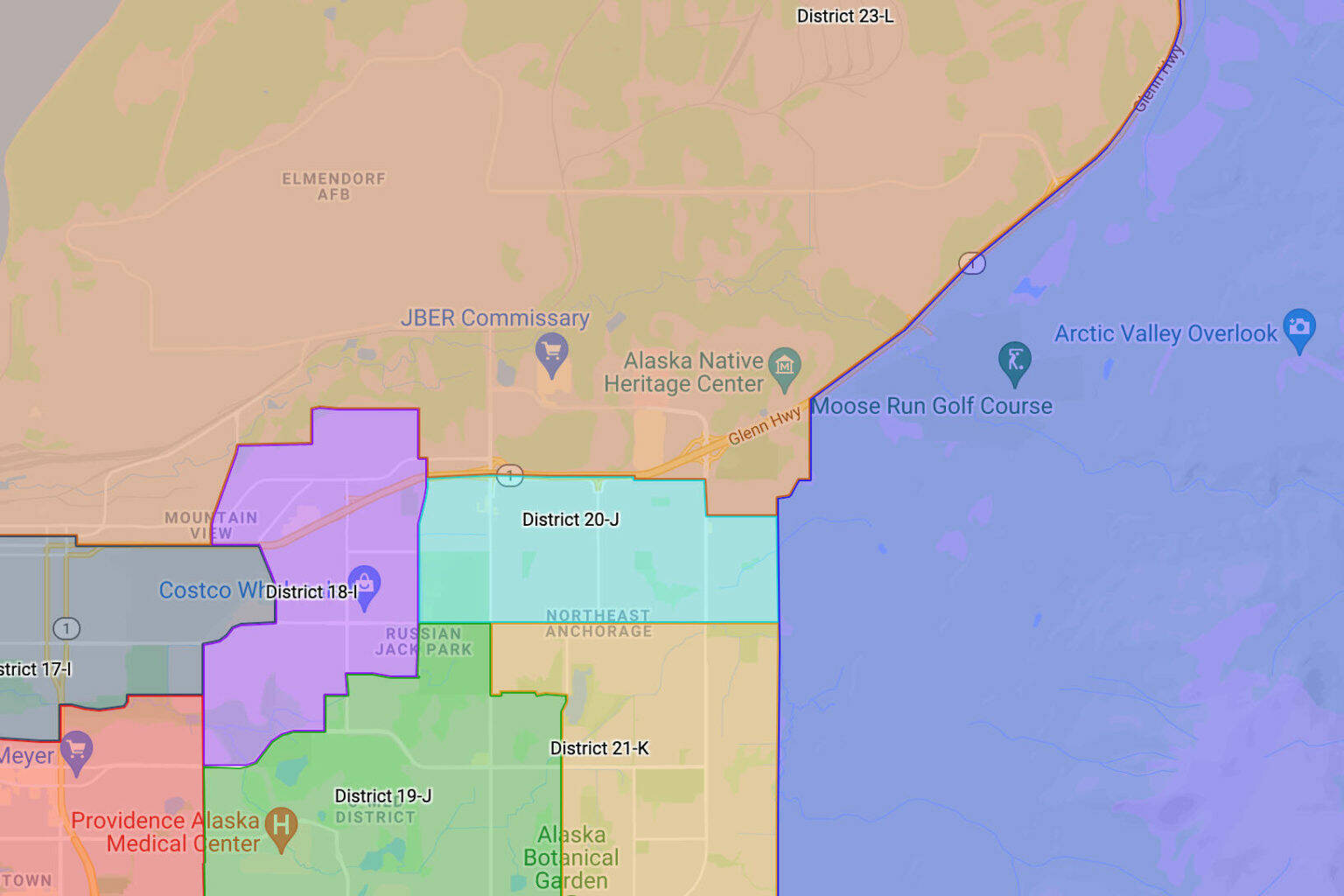
An Anchorage Superior Court judge ruled early Wednesday the Alaska Redistricting Board violated the state constitution in House districts and Senate pairings in East Anchorage and Skagway and ordered a redrawing of legislative maps. Following an executive session, the board voted to appeal the ruling.
“The Board did not follow the constitutional process when it drew the Senate map, and one of the challenged house districts,” Judge Thomas Matthews wrote in his decision. “The plan of reapportionment should be remanded to the Board to prepare a new plan which complies with this Order.”
Matthews ruled against the legal challenges brought by the Matanuska-Susitna Borough, the City of Valdez and Calista Corp., the Alaska Native Corporation for the Yukon-Kuskokwim region.
Matthews found the Redistricting Board violated the state constitution and the Open Meetings Act in several instances but only overturned the Senate pairings in East Anchorage and the House District lines in Juneau and Skagway. At issue was the voard’s decision to pair the East Anchorage community of Muldoon with nearby Eagle River and to place Skagway in the same House district as the Mendenhall Valley.
Public testimony from Skagway overwhelmingly favored being placed in the same House district as downtown Juneau, with residents citing the cruise ship industry as a significant commonality. The board’s current map cuts of the district with downtown Juneau and Douglas along Riverside Drive and Haloff Way. In his ruling, Matthews found the board had violated the Due Protection Clause of the state constitution by failing to account for public testimony from Skagway and East Anchorage.
In his findings for the East Anchorage senate pairing, Matthews found the board had held “secretive” procedures that discriminated against the residents of Muldoon.
[Legal memo cites issues with order to split state health department]
“Given substantial evidence of secretive procedures, regional partisanship, and selective ignorance of political subdivisions and communities of interest,” Matthews wrote. “(The) Court finds that the Board intentionally discriminated against residents of East Anchorage in favor of Eagle River, and this intentional discrimination had an illegitimate purpose.”
Board member Bethany Marcum — appointed by Gov. Mike Dunleavy — argued during the redistricting process that Eagle River residents regularly visit Muldoon, but Matthews noted in his decision it wasn’t shown that Muldoon residents travel to Eagle River.
“Member Marcum stated on the record that doing so would give Eagle River ‘more representation.’ Thus, it is apparent the Board understood the practical result of splitting Eagle River into two Senate districts,” Matthews wrote. “This Court agrees with Ms. Marcum that Senate District K gives Eagle River more representation. However, it appears to also have the converse impact, of diluting representation in East Anchorage.”
Speaking to the board in a meeting Wednesday morning, attorney Matthew Singer called many of Judge Matthews’ rulings to be “novel,” and said the judge appeared to give considerable weight to in-person public testimony.
“That’s a new concept,” Singer said. “A notion that public testimony should have a higher role or be more important than the sound discretion of the constitutionally appointed board.”
Following an executive session board members voted to appeal both the East Anchorage and Skagway decisions, citing Singer’s comments Judge Matthews’ rulings were novel.
Member Bud Simpson said Matthew’s rulings depart from established precedent to the extent it was necessary to seek guidance from the Supreme Court.
“I think there was new law,” said Board Chair John Binkley. “It’s really is important for the Supreme Court to weigh in on these issues.”
Members Nicole Borromeo and Melanie Bahnke voted against appealing the decisions, and said they agreed with Judge Matthew’s findings. Borromeo said previously drawn maps for East Anchorage could be used and the issue could be resolved in, “less than 15 minutes.”
Board members voted unanimously to defend the findings in the three remaining cases from the Matanuska-Susitna Borough, Valdez and Calista Corp, whose claims Matthews dismissed.
According to Singer, appellate court rules will require the Alaska Supreme Court to issue a ruling by April 1. If the higher court upholds Matthews’ ruling, the board will have to redraw districts for Skagway and choose new Senate pairings for East Anchorage. The deadline for candidates to file for office is June 1.
• Contact reporter Peter Segall at psegall@juneauempire.com. Follow him on Twitter at @SegallJnuEmpire.
