
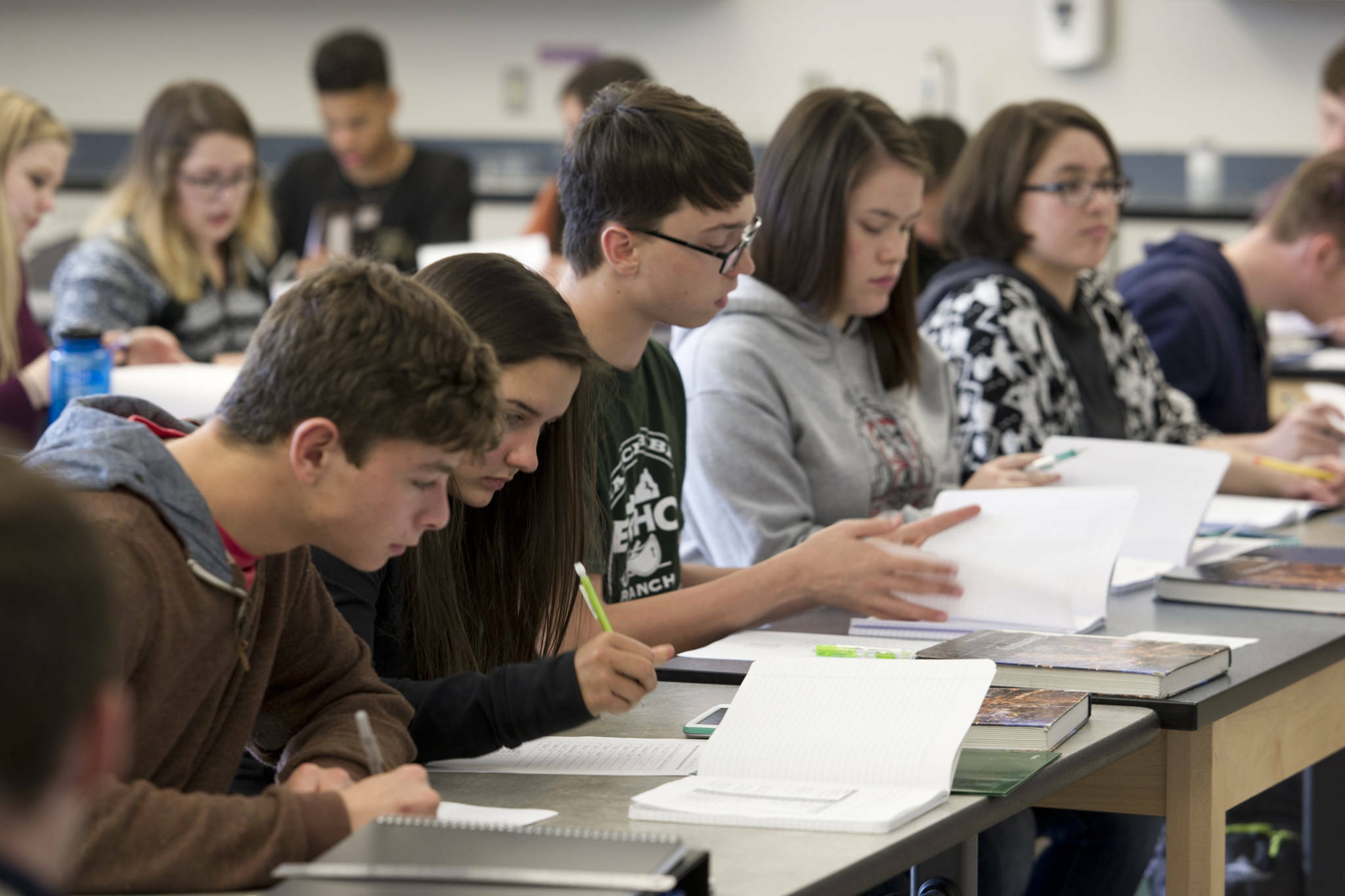
Juneau’s two main high schools ranked fourth and fifth out of 64 in Alaska, with the HomeBRIDGE program ranking 41st, in results published this week by U.S. News and World Report.
The rankings come as fourth-ranked Juneau-Douglas High School: Yadaa.at Kalé is scheduled to absorb the students from fifth-ranked Thunder Mountain High School when the school starts this fall as part of the Juneau School District’s consolidation plan. While declining overall enrollment is cited as one of the reasons for the consolidation, the number of students in the lower-ranked HomeBRIDGE program has increased in recent years.
Out of 17,655 nationwide schools ranked of more than 24,000 assessed, JDHS finished at 2,708, TMHS at 2,946 and HomeBRIDGE at 12,264. The magazine, in an overview of the results, noted magnet and charter schools that may be exempt from some state and local regulations are overrepresented in the rankings.
“All of the top-20 schools this year have either selective enrollment – with requirements often including a minimum GPA, teacher recommendations and an entrance exam – or a lottery system,” the overview notes.
The rankings are based on six criteria including graduation rates, standardized test scores, college curriculum breadth such as Advanced Placement courses, and performance of “underserved” students such as low-income and minorities.
Despite their close finish in the state rankings, JDHS and TMHS showed different characteristics in the magazine’s ranking criteria.
JDHS topped TMHS in students taking at least one Advanced Placement exam (47% for JDHS compared to 39% at TMHS), yet TMHS had 34% of students pass the exam compared to 30% at JDHS. JDHS students scored higher in reading and math proficiency (44% and 36%, respectively, compared to 36% and 23% at TMHS) — but TMHS students prevailed with 58% proficient in science compared to 52% percent at JDHS.
The graduation rate for TMHS was 96% and the school received a 35.6 readiness score, compared to an 89% graduation rate and 34.3 readiness score at JDHS.
Different characteristics of the two schools are one of the prime arguments of residents opposing the consolidation plan. Many of those residents favored keeping both schools open and expanding instruction to grades 7-12 (or 8-12), and could claim a validation of sorts for their proposal from the rankings which placed Cordova Jr/Sr High School, which provides instruction to grades 7-12, at the top of the state rankings.
However, that school had 83 students in grades 9-12 at the time of the survey, compared to more than 550 each at JDHS and TMHS. Juneau School District Superintendent Frank Hauser told school board members at a meeting in March than only 1.4% of Alaska’s schools are for grades 7-12 and they have an average enrollment of 152 students, so establishing two such schools in Juneau that would have an anticipated average of 818 students each next fall would be a “local and statewide experiment.”
Results of the HomeBRIDGE scores are more limited since it had 102 students at the time of the magazine’s rankings. HomeBRIDGE had a 62% graduation rate and 33% reading proficiency rate, with no other categories scored.
The alternative Yaaḵoosgé Daakahídi High School, with a listed enrollment of 69 students and 62% graduation rate, and Johnson Youth Center which provided high school instruction to 13 students were not ranked in the survey.
• Contact Mark Sabbatini at mark.sabbatini@juneauempire.com or (907) 957-2306.
