
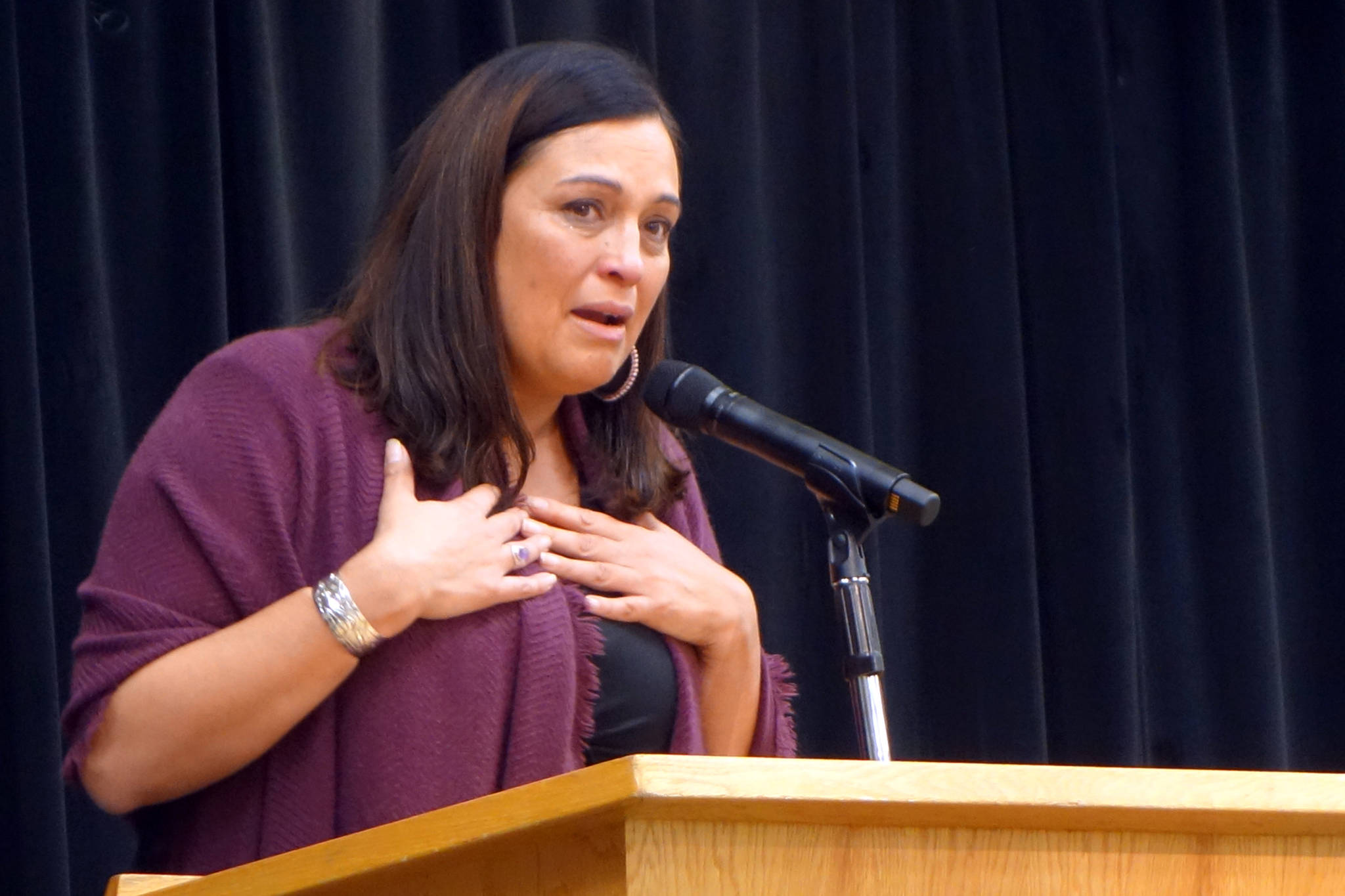
Deborah Parker didn’t want to be the face of an issue.
But, the Washington woman of Tulalip and Yaqui Native descent badly wanted further protections for Alaska Native and Native American women to be included in the federal Violence Against Women Act.
“I said, ‘I’ll be the face,’” Parker said with emotion Friday at a Juneau summit to raise awareness of domestic violence, “It’s not what I wanted to do.”
Still, in 2012, Parker shared her story of surviving physical and sexual violence to help humanize the stomach-churning statistics of violence against women, at a press conference in Washington, D.C., featuring multiple U.S. senators.
[Empire Live: Panel raises awareness of domestic violence]
More than 80 percent of Native American and Alaska Native women experience violence in their lifetime and more than 56 percent experience sexual violence, according to the National Congress of American Indians Policy Research Center.
“I am a Native American statistic,” Parker said in that 2012 speech. “I am a survivor of sexual and physical violence.”
Parker, who is a National Indigenous Women’s Resource Center board member, told those gathered in the Elizabeth Peratrovich Hall for the summit organized by Central Council of the Tlingit And Haida Indian Tribes of Alaska that it was the first time many of her family members heard her story.
The emotional appeal was part of an ultimately successful push for adding provisions to help protect Native women to the 2013 reauthoriation of the Violence Against Women Act, and it led to Parker hearing many other survivor stories.
During her keynote address at the summit Friday, Parker said if her story helps others, then her work is meaningful and encouraged others to speak about their experiences.
“No matter what you’ve been through, what you’ve seen, this is your life,” Parker said. “This is the time for us to no longer remain silent.”
Michelle Demmert, Chief Justice for Central Council Tlingit and Haida Indian Tribes of Alaska, who said she herself is a survivor of sexual abuse, also encouraged people to share their stories during her an update on the status of legislation pertaining to domestic violence.
Demmert encouraged those in attendance to look into reauthorization of the Violence Against Women Act — House Bill 1585 — and consider using their voices to support the legislation. The bill, which passed the U.S. House of Representatives in April with support from Rep. Don Young, would create a pilot program allowing five Alaska Native tribes to implement special tribal criminal jurisdiction and expand the definition of “Indian Country” to include Alaska Native Claims Settlement Act lands.
“The House has done their job,” Demmert said. “The Senate has not done that. In fact, the Senate version that’s being floated around right now, takes us back decades. It imposes a lot of paternalistic views on our court systems. Please watch for when that is eventually dropped, so you can say you do not want it.”
Another pending bill Demmert said is a positive development is the Violence Prevention and Services Improvement Act, which was introduced by U.S. Sen. Lisa Murkowski, R-Alaska.
It would authorize permanent funding for an Alaska Native Tribal Resource Center and permanently fund a Native Helpline to serve as the National Indian Domestic Violence Helpline.
Another part of reducing instances of domestic violence, is reaching out to men, said summit organizer Emily Edenshaw, director of business and economic development for Tlingit & Haida.
That was addressed by a panel of men — self-described as a “manel” — consisting of Simon Friday of Coaching Boys to Men, Will Kronick with Tlingit & Haida Tribal Family & Youth Services, Justin McDonald of Tlingit & Haida Tribal Family & Youth Services and Ben Horton with Aiding Women in Abuse and Rape Emergencies (AWARE).
The men said it’s important to reach out to boys and young men in an effort to dispute some of the concepts of masculinity that are pervasive in U.S. culture. Friday said it can be as simple as asking someone how they’re doing and letting them know it’s OK to need help.
“Building a connection with those young men is a positive way is one of the biggest things we can do,” Friday said. “I’ve had a couple mentors in my community who will ask me how I’m doing. In order to get away from that stigma, we have to do that with more young men in our communities.”
He also said being willing to express emotion despite the cultural emphasis placed on stoicism is also important.
He shared a personal example — how he allowed himself to grieve after the murder of a friend. While recalling her passing, Friday became emotional and the other men on stage offered supportive pats on the back and time for Friday to talk.
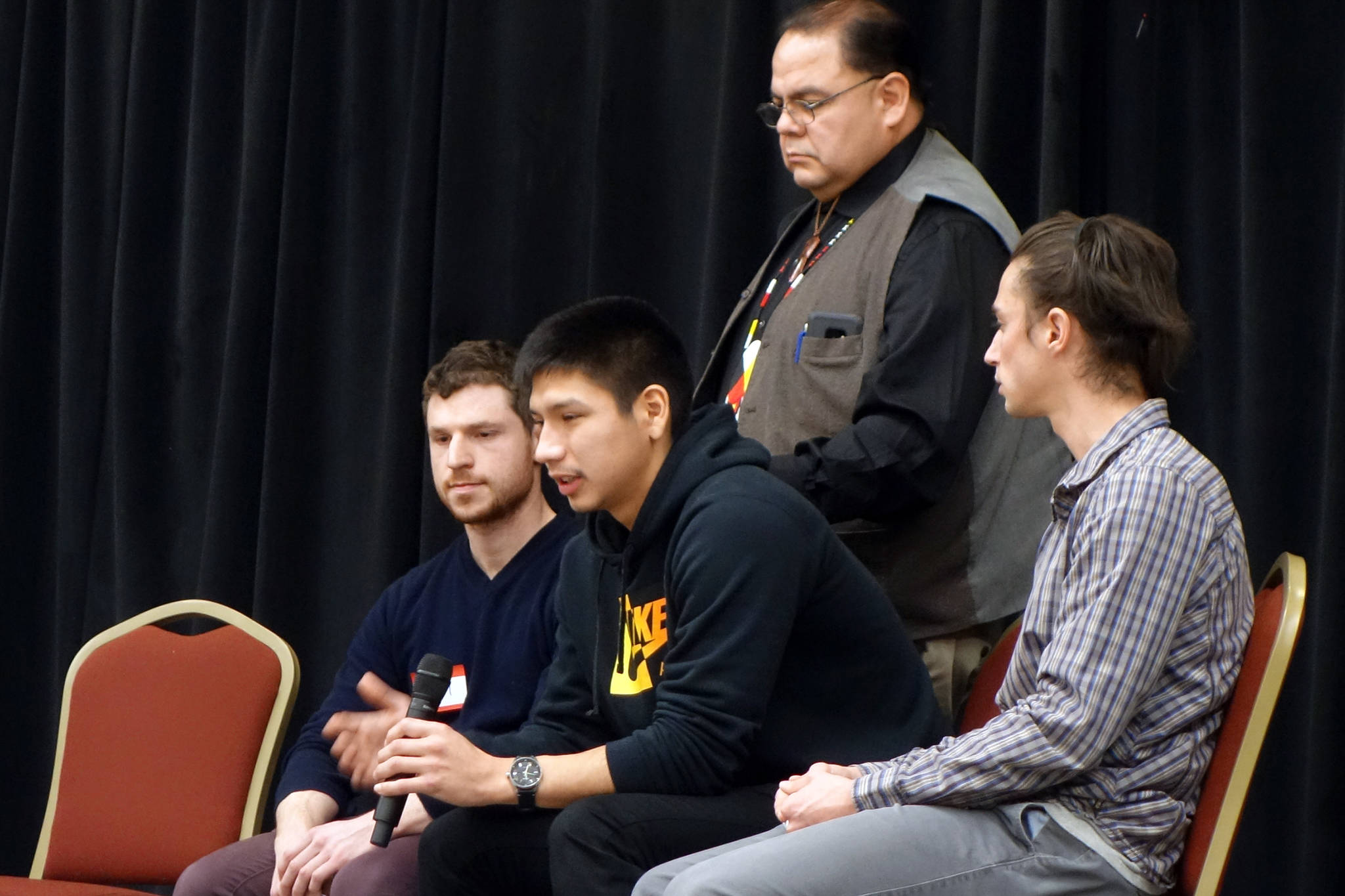
A panel consisting of Will Kronick with Tlingit & Haida Tribal Family & Youth Services, Simon Friday with Coaching Boys Into Men, Justin McDonald withTlingit & Haida Tribal Family & Youth Services and Ben Horton with Aiding Women in Abuse and Rape Emergencies (AWARE) discuss the role men can play in breaking cycles of domestic violence Friday, Oct. 25, 2019. (Ben Hohenstatt | Juneau Empire)
“That release is how we heal,” Friday said.
Those in attendance said, during a break in the summit’s speeches and panel talks, that the topic being raised is an important one.
“It’s beyond important, it’s survival,” said Lisa Sarabia. “Hopefully this will be a spring board to legislation. We’ve been overlooked particularly in this arena. We need to become more visible.”
• Contact reporter Ben Hohenstatt at (907)523-2243 or bhohenstatt@juneauempire.com. Follow him on Twitter at @BenHohenstatt.
