
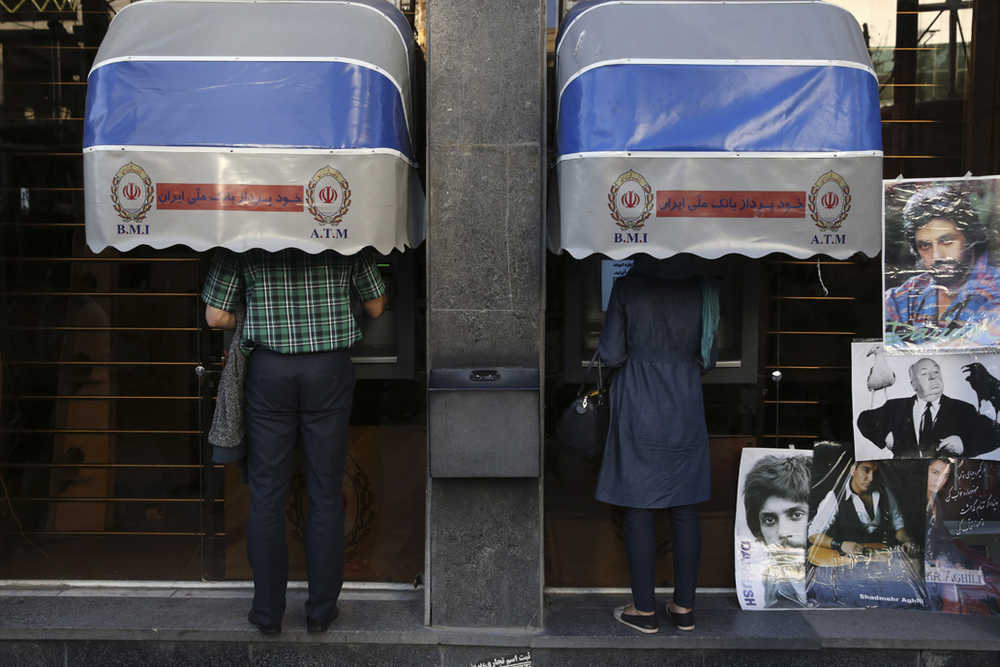
TEHRAN, Iran — Iran successfully transferred some of the billions of dollars’ worth of frozen overseas assets following the implementation of the nuclear deal with world powers, the head of the country’s central bank said Tuesday. But ordinary Iranians are still waiting to see how their daily lives will improve and how fast Iranian companies will gain access to financial markets worldwide.
Credit cards still don’t work in the Islamic Republic and its ATM machines remain separated from the rest of the world. That is not likely to change soon as many of the world’s major financial services companies operate in the United States.
Iranian state television quoted Valiollah Seif, the head of Iran’s central bank, as saying that Tehran transferred funds from banks in Japan and South Korea to other banks in Germany and the United Arab Emirates.
He did not say how much money was involved in the transfers, though he said the nuclear deal would give Tehran access to $32 billion in overseas assets and lower international currency transactions for the country by 15 percent.
The Mideast commercial hub of Dubai would be the most likely place in the seven-state Emirates federation for Iran to move its funds. The port city is home to a large Iranian expatriate community and has a long trading history with nearby Iran.
Emirates NBD, the largest bank in Dubai, declined to tell The Associated Press whether it was doing business with Iran now that nuclear-related sanctions have been lifted, citing a policy of confidentiality regarding potential or existing customers. However, it said “various regulatory authorities” have released guidance since the deal was implemented on Saturday.
“Any engagement with potential customers in previously sanctioned countries would take place in several stages and would require updates to policies, procedures, systems and controls as well as ongoing communication with regulators and correspondent banks,” it said.
Meanwhile, Seif also pledged to address the parallel exchange rate for Iranian rials and foreign currencies on the black market, which trade 20 percent higher than their official values. The black market rate is 36,000 Iranian rials to the dollar while the official rate is 30,000 rials for a dollar.
Iran expects an economic breakthrough after the lifting of crippling sanctions, and in particular, accessing its overseas assets and being able to sell crude oil more freely abroad.
The U.S. Treasury put out guidance to America-based companies after the deal, reminding them that “U.S. persons — including U.S. companies — continue to be broadly prohibited from engaging in transactions or dealings with Iran or its government.”
That includes companies like payment processors MasterCard Inc. and Visa Inc., both based in the U.S. and thus rendering their branded credit cards useless in Iran.
That also includes online payment options like those offered by U.S.-based PayPal Inc., which in March agreed to pay $7.7 million in a settlement with U.S. regulators over payments involving countries including Iran. Money-transferring companies like Western Union Co. and MoneyGram International Inc. also don’t operate in Iran.
“Our interpretation of current U.S. law is that U.S. companies like Western Union still may not offer remittance services to and from Iran,” Jean Claude Farah, Western Union’s president for the Middle East, Africa, Asia-Pacific, Eastern Europe and Russia, said in a statement to the AP.
For its part, ATMs in Iran aren’t linked to the global system. Iranians receive debit cards that resemble those from around the world, minus any of the international payment processors’ logos. They use the cards domestically but otherwise, cash remains king in Tehran.
Despite the lifting of the sanctions, Iranian-Americans also remain barred from transferring money in and out of Iran. They, as well as well as businessmen and others, continue to rely on moneychangers abroad, in places like Dubai in the United Arab Emirates or in Istanbul, who take a percentage off the top of transactions to forward money along.
However, the U.S. Treasury says Iranians will be able to use foreign banks to send money into local Iranian banks. No foreign banks operate in Iran as of yet.
SWIFT, a Belgian-based cooperative that handles wire transfers between financial institutions, said late Sunday that it had gotten in touch with delisted banks to restore their service. SWIFT declined to answer questions from the AP about whether Iranian banks had resumed transferring money, though it appeared Tuesday that most banks in Iran had yet to receive wire transfers from abroad.
Overall, the sanctions relief will be “credit positive for Iran because access to previously frozen foreign assets will boost liquidity while sanctions relief will revive the economy,” ratings agency Moody’s said Monday.
However, Supreme Leader Ayatollah Ali Khamenei said Tuesday that Iran needed to “exercise care the other party implements its commitments,” especially as U.S. politicians threaten new sanctions against the country over its missile tests.
___
Associated Press writer Adam Schreck in Dubai, United Arab Emirates, contributed to this report.
___
Gambrell reported from Dubai. Follow him on Twitter at www.twitter.com/jongambrellap .
