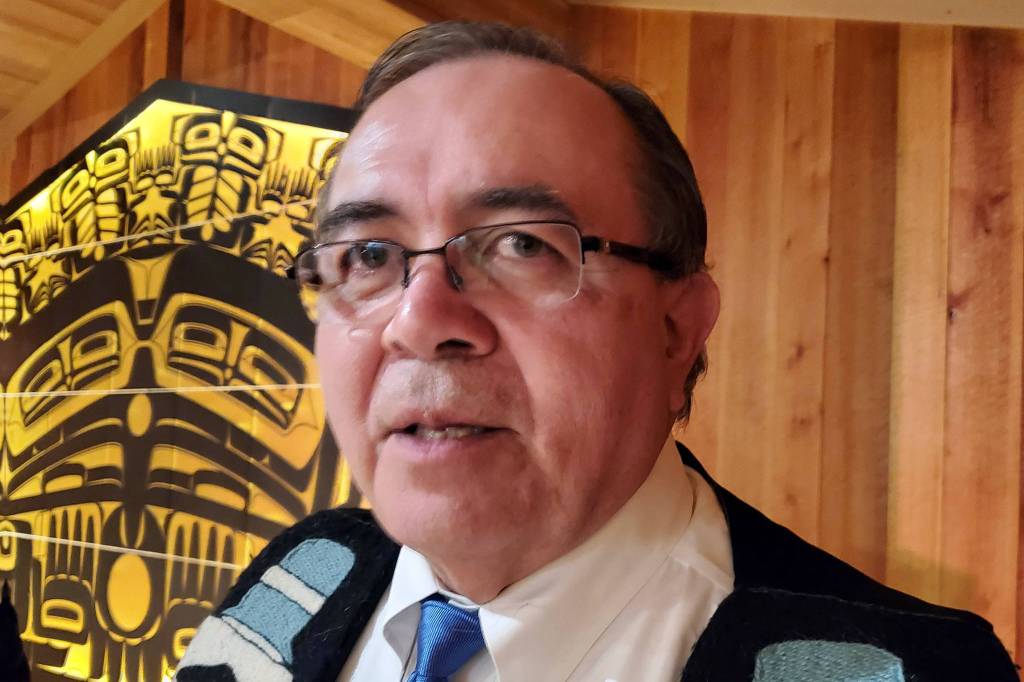
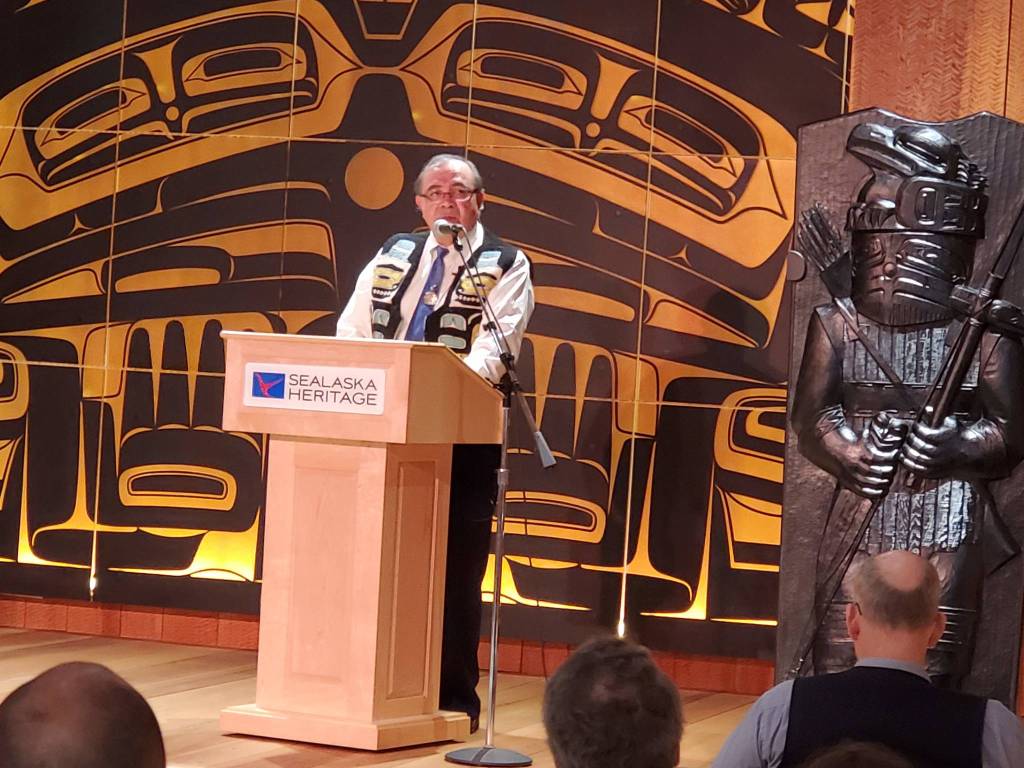
Chris E. McNeil, Jr., the owner of Native Strategy Group and former president and CEO of Sealaska Corporation, speaks about Tlingit and Haida Indians of Alaska v. United States Friday, Nov. 1, inside Sealaska Heritage Institute’s Walter Soboleff Building. (Ben Hohenstatt | Juneau Empire)

Chris E. McNeil, Jr., the owner of Native Strategy Group and former president and CEO of Sealaska Corporation, speaks about Tlingit and Haida Indians of Alaska v. United States Friday, Nov. 1, inside Sealaska Heritage Institute’s Walter Soboleff Building. (Ben Hohenstatt | Juneau Empire)

Important Alaska Native settlement case started as grassroots movement

It paid $7.5M to Tlingit and Haida.

A 90-year-old grassroots movement is still shaping Southeast Alaska.

Chris E. McNeil, Jr., the owner of Native Strategy Group and former president and CEO of Sealaska Corporation, said during a lecture Friday the roots of an important court case that ended with a $7.5 million settlement for Tlingit and Haida is rooted in ideas shared at a 1929 Alaska Native Brotherhood and Alaska Native Sisterhood meeting.

McNeil’s talk is part of an ongoing series of lectures hosted by Sealaska Heritage Institute this month for Native American and Alaska Native Heritage Month.

[Ferry service to Southeast towns canceled after repair costs]

McNeil said getting the wheels moving on what eventually became the Tlingit and Haida Indians of Alaska v. United States court case meant taking steam ships to Seattle from Southeast Alaska, then a cross-country train to Washington, D.C. It meant getting permission in 1935 to sue the U.S. government for taking roughly 17 million acres in land. Most of that came in the form of the 15 million acres that became Tongass National Forest. Glacier Bay National Monument added another 2 million acres to the total.

“I think they were energized,” McNeil said after his presentation. “This was done truly on the grassroots. It was done on the individual and community level. People really believed in these rights, and they were going to do everything they could to fulfill it.”

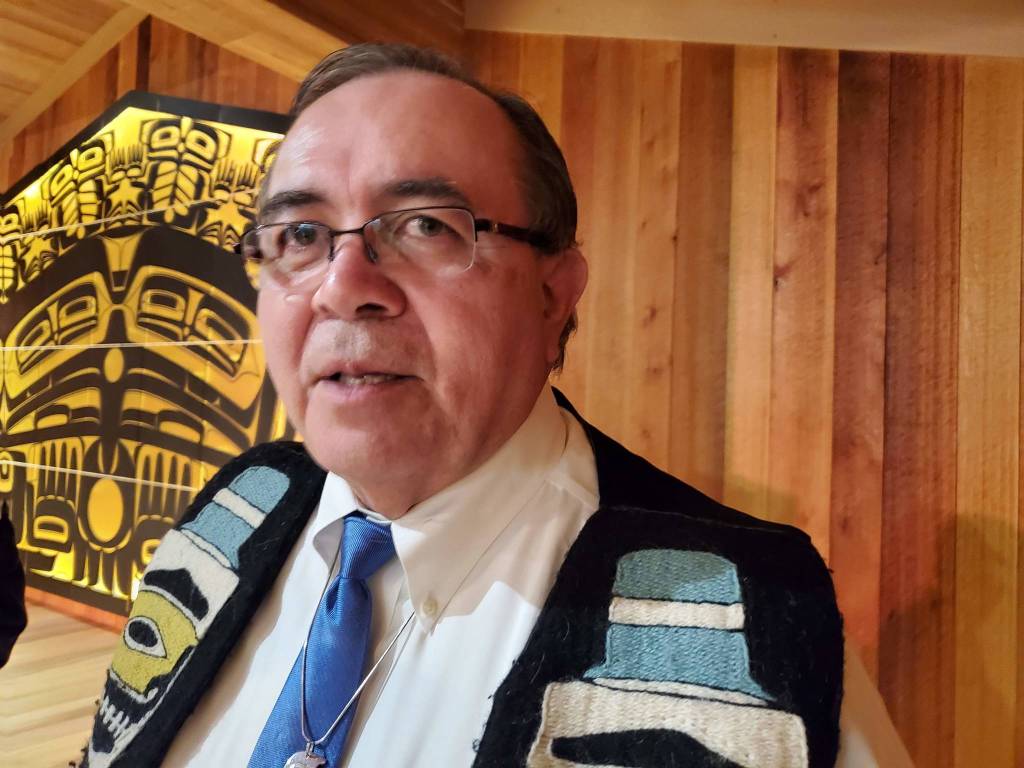
Chris E. McNeil, Jr., the owner of Native Strategy Group and former president and CEO of Sealaska Corporation, speaks about Tlingit and Haida Indians of Alaska v. United States Friday, Nov. 1, inside Sealaska Heritage Institute’s Walter Soboleff Building. (Ben Hohenstatt | Juneau Empire)

Chris E. McNeil, Jr., the owner of Native Strategy Group and former president and CEO of Sealaska Corporation, speaks about Tlingit and Haida Indians of Alaska v. United States Friday, Nov. 1, inside Sealaska Heritage Institute’s Walter Soboleff Building. (Ben Hohenstatt | Juneau Empire)

Decades later, in 1959, a court found that Tlingit and Haida had established aboriginal title to portions of Southeast Alaska, and the case wouldn’t be fully settled until 1968. McNeil said the settlement was important in shaping the tribal government Central Council of Tlingit and Haida Indian Tribes of Alaska.

“It really allowed the Tlingit and Haidas to be able to work with and create Tlingit and Haida Central Council as an operating entity,” McNeil said of the payment. “The Tlingit & Haida took the ball and ran with it. They went together and did economic studies. They put together an economic plan for the Tlingit & Haida people, and all at the same time, they were participating in the (Alaska) Native Claims Settlement Act. They did a lot of stuff at once as a result of getting the settlement.”

McNeil said years worth of studies and interviews added to the protracted length of the case.

While the settlement was pivotal, McNeil said it did not seem the government paid a fair amount for the land that was taken from Tlingit & Haida people.

[Jury announces verdict for one-time Assembly candidate accused of PFD fraud]

The settlement worked out to be about 43 cents per acre, and it did not include money for fishing rights and undervalued standing timber, McNeil said.

“It seemed pretty disingenuous to me that they would say, ‘Hey, it’s just not worth very much money,’” McNeil said. “There’s no doubt in my mind there were known ways to value this property, and they chose not to do it.”

McNeil said the decision could have been appealed, but there’s no guarantee the settlement would have been better, or if there would have been a settlement. He said the Tee-Hit-Ton v. United States case, which denied a subgroup of Tlingit people compensation for the taking of timber, may have also played a role.

“That was a hard moment for them to decide to appeal or not,” McNeil. “You have to keep in mind, in the background was the Tee-Hit-Ton case, which held there was Fifth Amendment rights for Indian takings. One of the last lines in that case said the United States could compensate, but it could do so as a gratuity.”


• Contact reporter Ben Hohenstatt at (907)523-2243 or bhohenstatt@juneauempire.com. Follow him on Twitter at @BenHohenstatt.

More in News

A commercial bowpicker is seen headed out of the Cordova harbor for a salmon fishing opener in June 2024 (Photo by Corinne Smith)
Planned fiber-optic cable will add backup for Alaska’s phone and high-speed internet network

The project is expected to bring more reliable connection to some isolated coastal communities.

Gustavus author Kim Heacox talked about the role of storytelling in communicating climate change to a group of about 100 people at <strong>Ḵ</strong>unéix<strong>̱</strong> Hídi Northern Light United Church on Wednesday, Dec. 3, 2025. (Mari Kanagy / Juneau Empire)
Author calls for climate storytelling in Juneau talk

Kim Heacox reflects on what we’ve long known and how we speak of it.

The Juneau road system ends at Cascade Point in Berners Bay, as shown in a May 2006 photo. (Michael Penn / Juneau Empire file)
State starts engineering for power at proposed Cascade Point ferry terminal

DOT says the contract for electrical planning is not a commitment to construct the terminal.

Members of the Alaska Air and Army National Guard, Alaska Naval Militia, and Alaska State Defense Force work together to load plywood onto a CH-47 Chinook helicopter, in Bethel, Alaska, Nov. 2, 2025, bound for the villages of Napaskiak, Tuntutuliak, and Napakiak. The materials will help residents rebuild homes and restore community spaces damaged by past storms. (U.S. Army National Guard photo by Spc. Ericka Gillespie)
Gov. Dunleavy approves Alaska National Guard assisting ICE in Anchorage

The National Guard said five service members will assist with administrative support; lawmakers and civil rights advocates worry that the move signals a ramping up of immigration enforcement operations in Alaska

A cruise ship, with several orange lifeboats visible, is docked in downtown Juneau. (Laurie Craig / Juneau Empire file photo)
CBJ seeks input on uses for marine passenger fees

Public comment period is open for the month of December.

Browsers crowd into Annie Kaill’s gallery and gift shop during the 2024 Gallery Walk. (Juneau Empire file photo)
Gallery Walk guide for Friday, Dec. 5

The Juneau Arts & Humanities Council announced community events taking place during… Continue reading

The Alaska State Capitol is seen on Tuesday, Nov. 25, 2025. (Photo by James Brooks/Alaska Beacon)
Alaska Senate Republicans confirm Rauscher, Tilton and open two vacancies in state House

The Alaska Republican Party is moving quickly after Republicans in the Alaska… Continue reading

Downtown Skagway, with snow dusting its streets, is seen in this undated photo. (Photo by C. Anderson/National Park Service)
Skagway’s lone paramedic is suing the city, alleging retaliation by fire department officials

This article was reported and published in collaboration between the Chilkat Valley… Continue reading

A spruce tree grows along Rainforest Trail on Douglas Island. (Mari Kanagy / Juneau Empire)
Where to cut your Christmas tree in Juneau

CBJ and Tongass National Forest outline where and how residents can harvest.

Most Read