ANCHORAGE — Before Morris Nashoanak heads out for days in search of bearded seals, beluga whales or salmon, he catches the weather on TV.
But it’s not the weather segment from a local TV station — there isn’t one. Instead, it’s a program designed for those living in rural and largely roadless Alaska, with separate forecasts for mariners, aviators and residents to help decide whether they can safely hunt, fish or fly.
“Alaska Weather” has been must-see TV for 47 years in a state where extreme weather dictates everyday life. But the daily program, the only weather show produced by the National Weather Service, will have its last on-air broadcast Friday, with business considerations ending its distribution to public television stations in Juneau and Fairbanks.
From then on, it will be available only on YouTube. That’s prompted fears that some of the state’s most vulnerable residents — those in far-flung Indigenous communities where internet service is unreliable, or who are older and uncomfortable getting information from a phone or computer — will be left on the wrong side of Alaska’s vast digital divide.
In Stebbins, a Yup’ik village of about 630 residents on St. Michael Island in the Bering Strait, Nashoanak said the internet is slow and can cut out for days at a time. The program informs Nashoanak, and other Alaska Native residents allowed to hunt and fish for subsistence under federal law, whether it’s worth spending over $6 per gallon of gas to fire up ATVs or boats.
“It’s critical and beneficial for many of us … something we can depend on,” Nashoanak said.
Alaska Public Media has traditionally provided the show via its Fairbanks station to the Alaska Rural Communication System, a series of state-owned, low-power transmitters that broadcast free programming across much of rural Alaska.
But Alaska Public Media in January said it would discontinue distribution unless it could secure $50,000 a year from the federal government. The weather service’s parent agency, the National Oceanic and Atmospheric Administration, agreed to come up with the money, but the network conducted a subsequent review showing that its total annual costs were actually $200,000.
“It made it impossible for us to come up with a path forward that would work,” said Carrie Haisley, chief of the Anchorage National Weather Service’s emergency services and multimedia branch.
Linda Wei, Alaska Public Media’s chief content officer, said the network simply can’t keep distributing the show for free.
“It’s no longer sustainable for us to continue in this manner,” she said. “It’s not a decision that we came to lightly.”
Allan Eustis was the show’s first anchor when it went on the air in 1976. The Lancaster, Pennsylvania, resident learned how appreciative people were for the program when he visited Alaska’s distant villages.
“A lot of them use the information to go out whaling during whaling season, and we would show satellite pictures of where the ice was,” he said of the federally allowed subsistence hunt. “If there’s a reason to continue the show, it really would be to support these folks.”
Eustis and his successors did the show live every day at Alaska Public Media’s studios until 2017, when the station decided it could use that space differently, Haisley said.
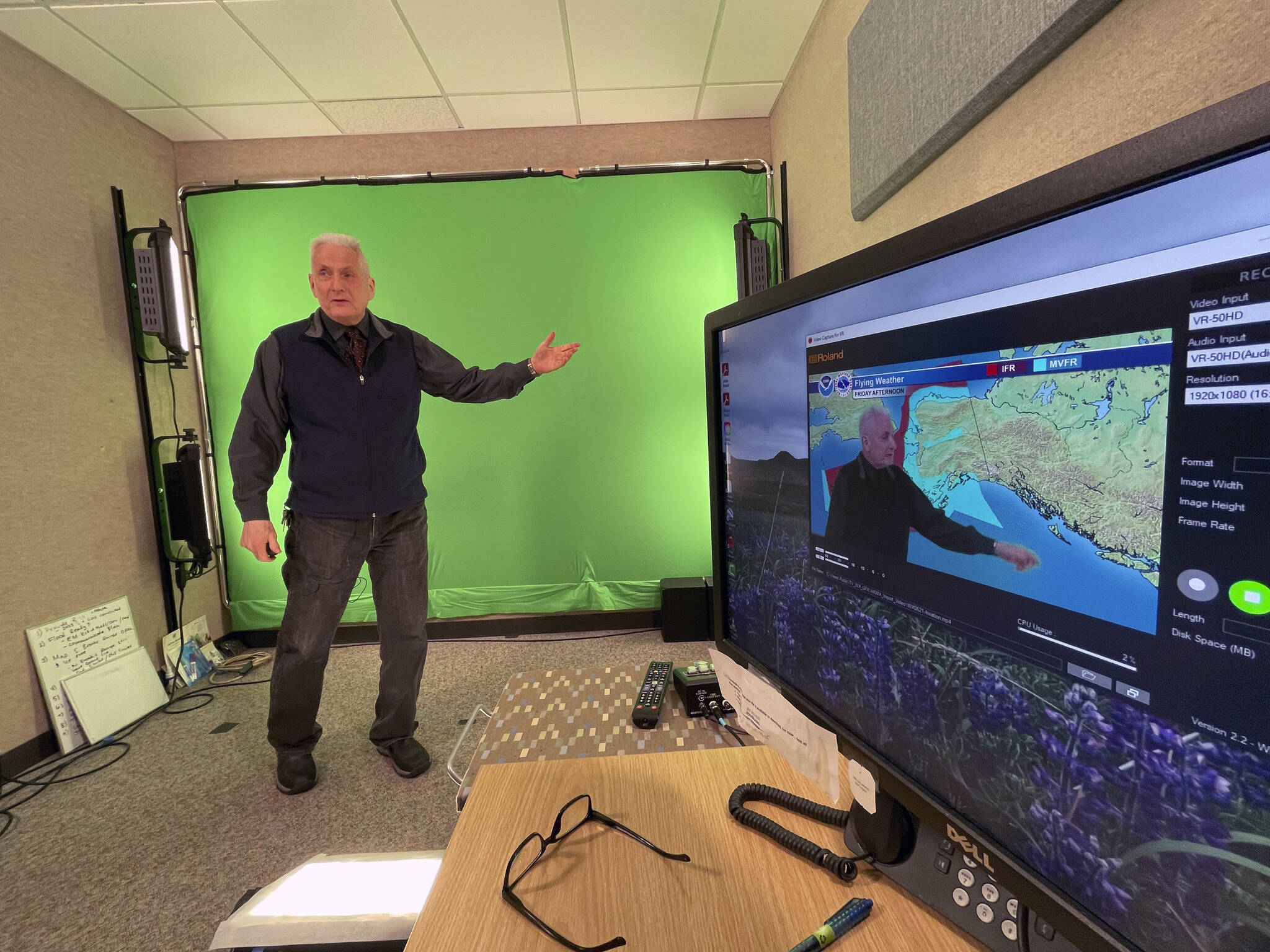
Production switched to the weather service’s office in Anchorage, where a small closet was cleared out for a mini TV studio complete with a green screen and a camera.
Two meteorologists produce the weather show 365 days a year, creating forecasts and maps and filming the program in three segments. Those are sent to Alaska Public Media, where technicians compile the 30-minute program.
Now, the three forecast segments will be uploaded to a National Weather Service YouTube channel.
Rick Thoman, a climate specialist at the International Arctic Research Center at the University of Alaska Fairbanks, called the end of the on-air broadcast a shame.
“If you don’t have good internet connectivity, you’re in a world of hurt in western and northern Alaska as far as getting weather information,” he said.
During a visit to Alaska last month, first lady Jill Biden touted the government’s efforts to address connectivity inequities in the nation’s largest state, particularly in Alaska Native villages. On Monday, the government announced another $1 billion to help build broadband infrastructure in Alaska.
But it will take time to build that network across unforgiving terrain. Even when there is a strong internet link, things can go wrong.
Earlier this month, about 20,000 Alaskans along the northern and western coasts lost their internet when ice scouring the floor of the Beaufort Sea cut a fiber optic cable. Ships can’t arrive to fix it until the sea ice melts, likely in early August.
“The information distribution in rural Alaska has been narrowed into this one communication channel called the internet that people have a very difficult time getting to,” Thoman said. “No matter how tech savvy you are, if your internet’s out, you can’t get it.”
Both the weather service and Alaska Public Media said they are open to further discussions.
Haisley also solicited public comment from rural residents, looking for other ways the weather service can deliver the information, with some suggesting radio programs or a podcast. Neither of those support graphics, however.
“We’ve relied for so long in this partnership with Alaska Public Media to use TV as a medium to do that, and there doesn’t seem to be another way that really fills the gap,” she said.
