

The Supreme Court case that denied a group of Tlingit people compensation for the sale of lumber from the Tongass National Forest was “an appalling miscarriage of justice,” said Walter Echo Hawk, but it was not inexplicable or unique.
Echo-Hawk, a Native American speaker, author and attorney spoke at length about the Tee-Hit-Ton Indians v. United States case, which decided in 1955 that indigenous peoples did not have rights under the Fifth Amendment to compensation for lands taken by the U.S. government.
“In short, this opinion placed the law into service of colonialism,” Echo-Hawk said.
During a lecture that’s part of a Native American and Alaska Native Heritage Month series at Sealaska Heritage Institute’s Walter Soboleff building, Echo-Hawk said it’s important to reflect on how and why such miscarriages of justice come to pass so that they are not repeated.
Echo-Hawk, a Pawnee Indian who practices law in Oklahoma and who wrote a book examining the “10 worst Indian cases ever decided,” said the cases that make up the “dark side of federal Indian law” tend to have some things in common.
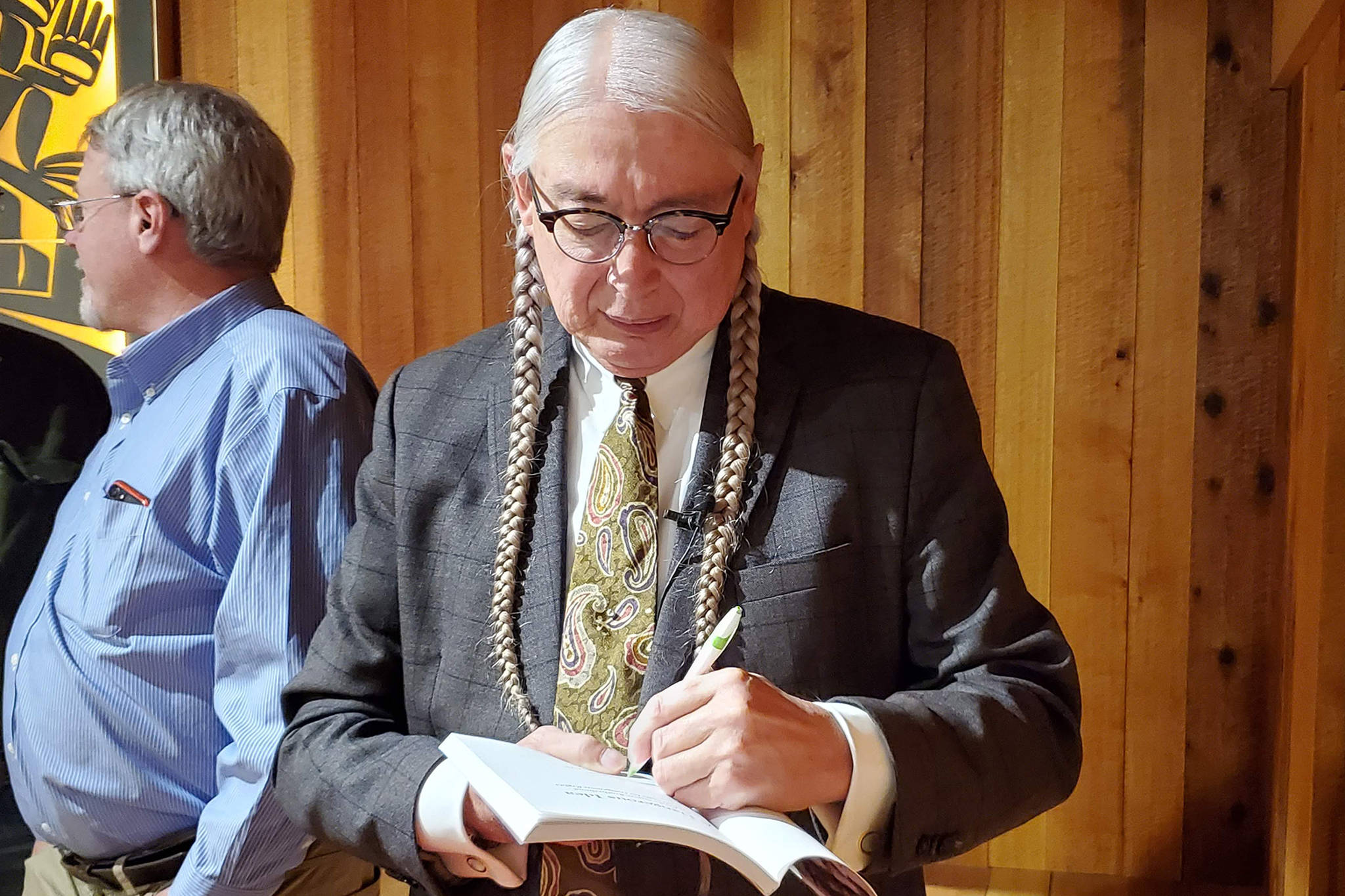
Walter Echo-Hawk, a speaker, attorney and author, signs a book after discussing the Tee-Hit-Ton v. United States case during a lecture at Sealaska Heritage Institute’s Walter Soboleff building Thursday, Nov. 7, 2019. (Ben Hohenstatt | Juneau Empire)
Those include a decision overtly influenced by race or racism, doctrines from law of colonialism, use of legal fictions and an apology.
“That’s judicial code for something very unjust is going to happen here,” Echo-Hawk said of decisions that include an apology.
Tee-Hit-Ton ticked off those other boxes via a decision written by Justice Stanley Reed that stated the U.S. had rights to the lands as conquerors, referred to indigenous peoples as “savages.”
“The Government denies that petitioner has any compensable interest,” reads the decision. “It asserts that the Tee-Hit-Tons’ property interest, if any, is merely that of the right to the use of the land at the Government’s will…Every American schoolboy knows that the savage tribes of this continent were deprived of their ancestral ranges by force and that, even when the Indians ceded millions of acres by treaty in return for blankets, food and trinkets, it was not a sale but the conquerors’ will that deprived them of their land.”
[Important case started as a grassroots movement]
Echo-Hawk said while there was some reason for optimism for a more just outcome since the same Supreme Court had found segregation unconstitutional just one year earlier, there were a lot of cultural and political factors working against the case.
Those influences cited by Echo-Hawk were the pervasive cowboys-vs.-Indians mindset of the popular Western genre, the Korean War, McCarthyism and upheaval surrounding segregation.
“This was not a good time to bring a case of this nature,” Echo-Hawk said. “The Supreme Court could hardly be expected to come down with a favorable opinion for the Tlingit.”
He said the result of the case was the nadir for American Indian law, but some progress has been made.
Echo-Hawk said there’s reason to hope that further strides could be made, and the potential exists to one day overturn the case.
He said implementing the 2007 United Nations Declaration on the Rights of Indigenous Peoples into law reform could be a step in that direction.
“It would replace the dark side of federal Indian law with human rights principles,” Echo-Hawk said. “This U.N. declaration is the antidote to the darkside of federal Indian law. It is the antidote to Tee-Hit-Ton.”
[Poet from Juneau releases award-winning poetry collection]
He said that’s something that will likely require well-placed plans and potentially decades of work but is needed to address dark chapters in U.S. treatment of indigenous peoples.
“These are seriously flawed cases that need to be put out of their misery, I guess you could say,” Echo-Hawk said.
• Contact reporter Ben Hohenstatt at (907)523-2243 or bhohenstatt@juneauempire.com. Follow him on Twitter at @BenHohenstatt.
