
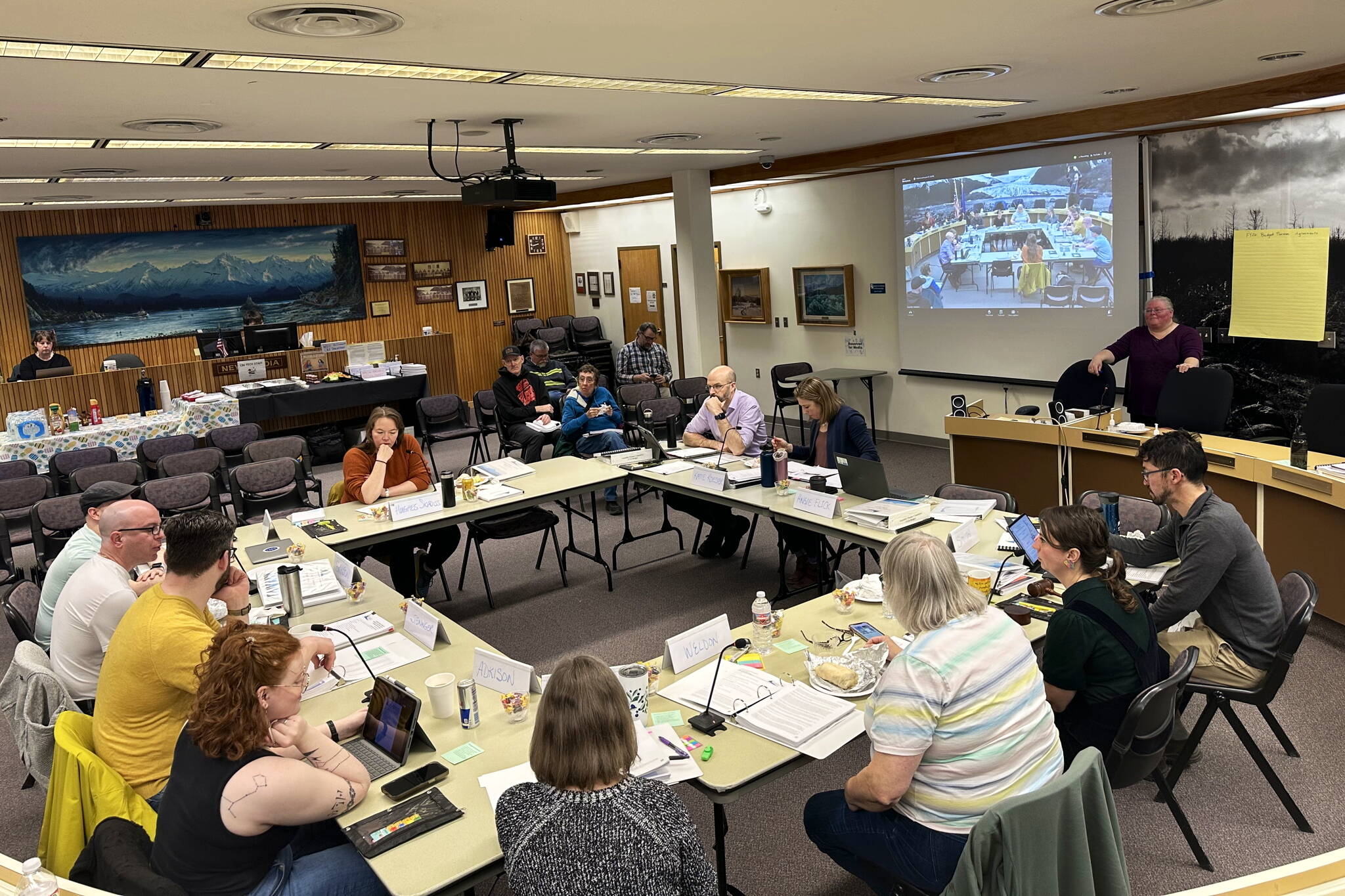
A bunch of proposals about how much in taxes and fees are paid by people in Juneau, and how the city spends those funds, are scheduled to be considered by Juneau Assembly members on Wednesday night.
The public also gets a chance to have their say on the current draft of next year’s municipal budget, including a proposed property tax increase to 10.19 mills (up from this year’s 10.04 mills). Assembly members will also discuss a possible seasonal sales tax during the cruise ship season and increasing utility rates — but a lower hike than a scenario last fall raising water rates more than 60% and sewer rates more than 80% over five years.
It’s essentially a mid-stage review for a budget process that formally started at the beginning of this month and is scheduled to conclude with the Assembly voting on a final budget after allowing further public comment on June 9.
The evening begins with an Assembly meeting at 5:30 p.m. at City Hall where public hearings are scheduled for ordinances on the proposed mill rate increase, Juneau School District budget, municipal operating budget and municipal capital projects budget.
Immediately after that meeting adjourns all of the Assembly members will gavel in again as the Finance Committee to consider possible rate increases and bond measures for utilities, the seasonal sales tax, and a list of community grants proposed as part of the budget. No public testimony will be taken during the committee meeting on the items, which will still need approval by the full Assembly if they are advanced out of committee.
Mill rate increase
The proposed increase to 10.19 mills for the fiscal year starting July 1 would return the rate to just above where it was two years ago at 10.16. The current 10.04 rate is Juneau’s lowest in decades, but Assembly members and city administrative leaders say a balanced budget for the coming year isn’t feasible at that rate due to extra costs the municipality is facing.
Among those costs are three buildings the City and Borough of Juneau took over from the Juneau School District after last year’s consolidation, according to CBJ Finance Director Angie Flick. The city is incurring numerous one-time costs as CBJ relocates some operations into the district’s former administrative building, evaluates renovation and demolition options for portions of the Marie Drake Building, and leasing out space at the former Floyd Dryden Middle School.
CBJ is also facing uncertainties with federal funding — which could affect major expenditures such as disaster assistance — due to freezes and cancellations by the Trump administration that in some cases are pending or under legal review.
The proposed mill rate increase for next year means property owners would pay $10.19 for every $1,000 in taxable value of their properties — equating to $75 more on a $500,000 home.
A ballot initiative petition seeking a cap of nine mills rather than the existing limit of 12 mills — not including debt service — is currently being reviewed by the municipal clerk’s office. If certified and eventually approved by voters during the October municipal election it could force a downward adjustment in the mill rate — but likely not drastic since 1.08 mills of the current rate are for debt service and thus could be added to the nine mill limit.
Utility rate hikes and another possible bond measure
A proposal increasing water rates by 10.25% a year and wastewater rates 12.75% a year for each of the next five years was introduced by CBJ’s utilities last November — a month after voters approved a $10 million bond to fund wastewater improvements. City leaders say utility rates weren’t keeping pace with inflation for years, putting CBJ in a situation where major corrective steps are needed — but those steps aren’t quite as big as they appeared last fall.
“The consultants were able to lower needed rate increases by an average of 1% (a year) on the water side and 3% on the sewer side based on two new pieces of information,” City Manager Katie Koester wrote in an April 22 memo to the Assembly. She stated the city got more revenue last year than was predicted as of November and “they found an error in one of the inputs for a capital project that was double counted.”
A revised study being presented at Wednesday’s meeting CBJ states a low-end operation plan is possible with an 9.25% annual increase in water rates and 9.75% increase in wastewater rates during each of the next two years (dropping to 9.25% for the following three years). Those equate to about a 55.6% increase in water rates and 57% increase in wastewater rates cumulatively over five years.
However, Koester is proposing the Assembly consider an even lower hike: annual increases of 5% for both water and wastewater rates, with the difference funded either through bond funding or redirecting some sales tax revenue for utility costs.
“The alternative scenarios are endless,” she wrote.
The city’s cumulative 5% sales tax rate has two “temporary” rates that have been habitually renewed by voters every five years. One is a 3% tax before voters in 2026, the other a 1% tax up for renewal in 2027. Koester states both taxes are designated for infrastructure and other municipal improvements that would be appropriate to designate for utilities projects.
Assembly members have also discussed a possible $20 million utilities bond, plus a school maintenance bond between $5 million and $15 million, the past few months. But some members also say they’re wary about whether voters would approve such bonds if a mill rate increase and utility rate hike occur at the same time, especially after voting for the $10 million wastewater bond and a $12.75 million emergency services bond last fall.
The Juneau Board of Education earlier this month approved wish lists for bonds at the $5 million, $10 million and $15 million levels. The project lists primarily focus on roof, heating, ventilation and security upgrades at schools throughout the district, with a priority on urgent short-term work that will avoid most costly future repairs.
Seasonal sales tax
A seasonal sales tax intended to boost the city coffers during the months 1.6 million or so cruise ship visitors are in Juneau has been considered and put on hold by the Assembly before. Among the concerns — which are being expressed again with the revived proposal — is how such a tax might hurt residents making large summer purchases such as materials for building upgrades, and locals with limited incomes being forced to pay more for everyday items.
Flick, as the city’s finance director, reminded the Assembly during an April 16 Finance Committee meeting there’s multiple approaches to a seasonal sales tax that, among other things, can exempt certain items such as food and utilities. Another factor is the gap between cold-season and higher warm-season taxes.
“There’s obviously a million variations that can happen within this,” she said, echoing the city manager’s observation about bond options.
A memo by Flick prepared for Wednesday’s meeting assumes visitors will pay about $18.4 million of the $65 million in annual total sales taxes based on 2024 figures and a status quote sales tax of 5%.
She projects that would increase to $21.1 million with a 5.75% sales tax between April and September, and a 4% tax the rest of the year, resulting in the same $65 million in total taxes. In a high-end scenario, visitors would pay $26.7 million of the $65 million with a 6.75% seasonal sales tax and a 4.5% sales tax the rest of the year — with basic food items and utilities exempt from sales tax.
“While no specific direction was given, the (Assembly) seemed warmer towards a smaller swing in a seasonal sales tax compared to a drastic large swing,” Flick wrote, referring to comments at the April meeting. During that meeting she raised hypothetical scenarios such as a seasonal tax of 8.75% and off-season rate of 1%.
If the Assembly wants to put a seasonal sales tax question before voters an ordinance will need to be introduced by the June 9 meeting and approved by July 28, according to Flick.
• Contact Mark Sabbatini at mark.sabbatini@juneauempire.com or (907) 957-2306.
