
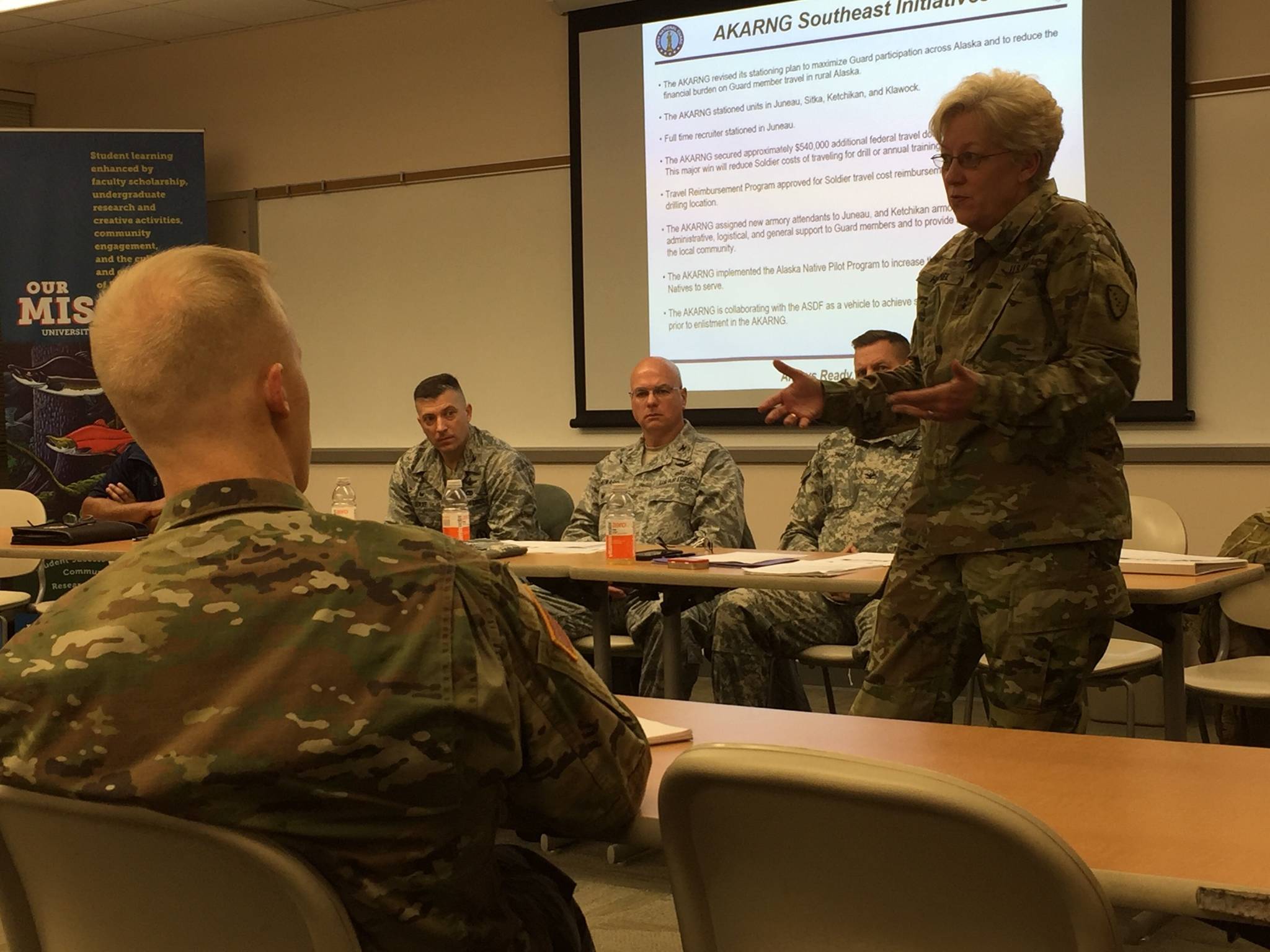
Retaining Alaska National Guardsmen in Southeast Alaska isn’t as easy as it used to be. Cultural and institutional shifts have made it harder, Guard personnel said at a recent town hall meeting, while a pullback from rural areas and the closing of armories statewide hasn’t helped.
Alaska National Guard leaders from both the Army and the Air National Guard branches spoke at the Thursday night meeting. The Guard’s top officer in the state, Maj. Gen. Laurel Hummel, was in attendance. Recruitment outside of Anchorage is a top priority, she said.
“We desperately want more active soldiers and airmen who come off the Southcentral road belt,” Hummel said. “When we have an Alaska National Guard comprised of Alaskans who all live on the Southcentral road system, we have all our eggs in one basket, and we can’t afford that.”
The ANG is working hard to change that, Hummel said. It’s an uphill battle, but one the top brass is willing to fight personally. Hummel leads approximately 1,773 Army National Guardsmen and the 2,067 Air National Guardsmen in the volunteer organization. She was flanked by Guard leaders from both branches at the town hall.
Hummel said there are a number of tensions the Guard is dealing with which make recruiting outside of the Southcentral area difficult. Structural changes to the Guard have made training more difficult, for one. Nationally, the guard has moved toward a “plug and play” structure, meaning modern Guardsmen have to be trained and organized as independent units that can be moved around the world when called upon. Specializing in small combat niches is more or less a thing of the past.
“An Eskimo scout group doesn’t make any sense to the guard of 2017,” Hummel said.
But a “plug and play” structure means Guardsmen outside Southcentral Alaska have to travel farther to round out training not available in rural areas. For guardsmen outside of Anchorage, that one weekend a month, two weeks a year commitment can balloon into three days a month and several weeks a year. Some guardsmen leave because of the travel commitment, said Col. Joel Gilbert, director of staff for the AKANG.
In the past a soldier would have to pay to travel to drills outside of their hometown. Sometimes that would amount to the entire paycheck received for a weekend training. But Gilbert said they’ve recently required the means to pay for travel from rural areas to locations of weekend drills, which are often in the Anchorage or Fairbanks areas.
Alaska Rep. Don Young helped the Guard secure $540,000 to transport guardsmen to participate in drills. It’s made a big difference, Gilbert said.
“It has hugely increased participation at drill weekends. We can do collective training and we get a lot more soldiers showing up for collective training,” Gilbert said.
Southeast has employed as many as 600 guardsmen. That number is currently around 83, with 50 of those soldiers based in Juneau, Gilbert said. Recruiting isn’t the biggest issue, it’s retaining soldiers.
The AKANG has met its latest recruiting goals to within a few percent. But they’re retaining only about 87 percent of those Guardsmen. Though travel is an issue, meeting height and weight requirements and passing the Armed Services Vocational Aptitude Battery (ASVAB) test remains the biggest reason guardsmen leave the service, Gilbert said.
SFC Natasha May, Southeast’s recruiter for the Alaska National Guard, said building rapport with small communities is a big challenge to recruiting. Many of her recruits want to leave the state when they turn 18, May added, which makes the Guard a tough sell.
“So many people from the Southeast, what’s their number one goal when they graduate high school? They want to leave Alaska,” May said. “You talk to them about going to the big city of Anchorage or Fairbanks, but a lot of them want to leave the state.”
SFC John Flood, who runs the National Guard Armory at the University of Alaska Southeast Rec Center, said cultural shifts have played a role in recruitment as well. Today’s soldiers are more likely to join to pay for college than out of patriotism. Today’s recruits might also be more interested in video games than service.
“Kids are walking around like zombies because they’re looking at computers or playing video games. Not that I don’t ever play video games,” he said. “Going out and doing physical labor and hard things isn’t necessarily part of that new generation, in my opinion.”
The National Guard will start their Great Alaska Toy Drive next week. Flood said they’ll start putting out donation boxes next week at local stores.
• Contact reporter Kevin Gullufsen at 523-2228 and kevin.gullufsen@juneauempire.com.
