
FLAGSTAFF, Ariz. — Election sites far from reservations. Poll workers who don’t speak tribal languages. Unequal access to early voting sites.
Native Americans say they have encountered a wide range of obstacles to voting. Advocates have been spending the last few months gathering stories from around Indian Country in the hope that tribal members can wield more influence in elections and to improve conditions among populations that encounter huge disparities in health, education and economics.
“Some of the problems they were facing actually were issues we thought we’d taken care of long ago,” said OJ Semans, a Rosebud Sioux tribal member and executive director of South Dakota-based voting rights group Four Directions. “If you don’t keep your eye open and the communication open, things will reverse.”
Tribes successfully have challenged what they see as discriminatory voting practices around the United States.
In Utah, a federal judge recently ordered school board and county commission districts redrawn after the Navajo Nation argued they had been divided by race. In Nevada, the Pyramid Lake and Walker River Paiute tribes won a legal battle to improve early voting access on their reservations. Alaska Natives reached a settlement in a case that includes increased language assistance for three areas.
When working with local election officials doesn’t work, tribes often turn to the 1965 Voting Rights Act to try to force changes, said James Tucker, a pro bono attorney for the Native American Rights Fund.
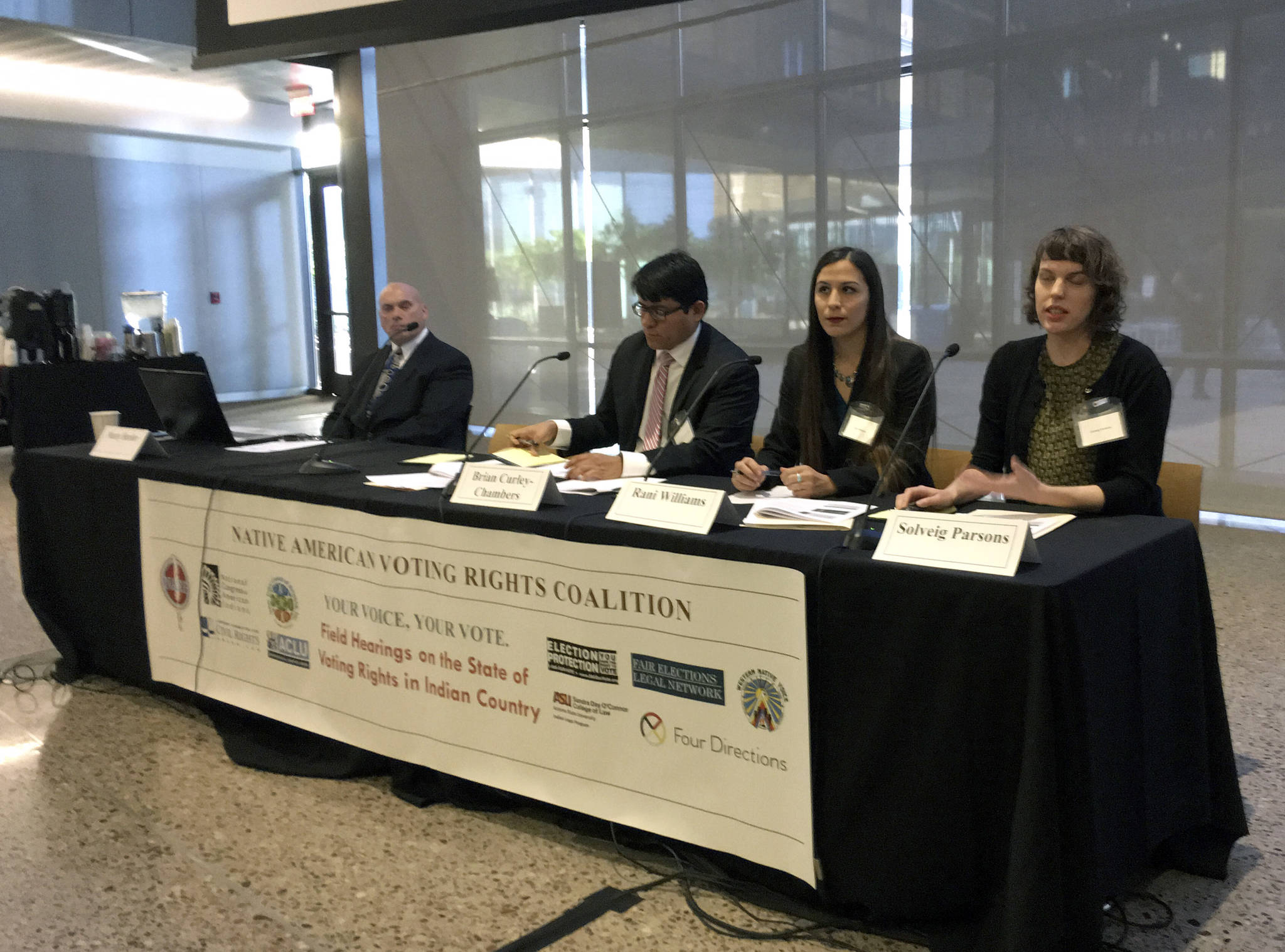
The group is part of a coalition holding field hearings nationwide ahead of the next round of redistricting to compile what it believes will be the most comprehensive look at voting rights abuses in Indian Country.
A hearing was held Thursday in Phoenix, and others are planned this year in Oregon, California, New Mexico and Oklahoma.
“What we’re trying to show is people don’t have equal opportunities to vote, to register to vote and to participate in Indian Country than you would see in maybe a more urban setting,” Tucker said.
Native Americans didn’t become U.S. citizens until 1924, but some states restricted who was entitled to vote up into the 1960s, with laws saying Indians who weren’t taxed, who lived on reservations or were enrolled with tribes couldn’t cast a ballot. Southwestern states were the last holdouts.
Barriers to voting persist, including long drives to polling places, laws that ban collecting ballots for others, mistreatment and intimidation of tribal members at polling sites, voter identification requirements and unequal opportunities for Native Americans to serve as poll workers, said Patty Ferguson-Bohnee, director of Arizona State University’s Indian Legal Clinic.
An issue in Arizona is whether counties that provided needed language assistance to tribal members will continue to do so despite recent census data saying it’s not needed, she said.
ASU student Rani Williams on Thursday told of cases in the 2016 general election where early voting sites on reservations were open less than eight hours and voters elsewhere had days to cast ballots.
Coconino County recorder Patty Hansen said shutting down polling sites near or on reservations forces Native Americans to drive even farther to vote.
“Our Native American voters take great pride in voting and celebrate it by making it a community event,” she said in prepared remarks. “They have had to fight hard for their right to vote and those of us in election administration need to dedicate the necessary resources to protect the voting rights of all of our citizens.”
Semans, the Rosebud Sioux tribal member, said he’s missed out on voting in at least one election in South Dakota. He said he would have had to drive at least 100 miles roundtrip to reach an early voting site off the reservation and couldn’t make it on Election Day.
His group and others have sued routinely over the issue, saying it’s unfair and discriminatory.
“There are not that many of us,” he said. “But what we did is open the door for minorities in order to use the case law to improve their voting opportunities.”
