
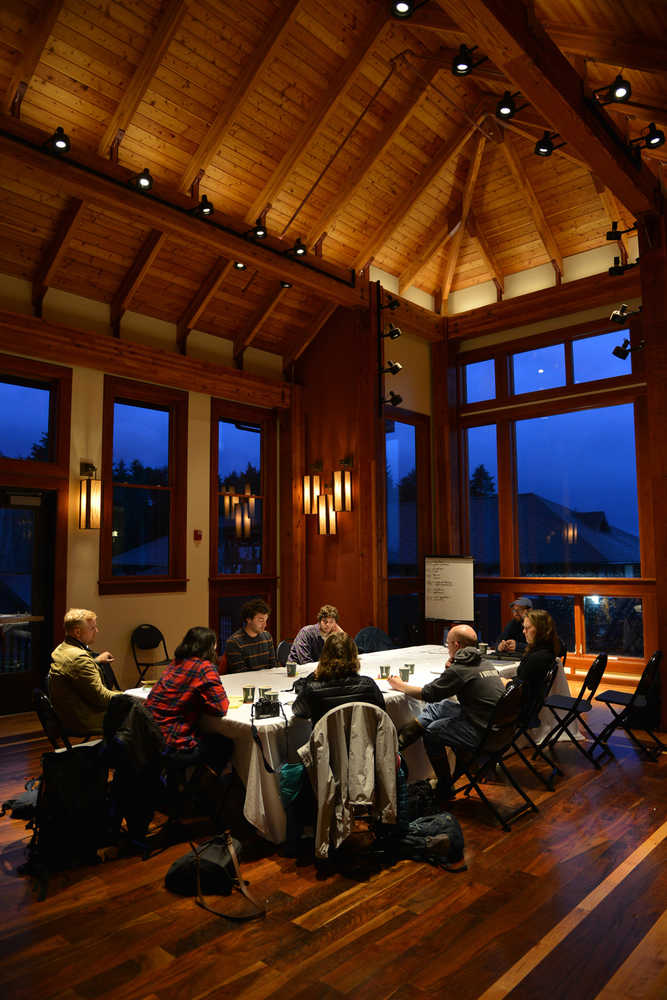
SITKA — For years Jonathan Kreiss-Tomkins has been finding ways to make use of the Sheldon Jackson campus, and his next idea is even more ambitious.
Kreiss-Tomkins is working with dozens of collaborators from Alaska and other states in an effort to bring an accredited college back to the campus.
The proposed Outer Coast College would offer a two-year program on a different model than that of traditional higher education.
Students would make decisions on nearly everything, from meals to classes to faculty. After Sheldon Jackson College closed in 2007 and the campus was turned over to the nonprofit Alaska Arts Southeast, the primary use of the historic campus has been for the summertime Sitka Fine Arts Camp.
“The campus is such a great attribute for Sitka, but it sits empty for most of the academic year,” Kreiss-Tomkins said. “I realized that creating a college on a campus would be an incredibly natural fit, and once I had that sort of practical or utilitarian fit, my mind sort of moved into idea connecting world.”
He connects the potential of Sheldon Jackson to a college he heard about while studying at Yale University — Deep Springs College. It’s a two-year institution founded in 1917 and located in the central California desert near the Nevada border.
Kreiss-Tomkins said he met a number of Yale students who had transferred from Deep Springs.
“A handful of Deep Springers would transfer to Yale for their junior and senior year and I got to know some of them and became exclusively impressed with their character and their personality,” Kreiss-Tomkins said.
In contrast to typical academic institutions, Deep Springs students are mostly on their own. Students handle admissions, self-governance, faculty hires and their own cooking and cleaning.
“Students effectively run the boarding school,” Kreiss-Tomkins said. “I would sort of describe that kind of labor as ownership of the institution and of the education of the students.”
Kreiss-Tomkins said modern education needs more of that approach, and he thinks Sitka can replicate that kind of success.
“The idea is for this to be a sort of academically and intellectually rigorous and alive place,” he said. “You can’t really quantify it but that’s one of Deep Springs’ most obvious and renowned features.”
The idea is still in the incubation stage. Kreiss-Tomkins expects the earliest it could start would be 2017 — a decade after Sheldon Jackson closed and a century after Deep Springs was founded. The student body would be small, “well under 100 students,” Kreiss-Tomkins said.
A number of hurdles lie ahead for the project, the largest of which is getting the school accredited. After that’s obtained, students would be eligible to transfer Outer Coast credits to other institutions, the way that Kreiss-Tomkins’ Yale colleagues did.
“Our limiting factor right now is figuring out accreditation,” Kreiss-Tomkins said. “We’ve been doggedly learning everything there is about accreditation over the last three months. We’ve definitely made progress so far — we have a pretty respectful understanding of how the process works so far.”
Kreiss-Tomkins is Sitka’s representative in the State House of Representatives, so he’s experienced with red tape. But even he was surprised at what it takes to get a school accredited.
“It’s a complex and difficult regulatory system and I say that as someone who spends a lot of my life regulating regulatory systems,” he said.
The group working with Kreiss-Tomkins includes Sitka residents and Deep Springs alumni. Fine Arts Camp Director Roger Schmidt is also helping. Schmidt manages the campus and has headed up most of the revitalization work.
Some of the people involved have been tied to past ventures such as the Bulldogs on Baranof program and the Sitka Fellows, which bring college and post-college students to Sitka for individual study projects and community service. Parts of those programs, such as revitalizing the SJ Campus or community volunteering, also are included in the Outer Coast vision.
“One of the big aspects of the college is going to be community integration, and this is effectively one of the founding principles of the school, which is Sitka is a magical place and young people have a lot to learn being a part of a place that is this integrated and this amazing,” Kreiss-Tomkins said.
Unlike Deep Springs, which has an all-male student body, Outer Coast would have no gender barrier. Aside from mapping out how the college will function, Kreiss-Tomkins and his team are also tracking down donors, through both Alaska and Deep Springs networks. Kreiss-Tomkins expects those efforts to step up in the coming months with the hope of taking applications in 2016 for the 2017 school year.
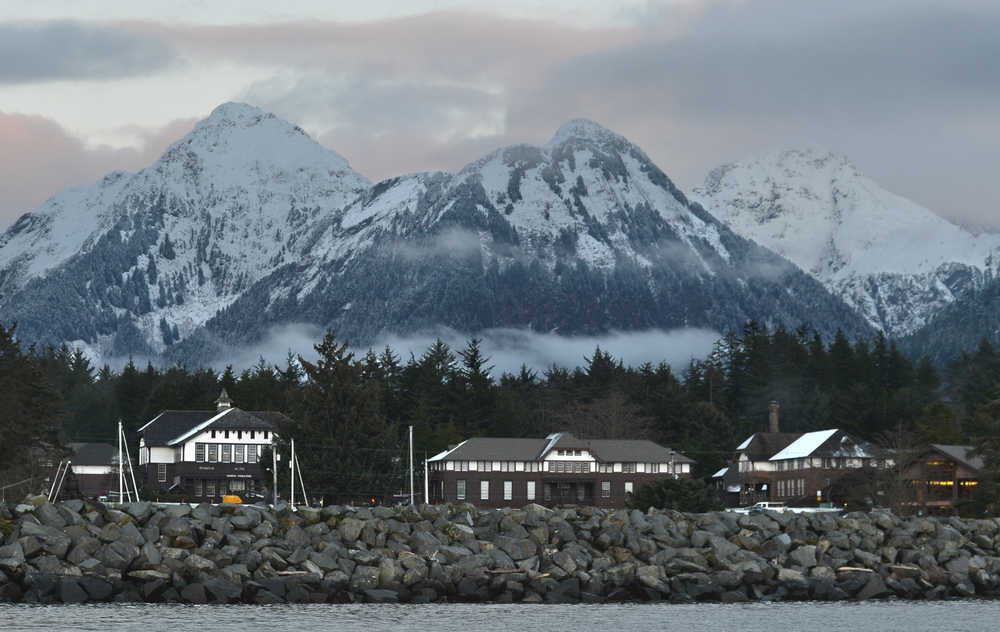
In this photo taken Dec. 13, the Sheldon Jackson College campus is pictured from Eastern Channel in Sitka.
