Governor says proposed budget will be released Thursday, funds for new ferry will be included
Published 9:30 pm Tuesday, December 12, 2023
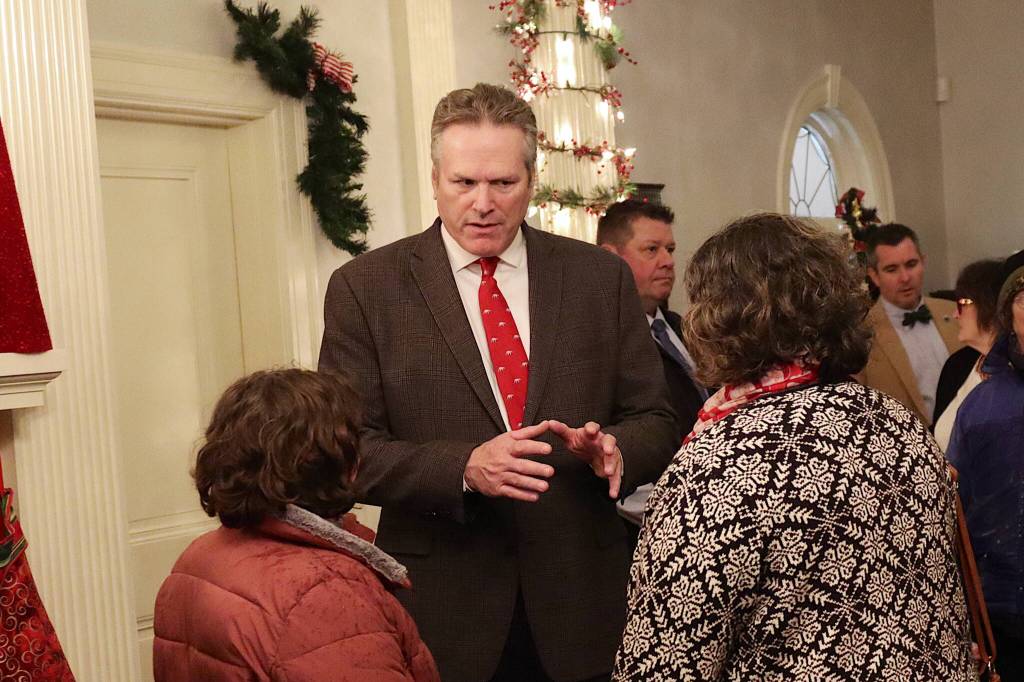


Gov. Mike Dunleavy said Tuesday he will release his proposed state budget for next year on Thursday, and it will include $23 million in matching funds to allow for the purchase of a replacement state ferry, plus initiatives to address “affordability” issues in Alaska.
Dunleavy, speaking to reporters before the annual Holiday Open House at the Governor’s Residence, also said education will be a key focal point of his agenda this session. But he emphasized programs such as charter schools rather than a permanent increase in per-student public school funding that was a dominant issue during the past session.
Another key element of Dunleavy’s budget to watch for is the proposed amount/formula of the Permanent Fund Dividend. Dunleavy has in the past proposed a so-called “statutory” dividend — which for the current year would have been well in excess of $3,000, but resulted in a deficit of several hundred million dollars — but the bipartisan-led Senate majority prevailed in a budget battle that resulted in a $1,312 PFD and an $84 million surplus.
A specific budget item that gained prominence last week was a request by U.S. Sen. Lisa Murkowski, an Alaska Republican, for $23 million in matching funds to secure $92 million in federal funds to replace the Tustumena ferry.
“I urge you to include those funds, which the state’s applications committed to providing, in your December budget proposal to signal to the State Legislature that it is a top priority to secure these awards,” Murkowski wrote in a Dec. 5 letter to Dunleavy.
In an interview with the Anchorage Daily News the previous week, she said state ferries had been allowed to go “into a death spiral” and “break down” because there had not been necessary “investment in operations and maintenance.”
Dunleavy said Tuesday “we’re working on the matching funding…we’ll include it in our budget.” He also said he disagrees with Murkowski’s characterization of the ferry system under his administration.
“We don’t believe it’s going into a death spiral,” he said. “As a matter of fact the last few years we’ve put a lot of money into it. We restructured it, we believe it’s on track to become an excellent transportation system for the state of Alaska.”
“We are looking forward to having a ferry that’s sustainable like everything else in Alaska. That’s the key.”
Another watch point for that budget item is if Dunleavy proposes to use conventional state funds to match the federal allocation, or seek an alternative as he did last year when he proposed using federal “toll” funds — essentially passenger and other similar fees — even though the legality of doing so for the state ferry system had not been established.
When asked about his goals for the next year, Dunleavy also mentioned “affordability” for residents as something that will be addressed in the proposed budget.
“The ability to live in Alaska, to afford it whether it’s housing, whether it’s energy grids (or) food, and that’s going to be rolled out too, some initiatives around that on Thursday with the budget,” he said.
The governor also suggested an education agenda with a different focus than many legislators had during the past session, when permanently and significantly increasingly the per-student pubic school funding formula was one of their top issues. A one-time increase of $680 per student was passed at the end of the session, but half of the amount was vetoed by Dunleavy.
The issue is again expected to be a central focus during the upcoming session, but Dunleavy on Tuesday discussed a recent first-ever study by two Harvard University researchers that found Alaska had the highest charter school scores for fourth- and eighth-grade students among 35 states and the District of Columbia.
“You’re going to see discussions on education, education funding, charter schools, home schools, you name it, because we have a model that works,” he said, adding “our educational system with a few tweaks, we believe, for all kids we can exceed and excel in Alaska.”
State law requires the governor to submit a budget to the Alaska Legislature by Dec. 15. The official fall revenue forecast is also expected to be released at or about the same time.
• Contact Mark Sabbatini at mark.sabbatini@juneauempire.com or (907) 957-2306.