
A previous version of this article stated Alaska Department of Labor and Workforce Development estimates show mining jobs have been on a slight decline in recent years. Those figures include jobs in the oil industry. The number of mining jobs has grown slightly in the past few years. The article has been updated to reflect this information.
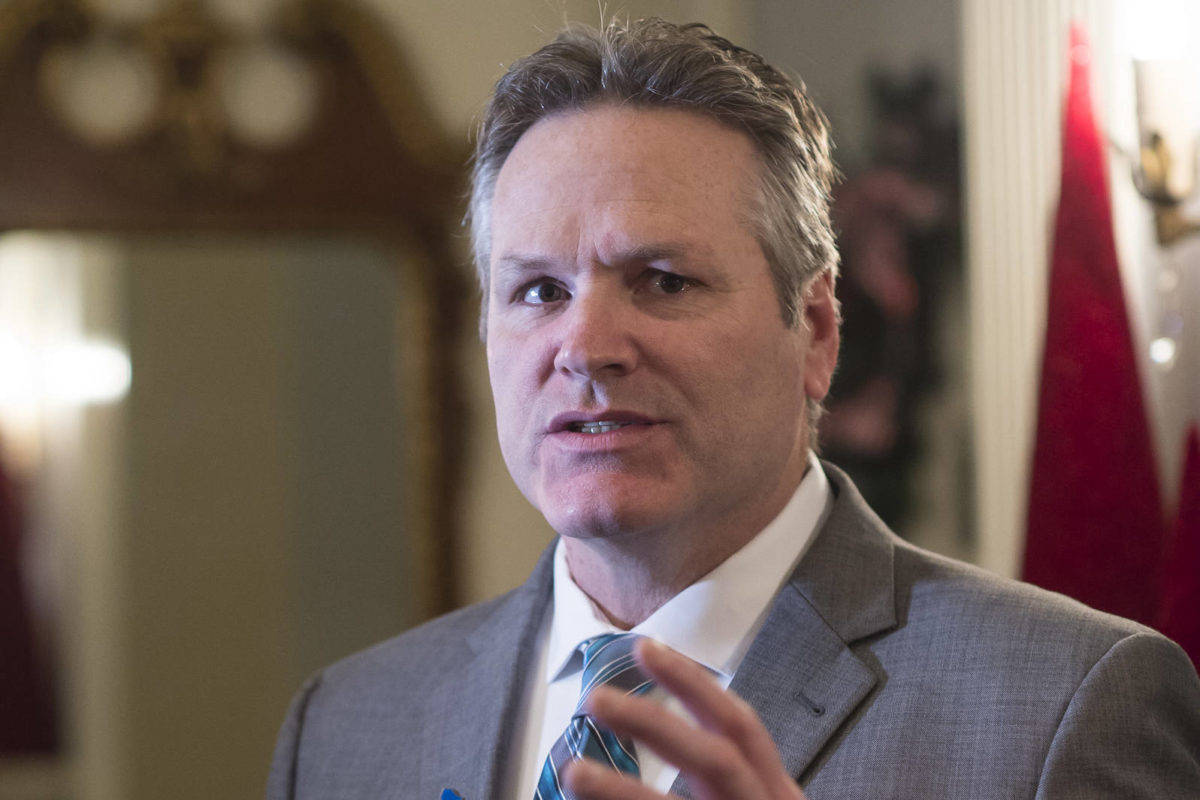
Gov. Mike Dunleavy told the mining industry Alaska is open for business during an annual mining conference in British Columbia.
Dunleavy, who spoke Wednesday at an Alaska Night event held during the Association of Mineral Exploration Roundup Conference, can be heard in a recording of his remarks obtained by the Empire emphasizing Alaska’s openness to mining projects.
“We have gold, silvers, lead, zincs, you name it,” Dunleavy said. “We have everything in the state of Alaska, and what you have now in the state of Alaska is an open invitation for all of you to set up shop in the state of Alaska.”
In a release prior to the convention, Dunleavy said he intended to encourage mining investment in Alaska at the conference and would be joined by commissioners Doug Vincent-Lang, Department of Fish and Game; Corri Feige, Department of Natural Resources; and Jason Brune, Department of Environmental Conservation.
While the content of the remarks was unsurprising to Salmon Beyond Borders Director Jill Weitz, who attended the event in British Columbia, she said it still struck her as odd.
“The fact that our governor and the three regulatory commissioners were promoting mining developments in Alaska, it was a new one for me,” Weitz said. “I think that was pretty significant.”
During his roughly 10-minute speech of the event, which was public but not streamed online, Dunleavy shared some of his personal story, facts about Alaska — it’s the northernmost, easternmost and westernmost state — and talked up the state’s viability for mining projects.
Part of Alaska’s appeal, Dunleavy told could-be investors, is Alaska has the benefits of U.S. laws and jurisprudence and the opportunities of an emerging economy.
“In Alaska, we like to say ‘We’re America and so much more,’” Dunleavy said.
During his comments, Dunleavy spoke to why he wants to see mining expand its presence in Alaska.
“In Alaska, most of the mining is happening in some of the poorest parts of the state,” Dunleavy said. “It transforms that area, and I would say for the better. When I lived up in Kotzebue, prior to Red Dog Mine, there was really no private economy of any large scale. That mine came in the ’80s and really changed that place for the better.”
He also said the industry is one of the oldest professions around and will outlast many other industries.
Employment estimates from the Alaska Department of Labor and Workforce Development shows the number of mining jobs in the state has been on the wane in recent years.
From 2017-2018, Alaska’s mineral industry decreased in reported value by almost 8%, according to the Alaska Department of Natural Resources Division of Geological & Geophysical Surveys. It totaled $2.9 billion.
In comparison, as of 2016, Alaska seafood harvest had a total ex-vessel value of $1.7 billion, and National Park tourism created $1.3 billion in economic benefit in 2016 for Alaska, according to the National Park Service. Direct visitor spending totals about $2.2 billion annually, according to Cruise Lines International Association Alaska.
In his comments, Dunleavy did not directly address transboundary mining concerns. Mining operations produce waste that is sometimes discharged into lakes or rivers that flow across borders.
Runoff from the Tulsequah Chief Mine in British Columbia flows into a tributary of the Taku River and has been an international point of contention for years. In June, every senator from each state that borders British Columbia sent a letter urging its premier to implement closer monitoring of transboundary water quality.
However, Dunleavy did address environmental concerns associated with mining. Dunleavy said mitigating environmental impact is part of the reason he wants new mining operations in Alaska.
“We protect our environment better than any other place on the planet,” Dunleavy said. “If we do it in Alaska, we feel we protect the entire planet because as you know, there are some places that may not have the environmental protection that America, Alaska or Canada has for example, but Alaska really does it well.”
• Contact reporter Ben Hohenstatt at (907)523-2243 or bhohenstatt@juneauempire.com. Follow him on Twitter at @BenHohenstatt.
