
For years, the need for food in Juneau has been growing. Now the city’s only food bank is, too.
The Southeast Alaska Food Bank recently began the groundwork for a much-needed expansion that will more than double the food storing capacity of the existing structure, according to Jim Wilcox, president of the food bank’s board of directors.
By the end of the next summer, the food bank will have a new warehouse space, including a walk-in cooler and a walk-in freezer. Once the addition is complete, the building’s footprint will have grown from about 1,000 square feet to almost 3,000 square feet, allowing it to begin shipping food up in bulk from the Lower 48. This will be critical if the food bank is to continue meeting the city’s growing needs, Wilcox said.
“The big chunks will be coming from down south, where we can get food for cheaper,” Wilcox said. “We’ll be bringing truck loads of food, and the reason we’re doing this is because our volume is increasing every year; every month it’s increasing.”
Growing needs
During the four years that Wilcox has sat on the food bank’s board, he said he’s seen the need for its services increase drastically. This is most obvious, he said, on Saturdays — the only day of the week the food bank is open directly to the public. On other days of the week, it provides food to its 30 or so member organizations, such as Catholic Community Service, which then distribute the food.
Though the food bank does not track or record who comes in, Wilcox said the number of people stopping in on Saturdays is on the rise. Darren Adams, the food bank’s manager and sole employee, has noticed the same.
“Once upon a time, a typical Saturday used to be 15 to 20 people,” Adams said of when he started working with the food bank 10 years ago. “Now, a typical Saturday is 80, 90, 100 people.”
Room to breath
(and to feed)
About a year ago, Wilcox said that a representative from Feeding America, a national “network of food banks,” came to Juneau to inspect the Southeast Alaska Food Bank.
“He asked how much food we put out of this little building, so we told him,” Wilcox said, explaining that as of Nov. 1 of this year the food bank had distributed more than 200,000 pounds of food. “He said ‘Holy Jesus! You got that much food out of this little building?’ He was amazed.”
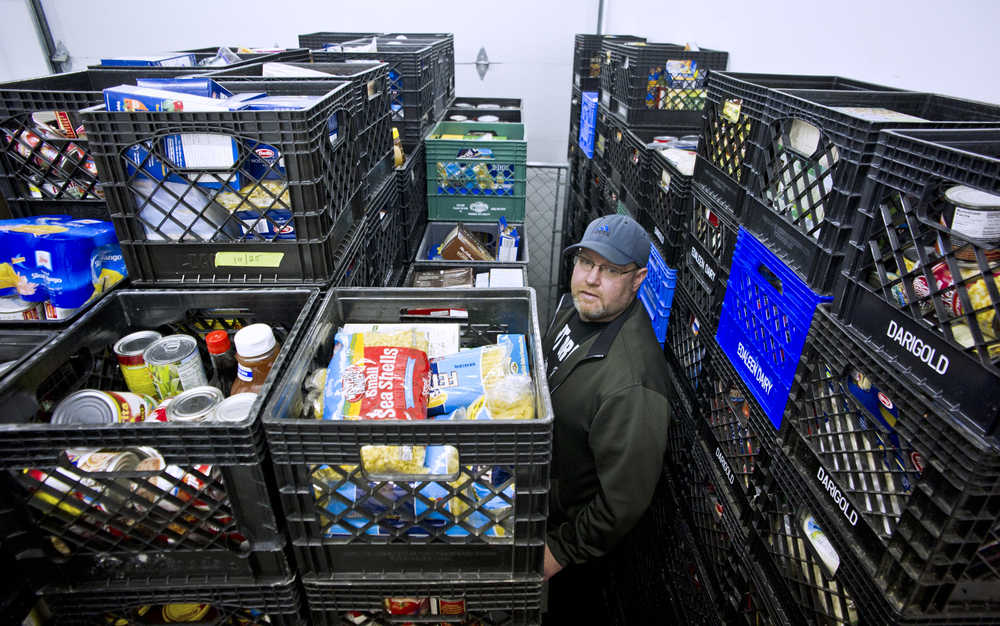
In the existing facility, Adams is constantly engaged in what basically amounts to a real-life game of Tetris — only instead of neatly stacking slowly falling geometric pieces, he stacks crates of food. And they don’t conveniently disappear every time he forms a line of them.
“It’s extraordinarily tight,” he said. “I’ve got food stacked everywhere I can stack it.”
Crates of food are stacked higher than Darren is tall. They are stacked under shelves. In some cases, crates of non-perishable food are even stacked in the refrigerator. Several bags of uncooked macaroni noodles share a shelf with milk in the refrigerator due to space constraints.
Right now, it’s even tighter than usual. Typically, the food bank tries to distribute every pound of food that it takes in. For instance, in October, it took in about 22,000 pounds of food and gave out about 22,200 pounds (there was a small surplus from the month before). At the end of last month though, the food bank had 12,000-pound surplus thanks to a successful community Thanksgiving food drive.
The lack of space limits the food bank’s ability to continue taking in new food, which also means it isn’t able to store as much as it otherwise could. Though Adams’ said this is a “very good problem to have,” it won’t be a problem once the new warehouse is built.
“This expansion is about thinking down the road,” he said. “It’s about thinking long term — over the course of the next 10, 20, 30 years.”
Wilcox said that the new warehouse should give the food bank “the space it needs” for years to come.
A giving town
All told, the food bank expansion will cost about $300,000. Wilcox is hopeful that the food bank won’t have to pay for any of it.
“I like to say that we’re putting on a $300,000 addition, and we’re not going to spend a dime,” he said.
In order to make this happen, Wilcox is counting on community support. So far, several contractors have donated nearly $80,000 worth of labor and materials (though mostly labor) to the project, Wilcox said.
“What we’ve got now is going to get the building up,” he said. “What we need is the money for lumber and other stuff.”
The food bank has begun its fundraising effort. Wilcox said that he has mailed out about 400 notices requesting money already, and the effort is ongoing. The food bank is also taking donations online through its website, seakfoodbank.com
Wilcox said he hopes to raise the remaining $200,000 by the time construction of the warehouse begins in April 2016, but he doesn’t seem worried about the timeline. He has faith in Juneau.
“This town is a giving town,” he said. “Surely at least half of the businesses who have donated to us have employees who come through here on Saturday.”
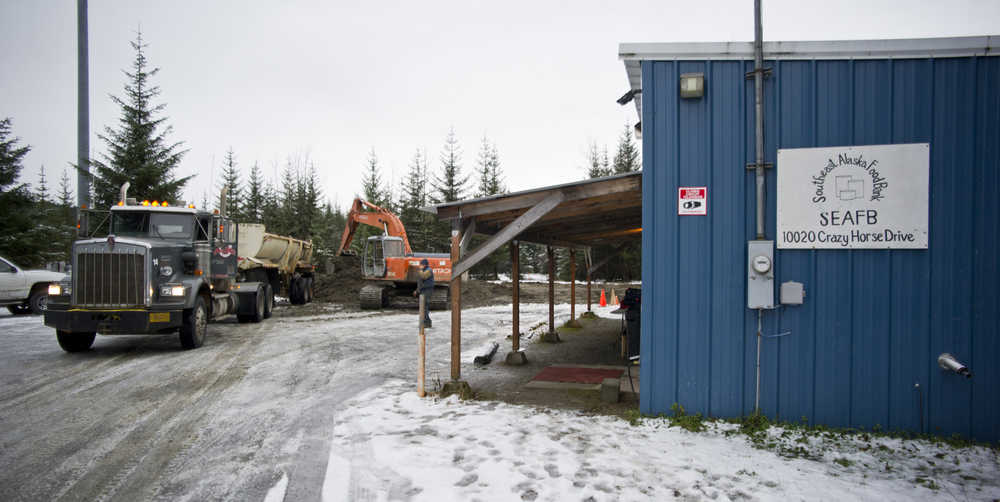
Ground preparation work is being down now for a new building to increase storage at the Southeast Alaska Food Bank.
