
Richard Peterson walked to the microphone at Monday night’s Indigenous Peoples Day celebration at Elizabeth Peratrovich Hall, clearly emotional.
Peterson, the president of Central Council of Tlingit and Haida Indian Tribes of Alaska, immediately told the crowd of more than 300 people to bear with him as he shared his frank, straightforward thoughts on the first officially recognized Indigenous Peoples Day in Alaska.
“This is not an insult to those who are not indigenous,” Peterson said, “but this is recognizing the people whose land that you’re standing upon, people who have paid the ultimate sacrifice. People who have lost their land, their culture, traditions.”
[Slideshow: Indigenous Peoples Day 2017]
Gov. Bill Walker, who was in attendance Monday, issued a proclamation in 2015 that made Alaska the first state to rename the second Monday in October as Indigenous Peoples Day instead of Columbus Day. Since 1937, Columbus Day has been a federal holiday honoring the Italian explorer who landed in the Caribbean in 1492.
Earlier this year, the Alaska Legislature approved the renaming to Indigenous Peoples Day, making Monday the first officially recognized Indigenous Peoples Day in Alaska.
There were events throughout the day Monday, mostly at the University of Alaska Southeast, in honor of the day. Beginning at 10:15 a.m. Monday, various speakers presented at UAS about topics from the importance of deer in Alaska Native culture to the cultural glorification of conquerors.
Many have taken issue with the way Columbus is glorified, particularly by the holiday. Though Columbus is credited with the feat of crossing the Atlantic and introducing Europe to the Americas, historical records have shown that he also enslaved and brutally treated the people he met upon landing in the West Indies.
Peterson spoke bluntly about the glorification of Columbus, saying that if people want to praise a man who “tried to enslave and do horrible things to” the indigenous people he met, they could go ahead and do it.
“I don’t disrespect you for doing that,” Peterson said, “but I am going to recognize our indigenous people who have been here for tens of thousands of years.”
In the back of the room, Samantha Falkner shared Peterson’s views. Falkner, of Tlingit descent, said she appreciated how important the day was to set the record straight about the relations between European explorers such as Columbus and the indigenous peoples of this continent.
“It’s nice to try and get this day given back to us,” Falkner said. “It’s important because it’s more accurate, I guess. It’s in recognition to the things that have happened to us since 1492.”
One of the themes throughout the day was the importance of deer in Native life. Alaska State Writer Laureate Ernestine Hayes’ talk early in the day was entitled “Stories of Deer” and a presentation at the UAS Native &Rural Center in the afternoon was entitled “Food and Sovereignty,” centering around the use of deer.
Rick Caulfield the chancellor of UAS, said attending the lectures and events throughout the day served as a valuable history lesson.
“There’s so much history to be learned,” Caulfield said, “and not often is that history written in our textbooks.”
At the nighttime event, attendees were able to get up close and personal with deer. Under a tarp just outside Elizabeth Peratrovich Hall, two deer lay on tables, ready to be prepared and processed. Lyle James, who prefers to go by his Tlingit name of xeetli.éesh, was there demonstrating to attendees how to cut and prepare deer.
Deer, James explained, serve an important role in uniting people.
“It not only feeds our family, but it also feeds us spiritually,” James said, “because we get to teach nephews how to harvest, we get to teach nieces, we get to teach sisters, we get to teach aunties. It doesn’t just confine us to ourselves. It expands beyond just the centralized area of people. That’s what we’re trying to do as a nation. We’re trying to expand that peace amongst everybody.”
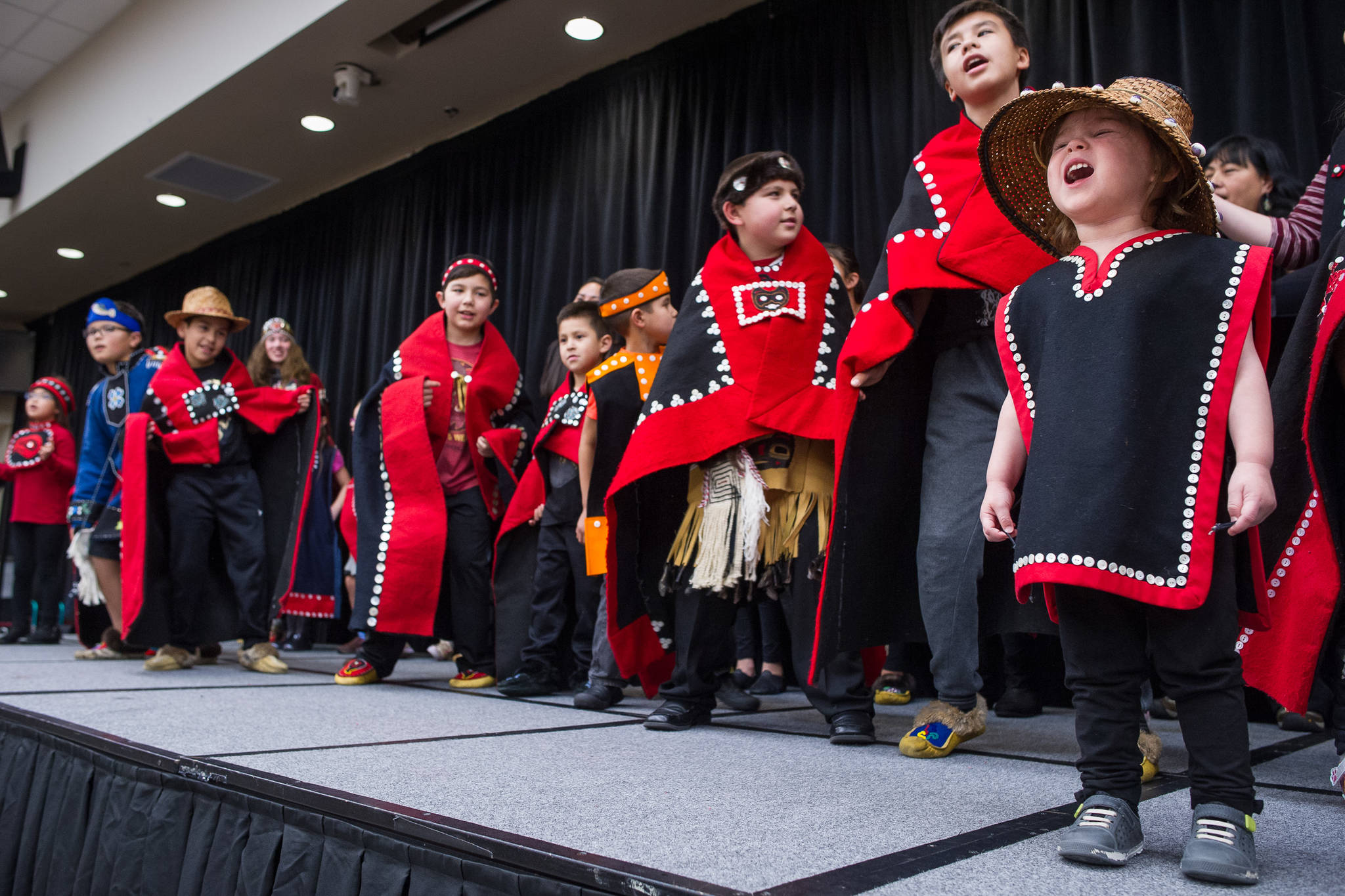
As much looking to the past as there was Monday, many in attendance were excited about the future. As the All Nations Children dance group performed — with more than 25 children singing and dancing in unison — the rest of the room cheered and recorded on their phones. During his remarks, Peterson said CCTHITA is going to start a program soon to teach employees Native languages, so they can greet visitors to the building in their native tongues.
Alaska Native Brotherhood Grand President Sasha Soboleff said Monday was both a culmination of a long journey and a peek into the future. After generations of young Alaska Natives were forced to not speak or write their native languages, there have been fewer and fewer fluent speakers.
While some would say the language and histories of Alaska Natives have been fading away, Soboleff feels differently, especially after seeing the children dancing Monday. He repeated something his father, Tlingit scholar Dr. Walter Soboleff, used to say about the future.
“It went underground,” Soboleff said of Native knowledge. “It didn’t disappear. Underground, it was waiting for all the eyes and ears to tune in once again to what it was like to be Native.”
• Contact reporter Alex McCarthy at 523-2271 or at alex.mccarthy@juneauempire.com.
