
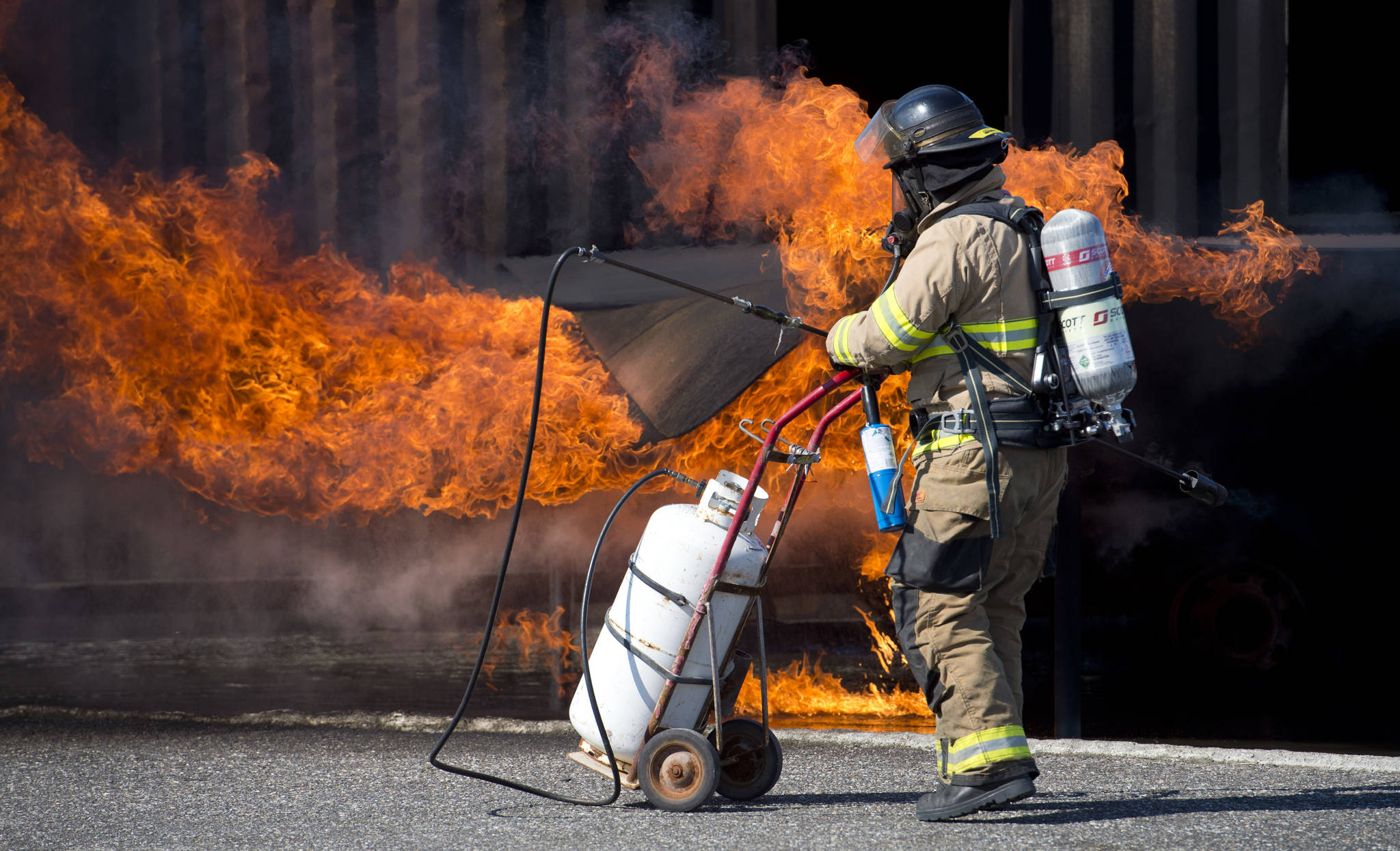
photos by michael penn | juneau empire Krista Telnes lights a training fire as Southeast firefighters update their airport rescue firefighting skills at the Hagevig Regional Fire Training Center on Thursday. See more photos on page A10.

photos by michael penn | juneau empire Krista Telnes lights a training fire as Southeast firefighters update their airport rescue firefighting skills at the Hagevig Regional Fire Training Center on Thursday. See more photos on page A10.

Firefighters practice aircraft rescue

As part of their training, firefighters often run simulations with scenarios designed to help them practice their skills in a semi-realistic setting, rescuing “victims” from burning “houses” or extricating accident victims from mangled vehicles.

But aircraft rescue and firefighting adds several layers of complexity to any potential call-out. Capital City Fire/Rescue members have to be certified by the Federal Aviation Administration to do aircraft rescue and firefighting (ARFF) at the Juneau International Airport. And part of that certification requires an annual training.

The need for ARFF-qualified firefighters has doubled for CCFR, explained Assistant Fire Chief Ed Quinto, because Alaska Airlines had increased the length of its aircraft and the number of its scheduled departures. That bumped up the airport’s ARFF index, which in turn means CCFR had to add staffing and training.

CCFR used to run one truck with a backup, but now is required to have two manned at all times, Quinto said.

The FAA mostly funded the purchase of the new truck, which was longer, which meant the fire station needed to rebuild a portion of the building to house it, that also was mostly paid for by FAA.

“We are required to have two trucks on the field in the event of a crash,” Quinto said.

The designated response time from the station to the middle of field for the first truck is within three minutes, and the second truck within 4 1/2 minutes.

“It doesn’t give you much time,” Quinto said. “You”ll see (in training) how fast these guys have to move.”

During Thursday’s training, firefighters simulated cutting into an aircraft and rescuing a passenger, as well as extinguishing a fire inside the aircraft. To run the simulation, they use propane and diesel, since planes use diesel fuel. Two firefighters from Yakutat were on hand to participate in the training session as well. Some of the firefighters wore special airport suits, with foil that helps deflect a little more heat.

In one scenario being run, CCFR Captain Noah Jenkins drove the truck, trying to get upwind of the fire and out of the smoke before spraying a mixture of foam and water at the burning “wing” of the “airplane” (metal storage container). He then laid down a blanket of foam on the tarmac to protect against the possible ignition of vapor from any fuel spill.

The ARFF truck carries 1,500 gallons of water and 220 gallons of foam, as well as 500 pounds of dry chem — similar to what is in a fire extinguisher — which is better for fighting aircraft fires. It also has a piercing nozzle designed to poke through the fuselage of a plane.

Part of the required annual training involves sampling the foam mixture to make sure the percentage is correct and the equipment is properly calibrated.

The FAA mandates the training and helps pay for it, Jenkins explained. Every three years, CCFR firefighters travel up to Kenai to a bigger fire training facility, where they can practice on bigger pit fires.

Quinto said 21 of CCFR’s firefighters are currently qualified to operate the ARF trucks.

But, he said, “In the event of a real emergency, we would throw everything in the city at it.”


Contact reporter Liz Kellar at 523-2246 or liz.kellar@juneauempire.com.
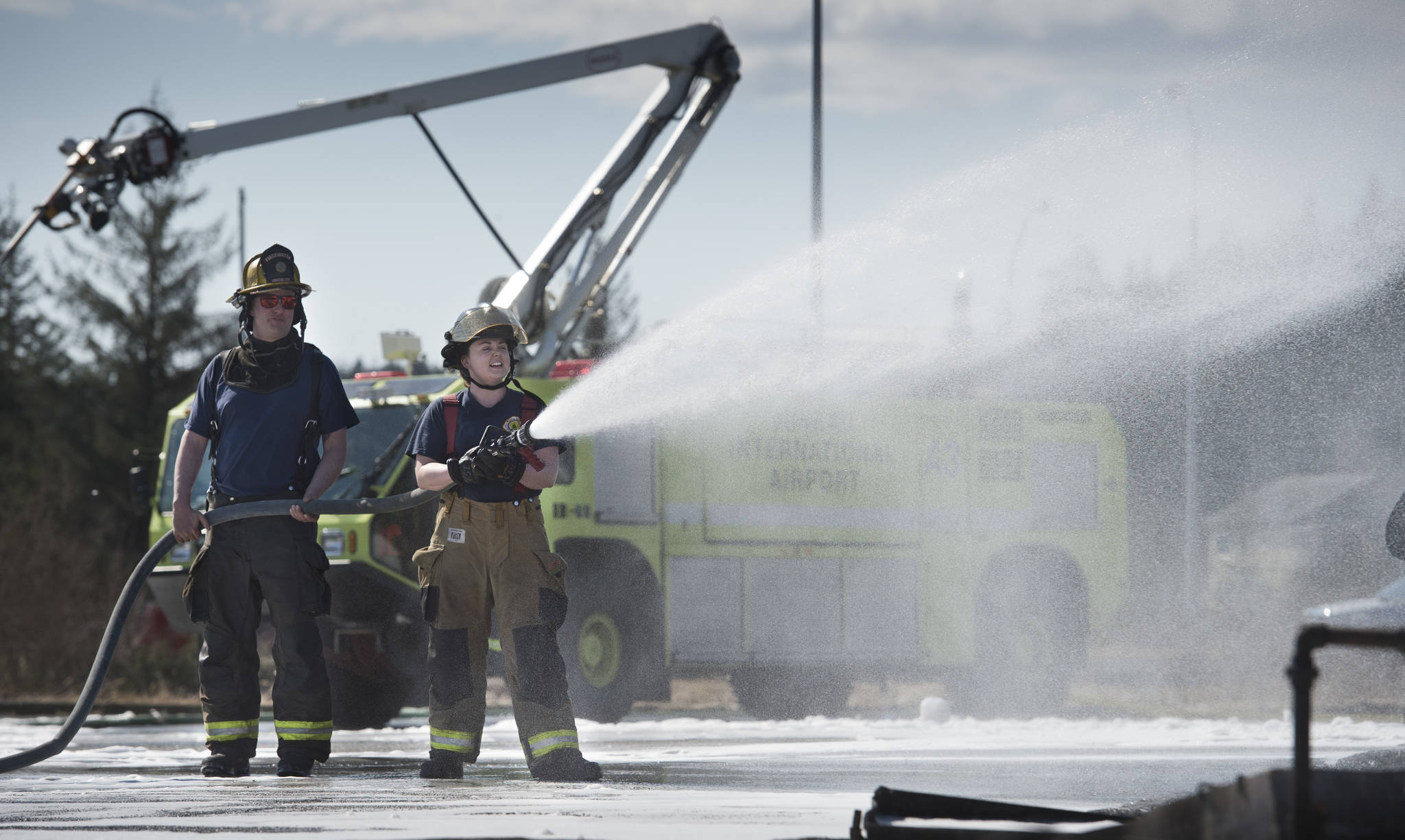


Firefighters Krista Telnes, right, and Dave Edmunds of Capital City Fire/Rescue washdown foam leftover from their airport rescue firefighting skills training at the Hagevig Regional Fire Training Center on Thursday, April 13, 2017.
Firefighters Krista Telnes, right, and Dave Edmunds of Capital City Fire/Rescue washdown foam leftover from their airport rescue firefighting skills training at the Hagevig Regional Fire Training Center on Thursday, April 13, 2017.
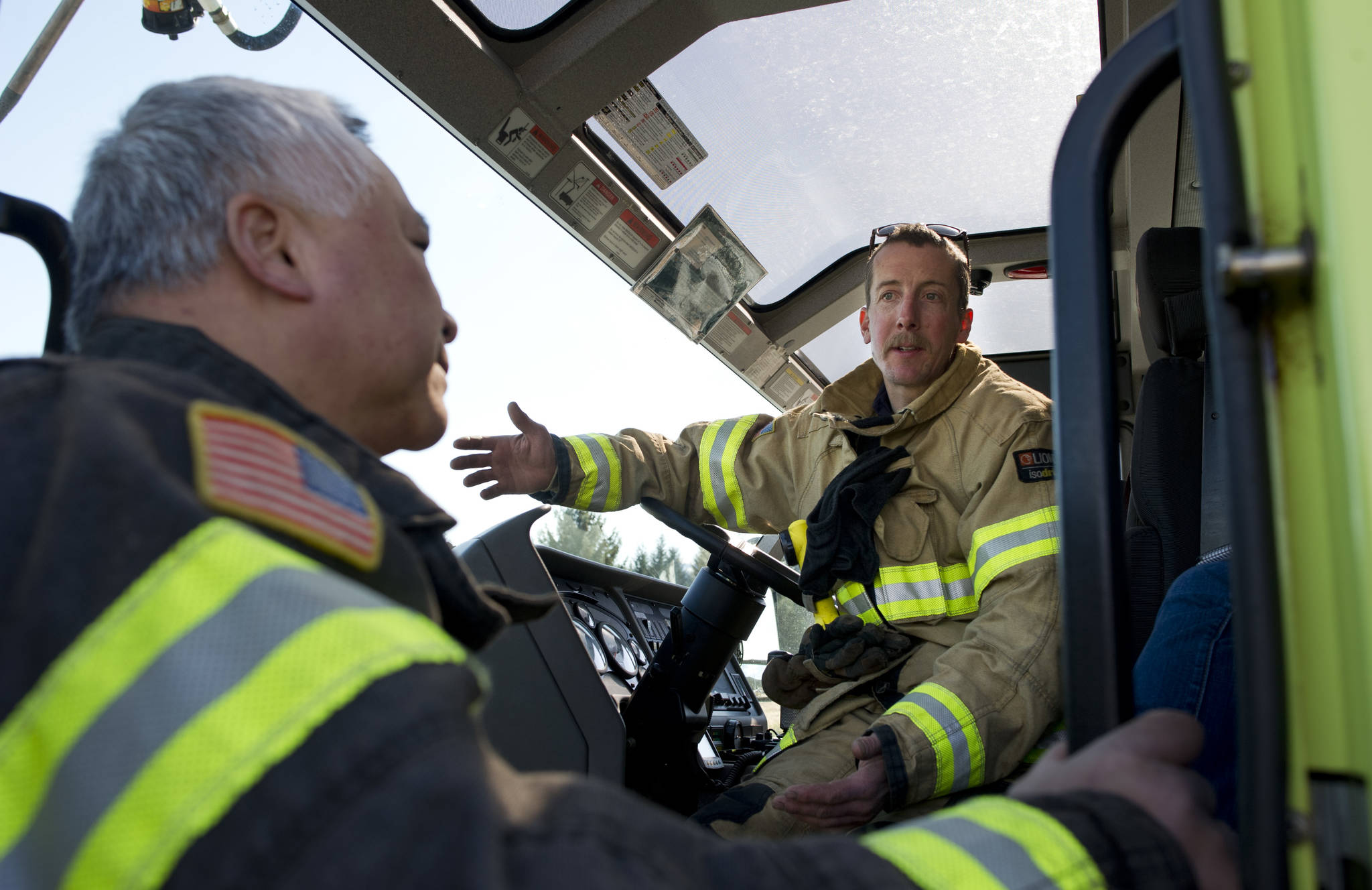
Capital City Fire/Rescue Assistant Fire Chief Ed Quinto, left, talks with firefighter Noah Jenkins during airport rescue firefighting skills training at the Hagevig Regional Fire Training Center on Thursday, April 13, 2017.

Capital City Fire/Rescue Assistant Fire Chief Ed Quinto, left, talks with firefighter Noah Jenkins during airport rescue firefighting skills training at the Hagevig Regional Fire Training Center on Thursday, April 13, 2017.

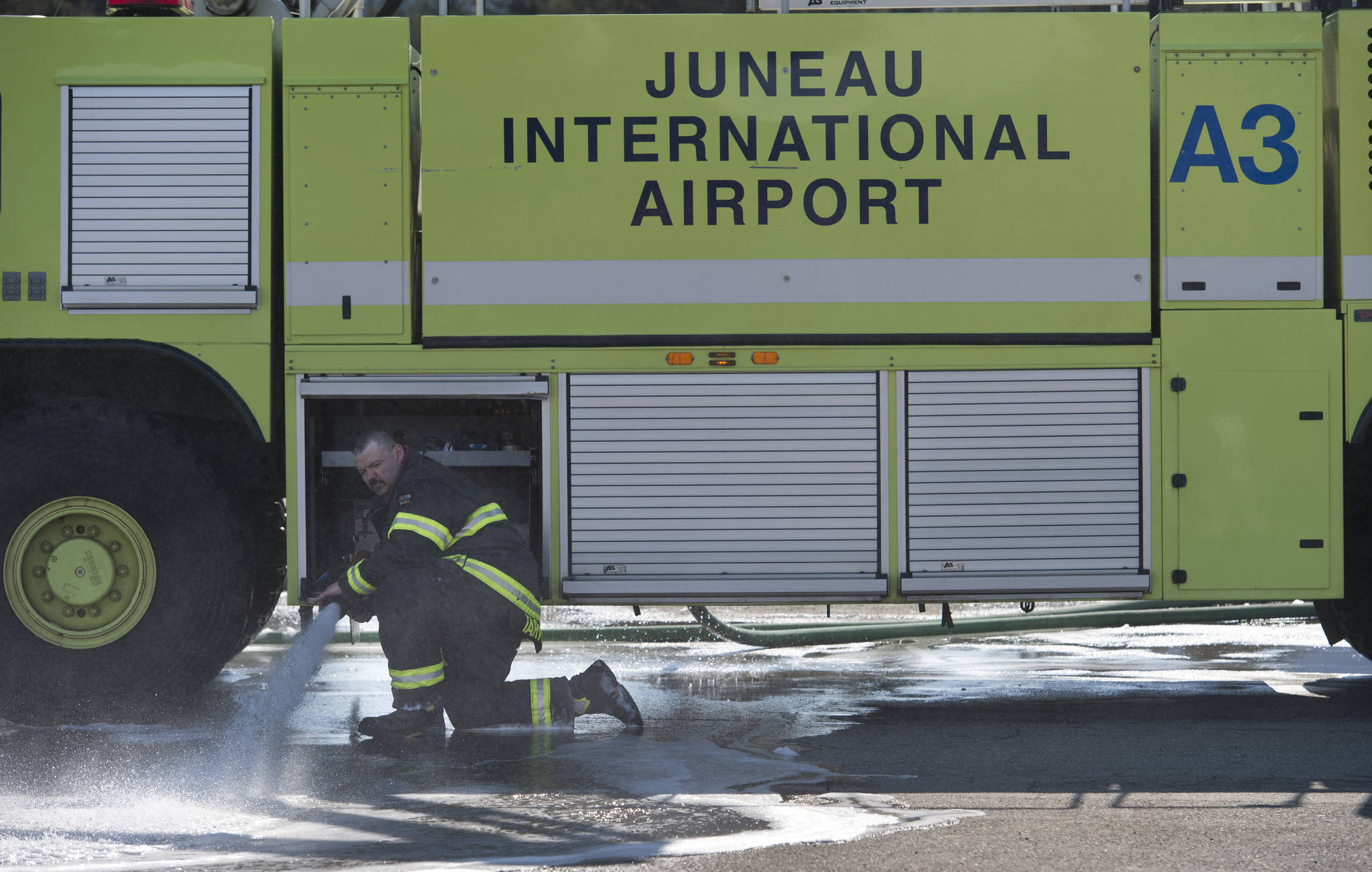
Airport Rescue Firefighter Jason Tarver flushes foam from an airport rescue firefighting engine at the Hagevig Regional Fire Training Center on Thursday.

Airport Rescue Firefighter Jason Tarver flushes foam from an airport rescue firefighting engine at the Hagevig Regional Fire Training Center on Thursday.

More in News

A house on Telephone Hill stands on Dec. 22, 2025. (Mari Kanagy / Juneau Empire)
Court sets eviction date for Telephone Hill residents as demolition plans move forward

A lawsuit against the city seeks to reverse evictions and halt demolition is still pending.

Juneauites warm their hands and toast marshmallows around the fire at the “Light the Night" event on winter solstice, on Dec. 21, 2025. (Mari Kanagy / Juneau Empire)
A mile of lights marked Juneau’s darkest day

Two ski teams hosted a luminous winter solstice celebration at Mendenhall Loop.

A Capital City Fire/Rescue truck drives in the Mendenhall Valley in 2023. (Clarise Larson / Juneau Empire file photo)
Juneau man found dead following residential fire

The cause of the fire is still under investigation.

CBJ sign reads “Woodstove burn ban in effect.” (City and Borough of Juneau photo)
Update: CBJ cancels air quality emergency in Mendenhall Valley Sunday morning

The poor air quality was caused by an air inversion, trapping pollutants at lower elevations.

A dusting of snow covers the Ptarmigan chairlift at Eaglecrest Ski Area in December 2024. (Eaglecrest Ski Area photo)
Update: Waterline break forces closure at Eaglecrest Friday, Saturday

The break is the latest hurdle in a challenging opening for Juneau’s city-run ski area this season.

Patrick Sullivan stands by an acid seep on July 15,2023. Sullivan is part of a team of scientists who tested water quality in Kobuk Valley National Park’s Salmon River and its tributaries, where permafrost thaw has caused acid rock drainage. The process is releasing metals that have turned the waters a rusty color. A chapter in the 2025 Arctic Report Card described “rusting rivers” phenomenon. (Photo by Roman Dial/Alaska Pacific University)
Ecosystem shifts, glacial flooding and ‘rusting rivers’ among Alaska impacts in Arctic report

NOAA’s 2025 report comes despite Trump administration cuts to climate science research and projects

The U.S. Capitol in Washington, D.C., on Oct. 1, 2025. (Photo by Jennifer Shutt/States Newsroom)
Moderate US House Republicans join Dems to force vote on extension of health care subsidies

WASHINGTON — Republican leaders in the U.S. House will face a floor… Continue reading

The National Weather Service Juneau issues a high wind warning forDowntown Juneau, Southern Douglas Island and Thane due to increased confidence for Taku Winds this afternoon. (National Weather Service screenshot)
Taku winds and dangerous chills forecast for Juneau

Gusts up to 60 mph and wind chills near minus 15 expected through the weekend.

Chloe Anderson for the Juneau Empire
Fallen trees are pictured by the Mendenhall river on Aug. 15, 2025. Water levels rose by a record-breaking 16.65 feet on the morning of Aug. 13 during a glacial outburst flood.
Lake tap chosen as long-term fix for glacial outburst floods

The U.S. Army Corps of Engineers and Juneau leaders agreed on the plan.

Most Read