
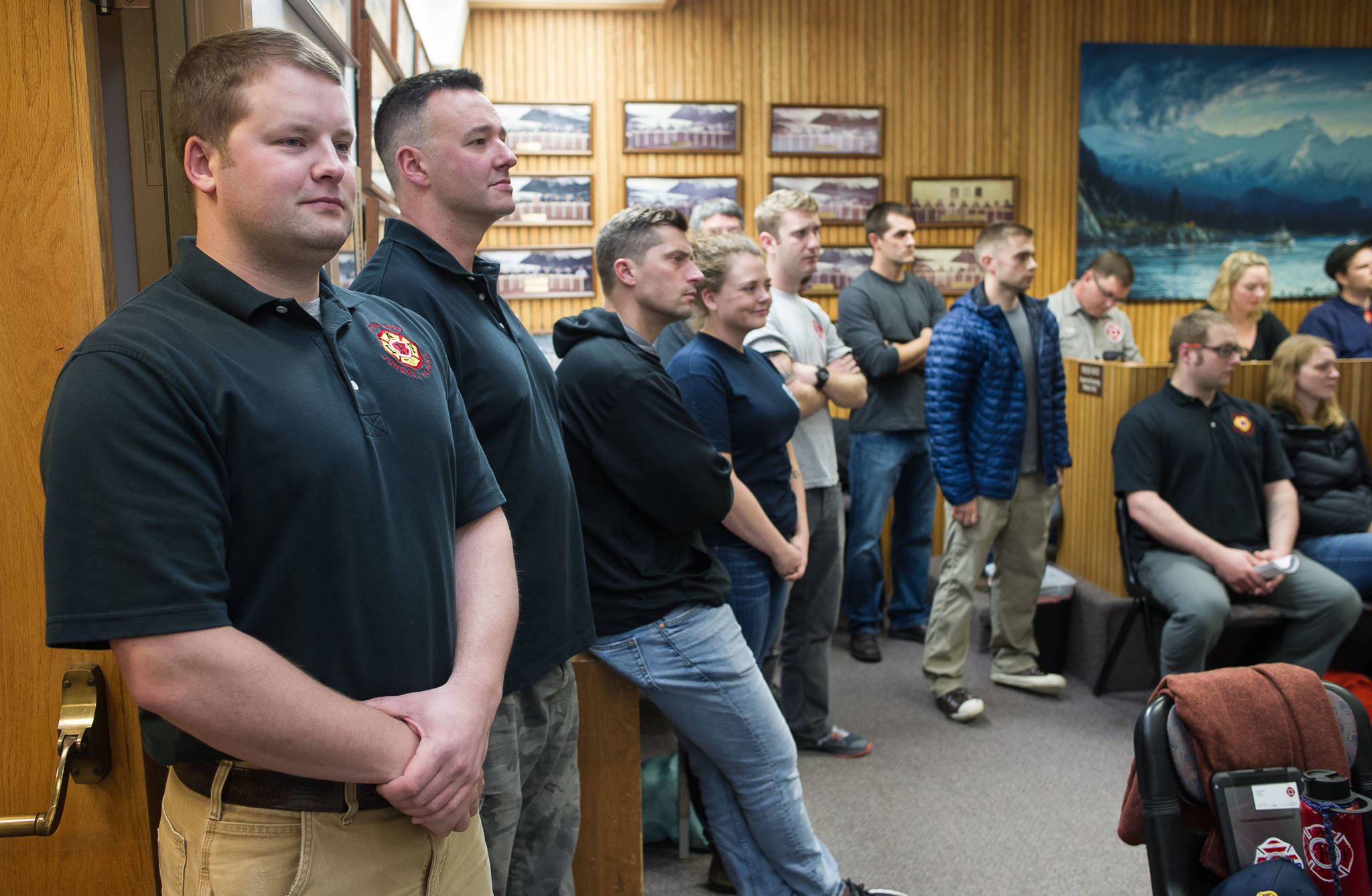
Capital City firefighter Brody Fink was one of the first people to arrive on the scene of the fire that killed two brothers.
“It’ll basically be one that will hang with me for my entire career,” he told the City and Borough of Juneau Assembly last week.
Two days after Juneau’s first fatal fire in four years, Fink was one in a line of firefighters who spoke one by one to the Assembly and pleaded for help.
“Right now, I believe we’re already stretched pretty thin and to our max,” Fink said.
In a series of interviews, firefighters said the city hasn’t kept up with surging demand for fire and ambulance services. The department is running flat-out to keep up with regular demand. When something exceptional happens, it may not be able to keep up.
On the morning of Sept. 17, when The Dining Inn burned and killed Luis Román Olivarría Mora and Adrian de Jesus Olivarria Mora, only four firefighters were in the first wave. Two came in an ambulance and two came in a fire engine. According to international standards, there should have been at least four firefighters on that engine.
The first four firefighters had to pull a woman off a roof, frantically set up equipment and rescue one of the two men who were still inside the building.
There weren’t enough people to immediately go inside and finish the search.
As the night went on and more firefighters arrived, there still weren’t enough — not enough to simultaneously run hoses and air tanks, not enough to trace the fire through the home’s thick walls. Four firefighters were sickened by smoke inhalation or heat exhaustion, but they had to stay on the job — there was no one else to do the work.
Even when volunteers and off-duty firefighters were called into service, there still weren’t enough. Civilian volunteers were pressed into service, carrying gear and even — in one instance — climbing a ladder to help.
“We’re going to sit around the dinner table and ask ourselves for years to come if having more firefighters would have made a difference,” said firefighter Travis Wolfe, head of the local union.
Burning numbers
CCFR’s annual report lists the problem in detail. In 2016, the department answered 4,517 calls for help, up from 4,013 the year before.
Ten years before, in 2006, the department answered 3,121 calls.
Fire Chief Richard Etheridge believes this year’s tally will top 5,300 calls.
“These guys are pretty much running around the clock anymore,” he said. “Being able to spread the workload out among more responders would definitely help out.”
CCFR doesn’t just answer fire calls. It’s the city’s ambulance service as well, and that’s where the growth has been most apparent.
“In 2016, Capital City Fire/Rescue saw an unprecedented rate of growth in emergency calls,” the fire department wrote in its report. “There was a 12.6 percent increase in call volume. Never before has Capital City Fire/Rescue seen that large of an increase in call volume in the 21 years of reporting.”
The fire department’s Facebook page also illustrates the rise.
On June 11: “Our ambulances are running like crazy today. We are having to triage calls and route the ambulances to more serious incidents. We have had 11 medical calls in the last 2 hours. Most all of them have been local residents.”
About 20 calls were reported on that date, the department later said.
On Sept. 6: “It’s a busy night in the Capital City. All units are tied up on calls and JPD is even standing by with a patient until we can free up a unit to respond. … Great teamwork and triage is the only way to pull off this amount of simultaneous activity.”
Juneau gets older, fatter
There are many reasons for the increase in calls. Juneau’s population is aging: More than 6,100 of the capital city’s 33,000 people are aged 60 or older, according to state demographics. Juneau is getting fatter: More than a third of the city’s population is obese, according to figures compiled by the Institute for Health Metrics and Evaluation at the University of Washington.
The city is enduring a spike in drug abuse and may also be seeing a surge in the number of homeless residents. Poor residents may not have health insurance or regular medical checkups, leading them to avoid treating chronic medical problems.
“I think it’s just the medical system and the way it’s developing, not just in Alaska, but nationwide,” Etheridge said.
The number of cruise ship passengers visiting the city is up (and should set a record this year), but tourism is only slightly contributing to the surge in calls. According to CCFR figures, the number of “nonresident patients” — people treated by CCFR who don’t live in Juneau — has bounced between 21.5 percent and 26.9 percent, rising and falling between 2008 and 2016.
By and large, the surge in calls appears to be a Juneau problem, caused by the needs of Juneau residents.
The issue has lingered for years, but it’s coming to the surface because the number of volunteer firefighters has declined, because two men died and because firefighters have been gagged.
For the past year and a half, the city’s firefighters’ union has been negotiating for a new contract. While negotiations continued, firefighters were bound by an agreement that kept them quiet about the department’s problems.
The night the CBJ Assembly approved the new contract was the night firefighters lined up, one by one, to voice their concerns.
“If we had two extra hands yesterday, we would’ve been able to do more work quicker,” said firefighter Peter Flynn. “I can’t say we would have saved anybody’s life, but the possibility, the better chance of being able to do that, is worth a lot to me.”
Cost concerns
How much it’s worth to the City and Borough Juneau is another question.
Firefighters are asking for the full-time staffing of a third advanced life-support ambulance. The city currently has two, and a third is staffed during daylight hours in the summer.
The third ambulance, stationed downtown, would give the city two more on-duty firefighters capable of answering ambulance calls or fire calls.
Why not simply do it?
“It’s expensive,” said city manager Rorie Watt.
Watt said that if the issue were just about hiring two firefighters, it wouldn’t be a significant obstacle. But hiring two 24-hour positions is different from hiring two workers on the clock from 9 a.m. to 5 p.m.
According to the city’s estimate, it would need to hire nine firefighters to fill two 24-hour ambulance jobs. That has an annual cost of about $1 million, Watt estimated.
“A million dollars, plus an ambulance. It’s something like that. It’s a big jump,” he said.
Watt spoke with the Empire in early September, before the fatal fire.
A million dollars is a lot of money by CCFR’s standards. In the current fiscal year, according to CBJ budget documents, the fire department’s entire budget is just under $8.5 million. Personnel costs alone are about $6.25 million.
The city this year expects to collect about $3 million for fire/ambulance services from the people using them. (Usually, insurance reimburses at least a portion of ambulance transport.) Another $2.1 million will come from the city’s general fund, and $3.1 million from property taxes dedicated to fire service. About $232,000 will come from the cruise ship head tax.
“In the short run, we’re not looking at adding staff, because it’s just really, really expensive,” Watt said.
Instead, the city is bringing in a contractor to conduct a staffing study. That study will tell the city whether it needs more full-time firefighters or if it can simply shift the existing workload in some fashion.
The city’s firefighters think they already know the answer.
“Your local fire department is severely short-staffed,” the union wrote on its Facebook page on Sept. 17. “We have tried to express our concerns to the decision makers of our community for years, and they have not listened. Let today’s tragedy be a solemn reminder of why the fire service has minimum staffing requirements. When we do not have the resources we need — people get hurt.”
DV.load(“https://www.documentcloud.org/documents/4059561-CCFR-2016-Annual-Report-Final.js”, {
responsive: true,
height: 700,
container: “#DV-viewer-4059561-CCFR-2016-Annual-Report-Final”
});
CCFR 2016 Annual Report Final (PDF)
CCFR 2016 Annual Report Final (Text)
Clarification: The initial version of this story incorrectly implied that firefighters were not able to enter The Dining Inn quickly. While firefighters were able to find and rescue one of the two brothers on their initial entry, they were not able to find and rescue the second brother. The introduction has also been expanded to state that four firefighters were injured during the course of the fire.
• Contact reporter James Brooks at james.k.brooks@juneauempire.com or call 523-2258.
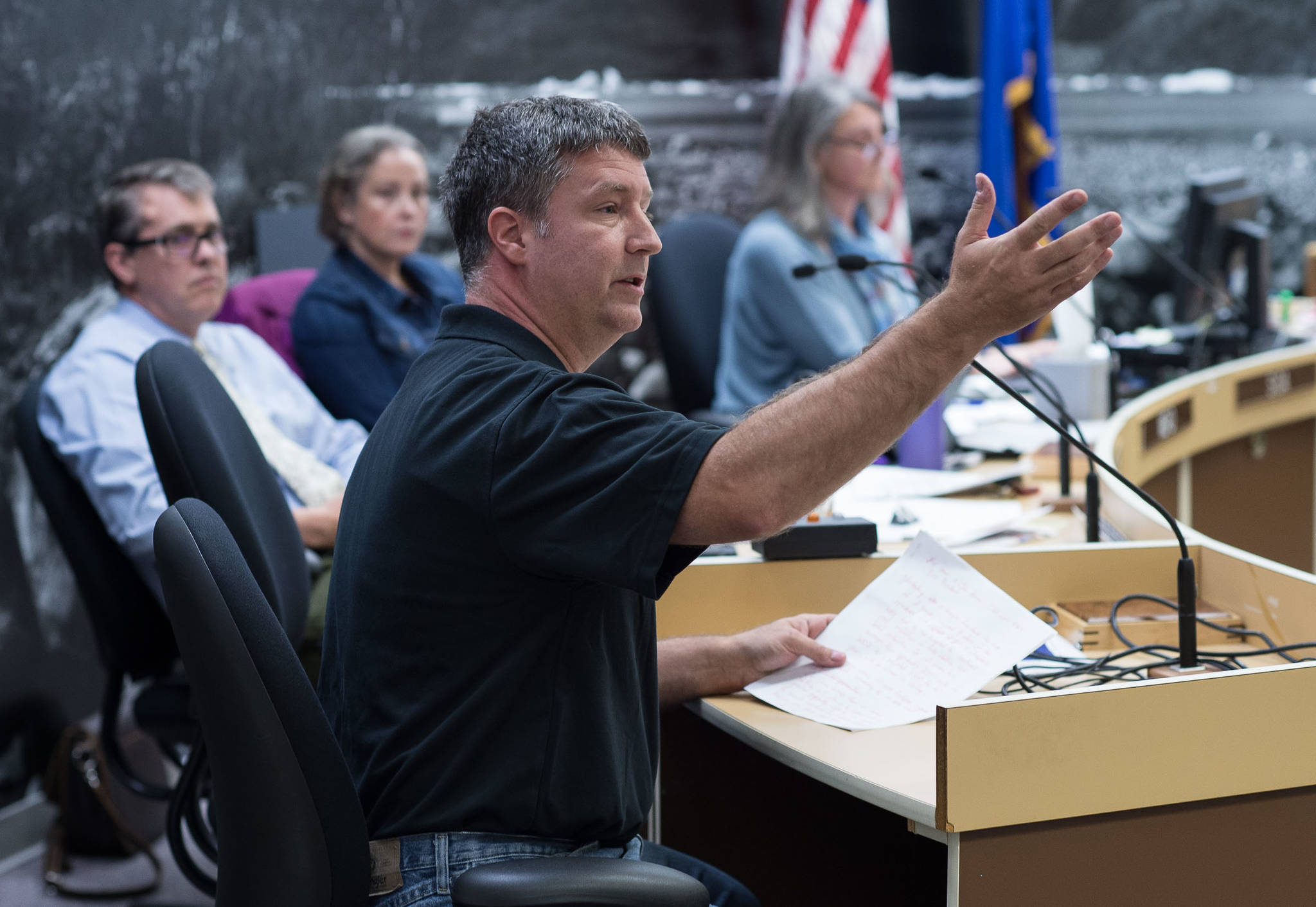
Juneau firefighter John Adams, vice president of International Association of Fire Fighters Local 4303, points out the number of firefighters attending the Assembly meeting on Monday, Sept. 18, 2017, to voice their concerns on the number of career firefighters working in Juneau. (Michael Penn | Juneau Empire)
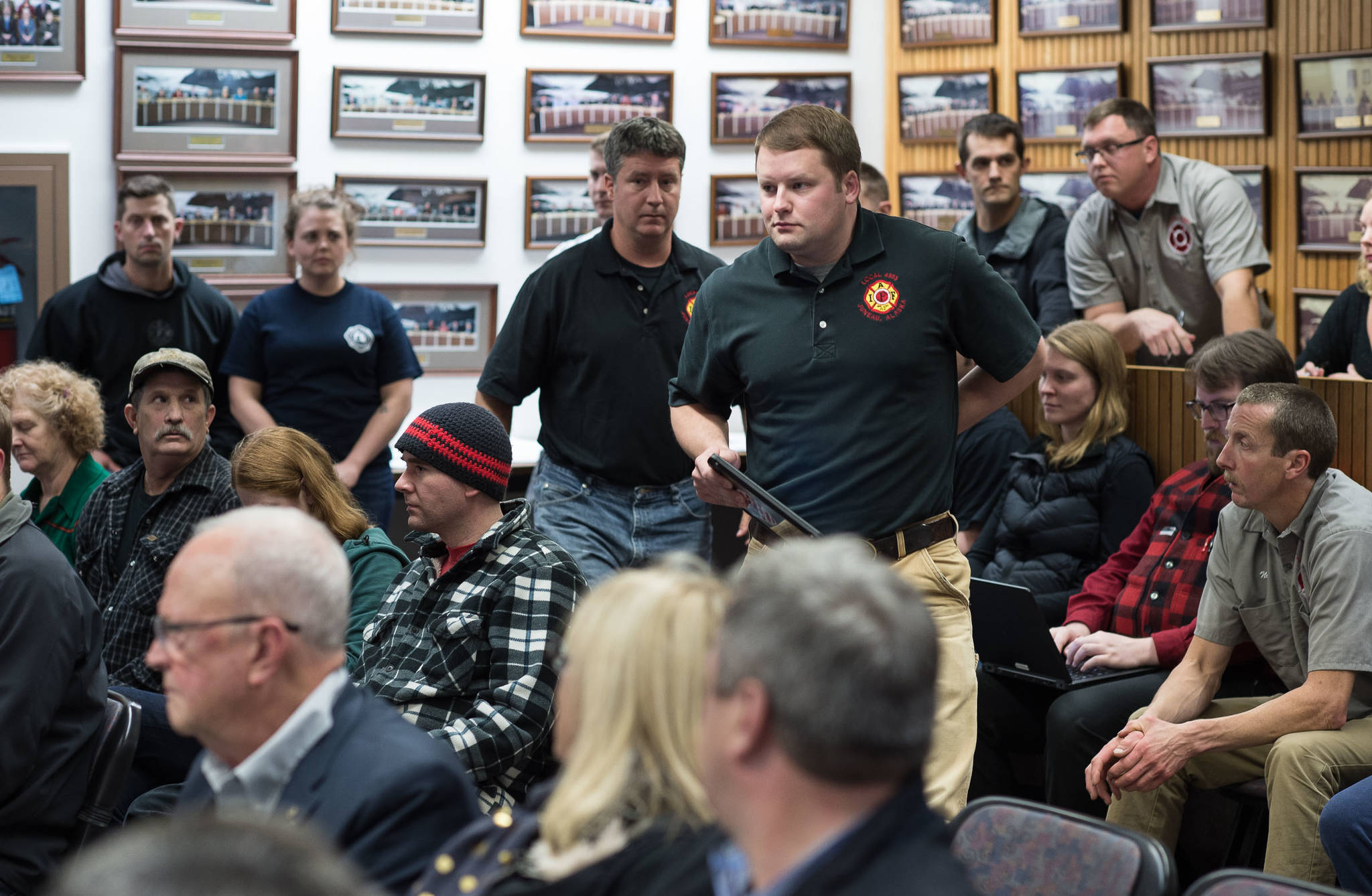
Travis Wolfe, front, president of International Association of Fire Fighters Local 4303, and John Adams, vice president, walk to the speakers table on Monday, Sept. 18, 2017, to speak to Assembly members about their concern in the number of career firefighters working in Juneau. (Michael Penn | Juneau Empire)
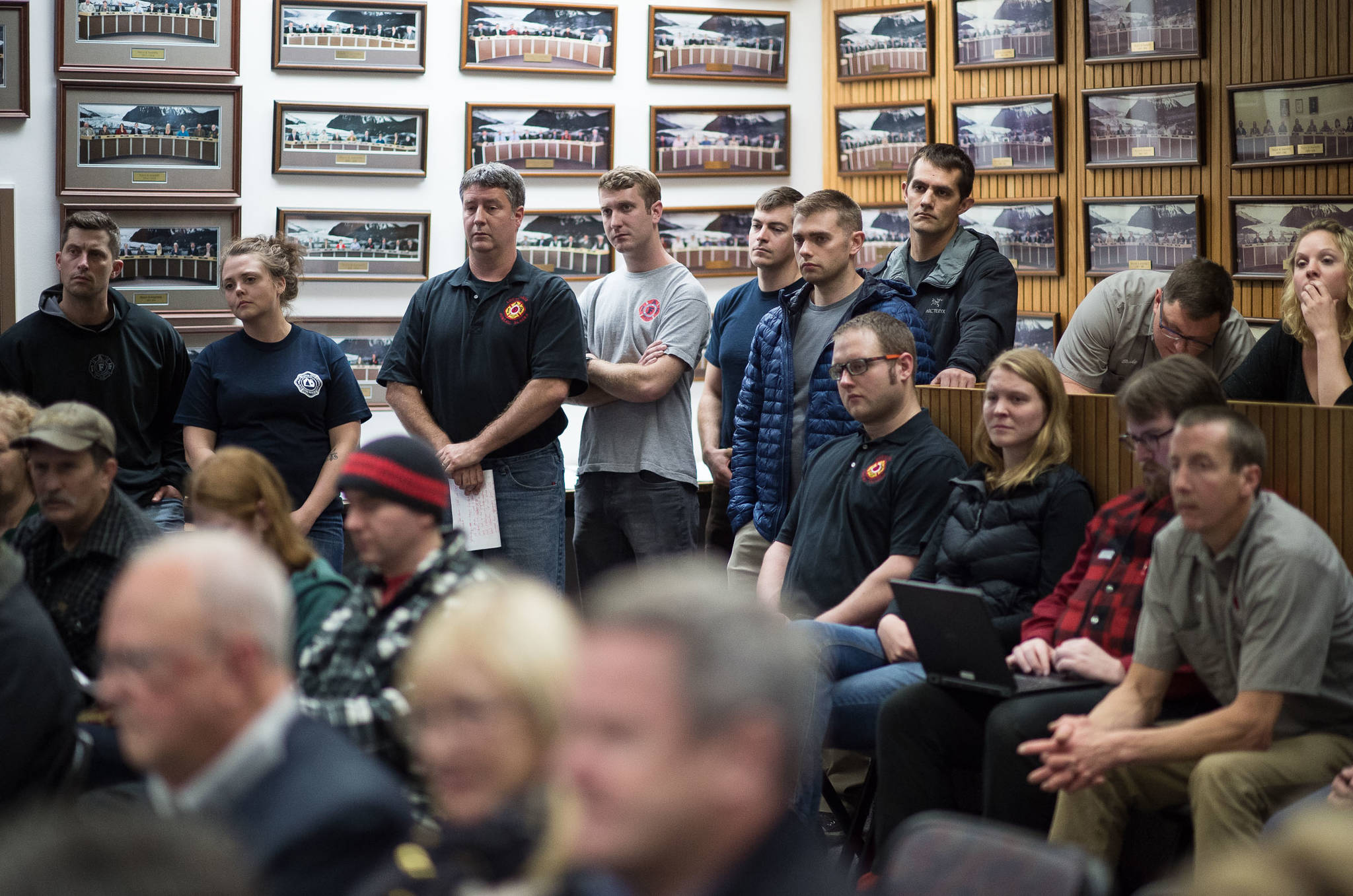
Members of International Association of Fire Fighters Local 4303 attend Monday, Sept. 18, 2017, Assembly meeting to speak to Assembly members about their concern in the number of career firefighters working in Juneau. (Michael Penn | Juneau Empire)
