

Kamaile Levale, 9, said she’s been a bit nervous having a film crew follow her around at school and music performances the past two weeks. But there’s also a thrill of knowing a wider audience may soon experience more than just the music she and her classmates are playing.
“I really liked that they got to reach out to us, and filmed us playing our language and music,” she said after performing in an hour-long “Gratitude” concert Thursday at the Sealaska Heritage Institute Clan House as the wrapup event for the documentary project.
Having two people with video cameras and another with a boom mike weaving amongst the students and audience during the performance is a little strange, “but when we’re playing and I’m surrounded by my friends it’s really fun,” Levale said.
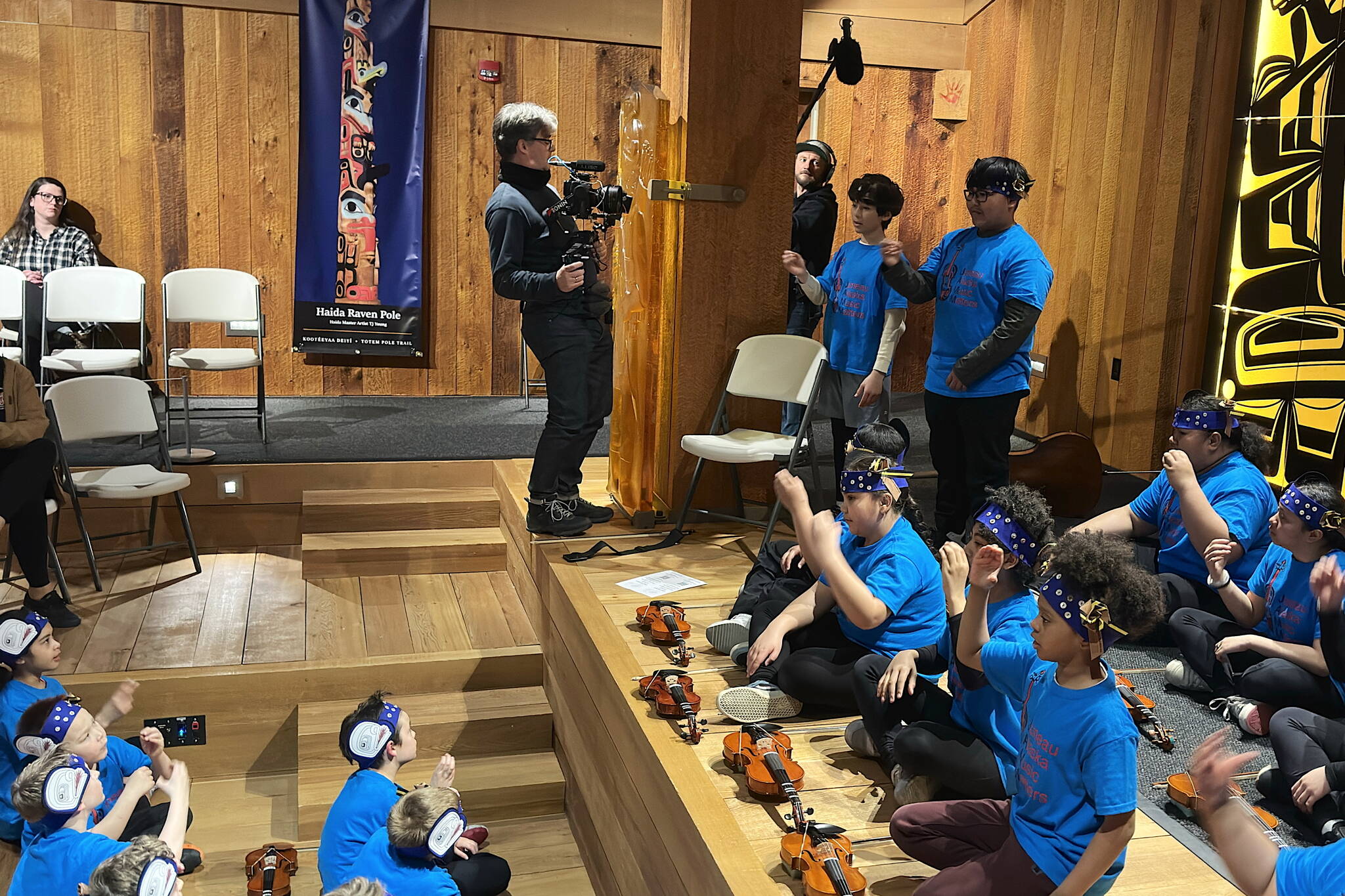
Axel Baumann films and Max Osadchenko captures sounds of Juneau Alaska Music Matters students performing a “Gratitude” concert at the Sealaska Heritage Institute Clan House on Thursday, May 8, 2025. (Mark Sabbatini / Juneau Empire)
The visiting filmmakers are producing a full-length documentary featuring the Juneau Alaska Music Matters (JAMM) program and a similar multilingual student music program in El Paso, Texas. Those are the northernmost and southernmost of the 140 nationwide El Sistema USA music education programs, said Steve Gomer, the movie’s director.
“These kids, to me, are just remarkable,” he said after Thursday’s concert. “They’re learning the language, they’re embracing the culture, they’re kind to each other, they’re helping, they’re collaborating. A kid the other day — a little, tiny 10th-grader — heard the kid next to her wasn’t doing something quite right and without anybody prompting said ‘You know, if you do this it’ll sound a little bit (better).’ They’re just so kind, and that’s what they’re teaching and they’re embodying the culture.”
JAMM and its U.S. counterparts are modeled on Venezuela’s El Sistema, a publicly financed music education program launched in 1975 and now emulated in more than 60 countries. The Juneau program founded in 2010 links its tuition-free music learning to the traditional songs, dance and language of the area’s original Tlingit inhabitants.
Gomer, a television and movie director for nearly 40 years, is credited with the acclaimed 2017 movie “All Saints” and numerous TV series such as “The Unit,” “Veronica Mars” and “The Guardian.” The idea for the music program documentary originated with Lorenzo Candelaria, the film’s producer, based on his familiarity with the El Paso program. He said the differences between that program and the one he’s observed the past two weeks in Juneau are striking.
“I think what makes this distinctive is that it’s on the leading edge, the cultural preservation of the language, and not just in the abstract,” he said after Thursday’s concert. “I mean that’s what we’ve discovered in our time here. It’s not just about learning vocabulary and how to communicate. It really is living the language and living through the language, which we were learning. This is a verb-based language, as opposed to a noun-based language. And so we’re understanding that concept, getting to observe it firsthand.”
The southernmost group is the Tocando Music Project, under the umbrella of the El Paso Symphony Youth Orchestra, which Gomer said shares many similarities with JAMM — aside from the Tlingit language component.
“They’re doing a really wonderful program that’s primarily after school for third and fourth graders,” he said. “They do sort of incorporate Spanish — some kids are bilingual and they make sure that the bilingual kids help the other kids — so everybody’s learning, and everything’s talking about Spanish and English.”
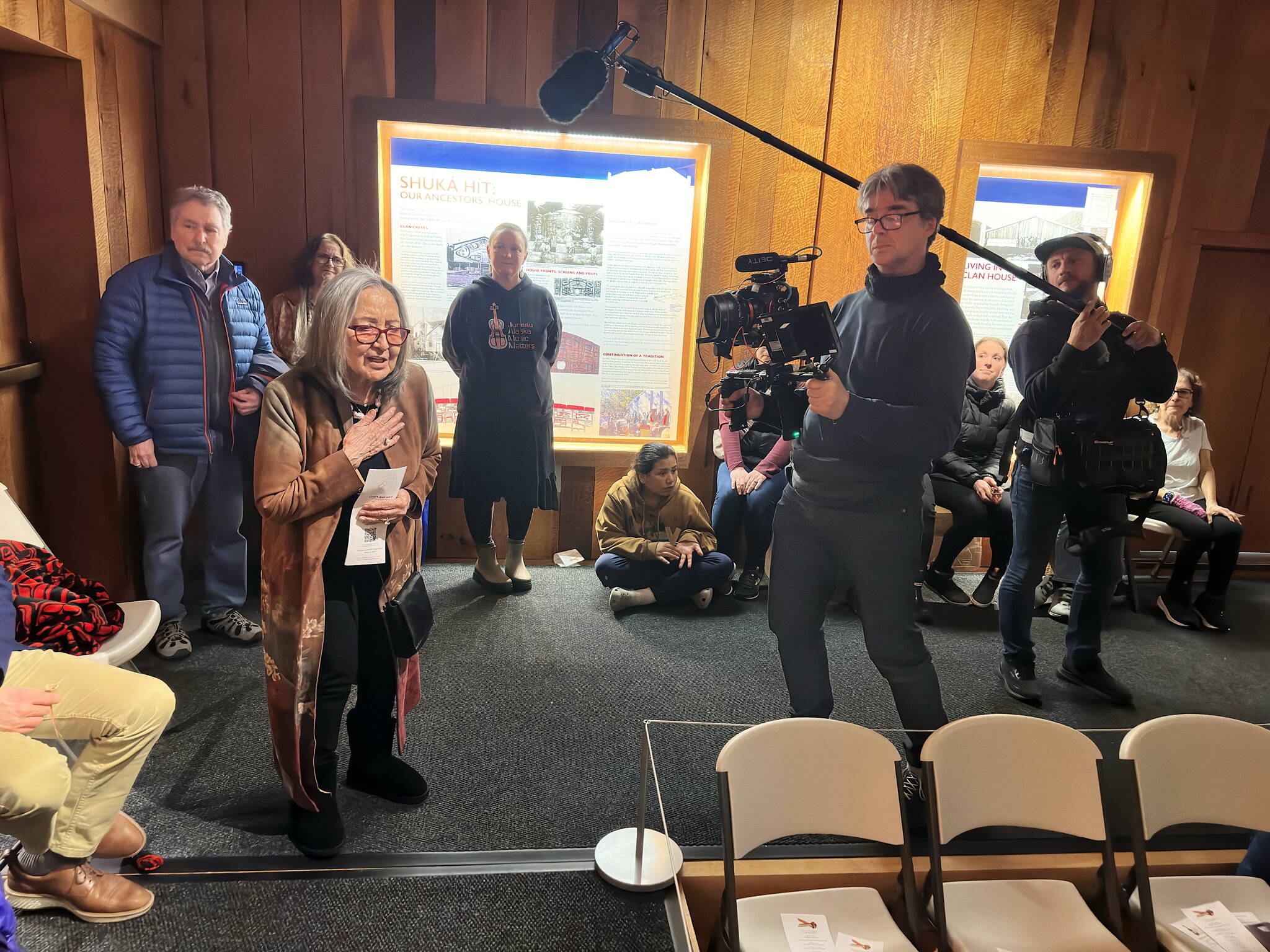
A tribute by Kaaháni Rosita Worl, president of the Sealaska Heritage Institute, to students in the Juneau Alaska Music Matters program is captured by camera operator Axel Baumann and sound engineer Max Osadchenko during a performance by the students at the Sealaska Heritage Institute Clan House on Thursday, May 8, 2025. (Mark Sabbatini / Juneau Empire)
In Juneau about 30 students from Sítʼ Eetí Shaanáx̱ Glacier Valley Elementary School and several JAMM instructors took part in the “Gratitude” concert that featured about a dozen traditional Tlingit songs spanning a wide range of cultural narratives. They included a land acknowledgement far more elaborate than the brief spoken words many Juneau residents are familiar with at public events, in the form of the song “A káx̱ has na.átjin aani áyá, yá haa léelkʼu hás” (“This is the land our ancestors walked upon”), with lyrics written by Aanyaanáx̱ Ray Wilson and music by Yux̱gitsy George Holly.
“During this song you’ll hear some of the things that the friends are grateful for from living on this land,” Holly said before leading the students through the performance for the camera crew and audience. “And they’ll also — well, someone — will be calling out several elders names and a couple places. And we would just like to think of all of our ancestors — I think we are all feeling their support. And we’ve had an amazing couple weeks where these friends have been sharing about their experiences and living out their joy here, so gunalchéesh to the Áak’w Kwáan folks, and here is that song for the land acknowledgement.”
Among those in the audience was Kaaháni Rosita Worl, president of the Sealaska Heritage Institute, whose words were also captured on camera near the end of the performance as she, in response to a tribute by JAMM leaders, spontaneously exclaimed “My beautiful children, our noble children, you have called the spirits of our ancestors.”
“I know from your words and the power of your songs that we have a great future, that our people are going to survive, that our culture is going to survive, that the words of our ancestors will survive,” she said. “No one will be able to take those cultural words, those cultural diversity values away from us. For you are our future, and I thank you for giving us these powerful, powerful gifts that you have given us today.”
Such moments are part of the 50 hours of film Gomer’s crew has captured the past two weeks that he said will be edited down to about 45 minutes to provide half of the content for the documentary. Besides filming students and instructors inside and outside the classroom, the crew captured the performers at outdoor events such as the Juneau Maritime Festival (among the various times when rain was among the filming challenges) as well as scenic depictions of Alaska’s capital city.
“We would come in first thing in the morning and then we had a schedule — which changed every day because we saw other things happening,” he said.
Gomer said the film, which has the working title of “Play It Up,” will likely take a year of editing before completion. However, a synopsis has already been posted at the Internet Movie Database’s website.
“The focus of this film is on the universal power of music to build and bind communities,” the summary notes. “Social mobility through music. Music is a powerful and accessible tool that levels the playing field and breaks generational poverty and inequity.”
Where and when the film will appear on screens — and with what final title — are open questions.
“This is a real festival kind of movie because of who we’re dealing with and what we’re dealing with,” Gomer said. “You know, the stuff going on in both places that people just don’t know about.”
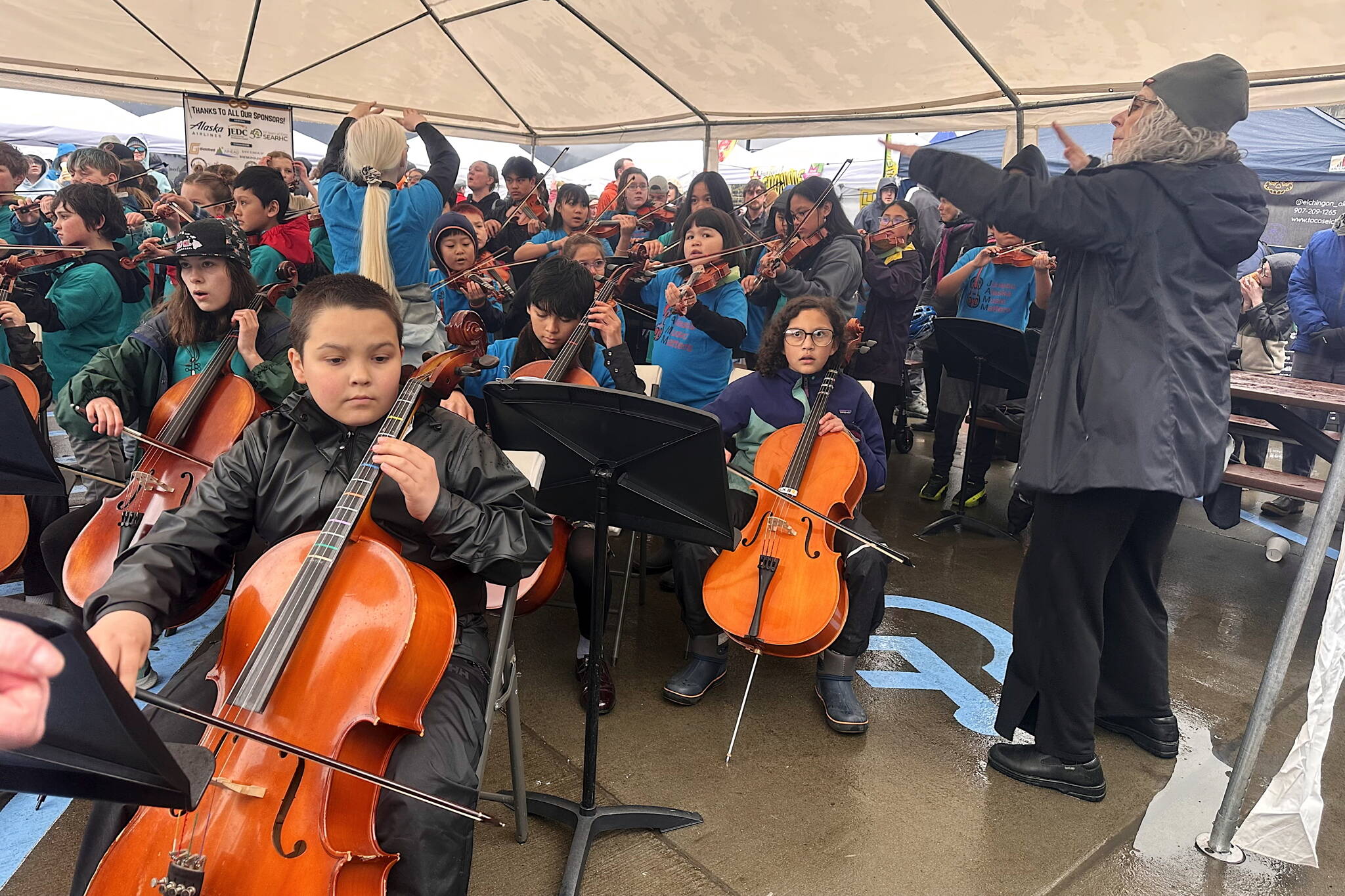
Juneau Alaska Music Matters Students perform at the Juneau Maritime Festival on Saturday, May 3, 2025. The performance was among many captured by a film crew for an upcoming documentary featuring the music program. (Mark Sabbatini / Juneau Empire)
The filmmakers, in addition to capturing the cultural experiences passed among generations during many thousands of years, also are observing how current events are threatening to mute that heritage.
Meghan Johnson, JAMM’s executive director, introduced the song “Yéil Sh Kalnéegi” (“Raven Stories”) by noting JAMM’s teaching artists learned it from a Sitka instructor during a weeklong visit there funded by a National Endowment for the Arts grant.
“We did, unfortunately, find out just yesterday that that grant is no longer around,” she told the audience and cameras. “But we were really blessed to have that inspiration and to continue on with that work.”
Gomer said the loss of funding now occurring to arts and culture programs nationwide will be an element of the film, but while he believes government should support such programs “I don’t think art should ever be dependent on government funding or any one funding source.”
“This is what’s really remarkable, is these are community based,” he said about JAMM, which receiving a major portion of its funds from local tribal and other community organizations.
Seeing how students in two vastly different areas are benefiting from programs with many similarities, while retaining their cultural uniqueness, may also motivate further support for such programs, Candelaria said.
“Ideally the film, at least part of it, will serve to show ‘Look, this could be going on in your community and it’s worth it,’” he said.
• Contact Mark Sabbatini at mark.sabbatini@juneauempire.com or (907) 957-2306.
