
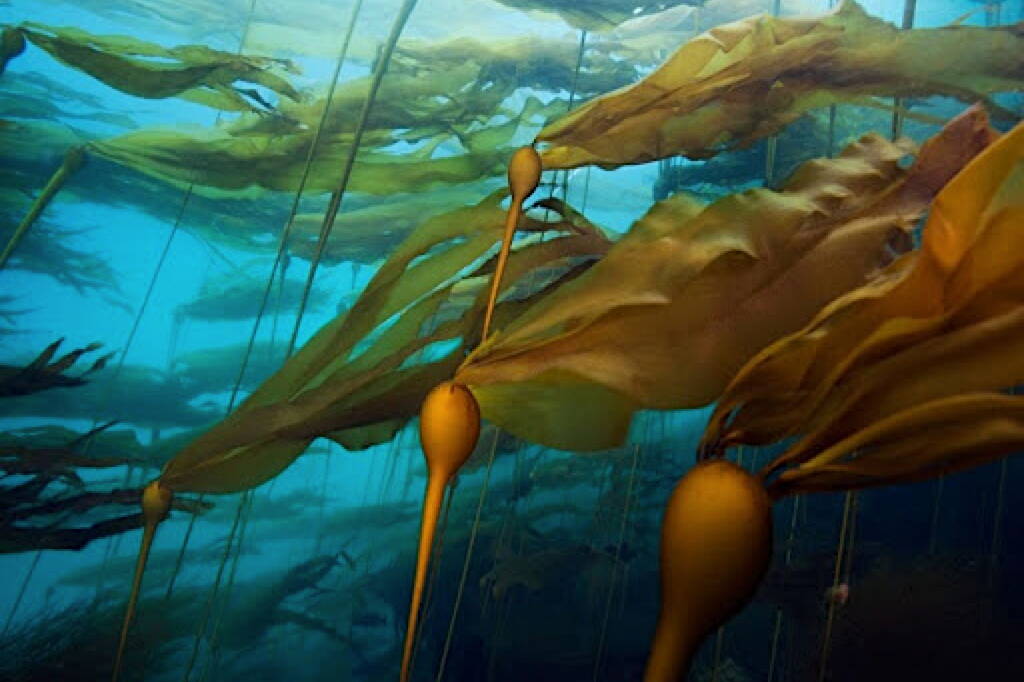
What if prized rare earth elements could be extracted from seaweed, avoiding the need to dig into the ground for the materials used in technology and renewable-energy equipment?
That question will be addressed by a new project to examine whether those elements can be found in seaweed growing in the waters of Southeast Alaska.
The University of Alaska Fairbanks-led project is funded by the U.S. Department of Energy as part of a broader push for domestic rare earth elements.
It is one of three department-funded “algal mining” projects funded by the department. The others are in Washington state and California.
The Southeast Alaska project will launch in March with collection and analysis of various types of seaweed near Prince of Wales Island. The project is trying to determine whether significant amounts of rare earth elements are being absorbed by that seaweed from Bokan Mountain, a site known to contain several of those minerals. Beyond that, the project will examine the possibilities for cultivating enough seaweed to make it worthwhile to extract those absorbed critical elements, said the project’s lead researcher, UAF’s Schery Umanzor.
“This is absolutely a moon shot,” said Umanzor, a Juneau-based assistant professor of marine biology at UAF’s College of Fisheries and Ocean Sciences.
Seaweed is known to absorb metals, including those in the rare earth category. However, “the amount is miniscule.”
So the search will be for something that can absorb to the maximum extent possible, she said. “We will try to find a species or many species that can hyper-accumulate,” she said. The focus is on seaweeds “that we know how to grow already,” like rockweed and certain types of kelp.
The on-the-water sampling will take place in marine waters downstream from Bokan Mountain, requiring about a four- or five-hour boat ride from Ketchikan and an estimated five to nine days of sampling across grids, Umanzor said.
The site is remote but has potential, she said. There is so much rain that natural leaching “happens at a good rate,” she said.
Once seaweed and water samples are collected, research partners will carry out further analysis, she said. Partners include scientists with the University of Alaska Anchorage, who will do geochemistry work, and with the National Renewable Energy Laboratory, who will analyze metal content, she said.
Bokan Mountain, located in the Tongass National Forest, is the site of a rare earth elements exploration project pursued by Nova Scotia-based Ucore Rare Metals Inc.
Bokan Mountain has a decades-long mining history. It was the site of a uranium mine that operated from 1957 to 1971, according to the U.S. Forest Service.
Ucore acquired leases there in 2006 and began exploring for rare earth elements. Its most recent exploration report was from a 2022 sampling program. The site contains numerous rare earth elements, including dysprosium, terbium and yttrium.
Seaweed is not the only potential unconventional source from which rare earth elements might be extracted in a way that avoids potentially destructive mining.
The Department of Energy and other organizations are investigating the possibility of pulling the minerals out of coal waste, including waste from Alaska’s Usibelli and Wishbone Hill coal mines, and from other industrial byproducts like wastewater from petroleum production.
• Yereth Rosen came to Alaska in 1987 to work for the Anchorage Times. She has reported for Reuters, for the Alaska Dispatch News, for Arctic Today and for other organizations. She covers environmental issues, energy, climate change, natural resources, economic and business news, health, science and Arctic concerns. This story originally appeared at alaskabeacon.com. Alaska Beacon, an affiliate of States Newsroom, is an independent, nonpartisan news organization focused on connecting Alaskans to their state government.
