
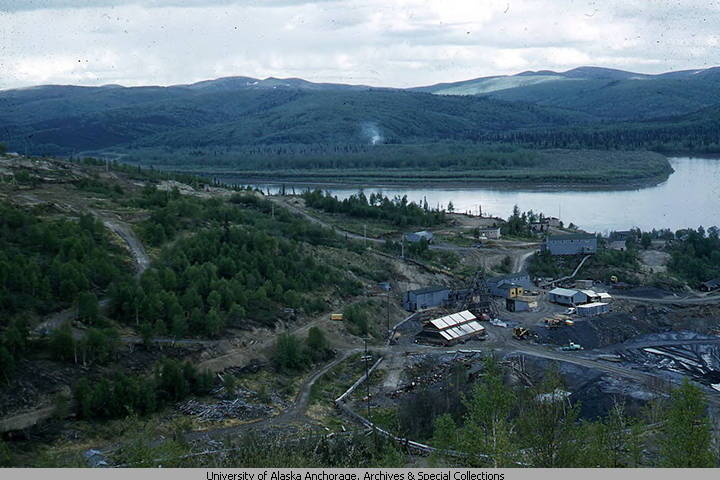
Nearly a century after a Western Alaska mine began producing mercury, cleanup of the site is entering a final but long-term phase.
The U.S. Bureau of Land Management on Wednesday issued a document known as a record of decision approving a long-term remediation plan for the Red Devil Mine, a onetime mercury producer that contaminated the Kuskokwim River region for decades.
The mine, located about 250 miles west of Anchorage and 160 miles northeast of Bethel, produced mercury from 1933 to 1946, and then sporadically between 1952 and 1971. Over the years, mine operators used tailings – the waste rock from mining operations – as fill material, and those tailings contained toxic mercury, arsenic and antimony.
The mine site is on land managed by the BLM, giving that agency the lead authority for cleanup and reclamation under federal law.
“This signed decision on Red Devil Mine marks a major step forward for addressing contamination at this site,” Steve Cohn, the BLM’s Alaska state director, said in a statement. “We look forward to working with Tribes, Alaska Native Corporations, the State, and others to implement this plan to the benefit of the lands and communities.”
Cleanup work at Red Devil started in the 1990s, said Gordon Claggett, a BLM spokesperson. Previous work focused on the mine’s buildings, he said. The newly approved plan addresses what is considered the last source of environmental risk at the site: the high-concentration tailings.
The plan approved by the BLM includes evacuation of contaminated materials from Red Devil Creek and downstream areas of the Kuskokwim River, consolidation and safe storage of evacuated materials, long-term maintenance of that storage facility and long-term monitoring of groundwater and river sediments.
The total cost for capital needs and operations is about $40 million, according to the BLM’s decision. The money is to be provided by the federal government, Claggett said.
It is assumed that the work will last for 30 years, with periodic analysis to look for any possible problems, he said. The BLM will share its long-term monitoring data with the Alaska Department of Environmental Conservation “and will formally review the data every five years, specifically to evaluate the effectiveness of this remediation plan. If the data indicates that further action is needed, we will take action,” he said by email.
The Department of Environmental Conservation has been an important player in the long-term Red Devil cleanup since 1990, said Kelly Rawalt, a department spokesperson.
“DEC has worked with the BLM and has reviewed the investigation and feasibility study, proposed alternatives, and the draft Record of Decision, as well as participated in community outreach efforts,” she said by email. “DEC will review the final Record of Decision and will continue to be involved in the cleanup plan, long term monitoring plans, construction and monitoring of the repository, and periodic reviews through the life of the project.”
Also involved in an indirect way has been the Alaska Division of Public Health, which has an ongoing program allowing Alaskans to monitor their own mercury exposure. Through that program, Alaskans can send hair samples to be analyzed for mercury content. The division operated a special project to evaluate the risks of mercury exposure from consumption of northern pike in certain rural sites, including the Kuskokwim River area that includes the Red Devil Mine. The project, conducted with the U.S. Fish and Wildlife Service, resulted in some advisories for consumption of northern pike in the Yukon-Kuskokwim Delta region and elsewhere. Northern pike are considered to be vulnerable to mercury contamination because they are long-lived and can thus accumulate the metal over several years.
Mercury exposure is dangerous for people and can cause brain and nerve damage, especially among children, among other maladies.
Human use of mercury dates to antiquity, as do signs of mercury poisoning. A recent discovery of human bones as old as 5,000 years at a vineyard in Portugal revealed some high levels of mercury, particularly among those dating back to the early Copper Age. In the early 1800s, at a time when hatmakers commonly used mercury to cure felt, the noticeable effects on their health resulted in the coining of the term “mad as a hatter.”
Potential mercury contamination of Kuskokwim River fish has been a concern over the years of the Red Devil cleanup. A BLM study that examined mercury levels in fish and insects collected from 2010 to 2014 at Red Devil Creek and the Kuskokwim River turned up mixed results.
The Red Devil Mine site is located along what is referred to as Alaska’s “mercury belt,” a string of naturally occurring mercury deposits extending about 500 kilometers (300 miles) along the Kuskokwim River.
