
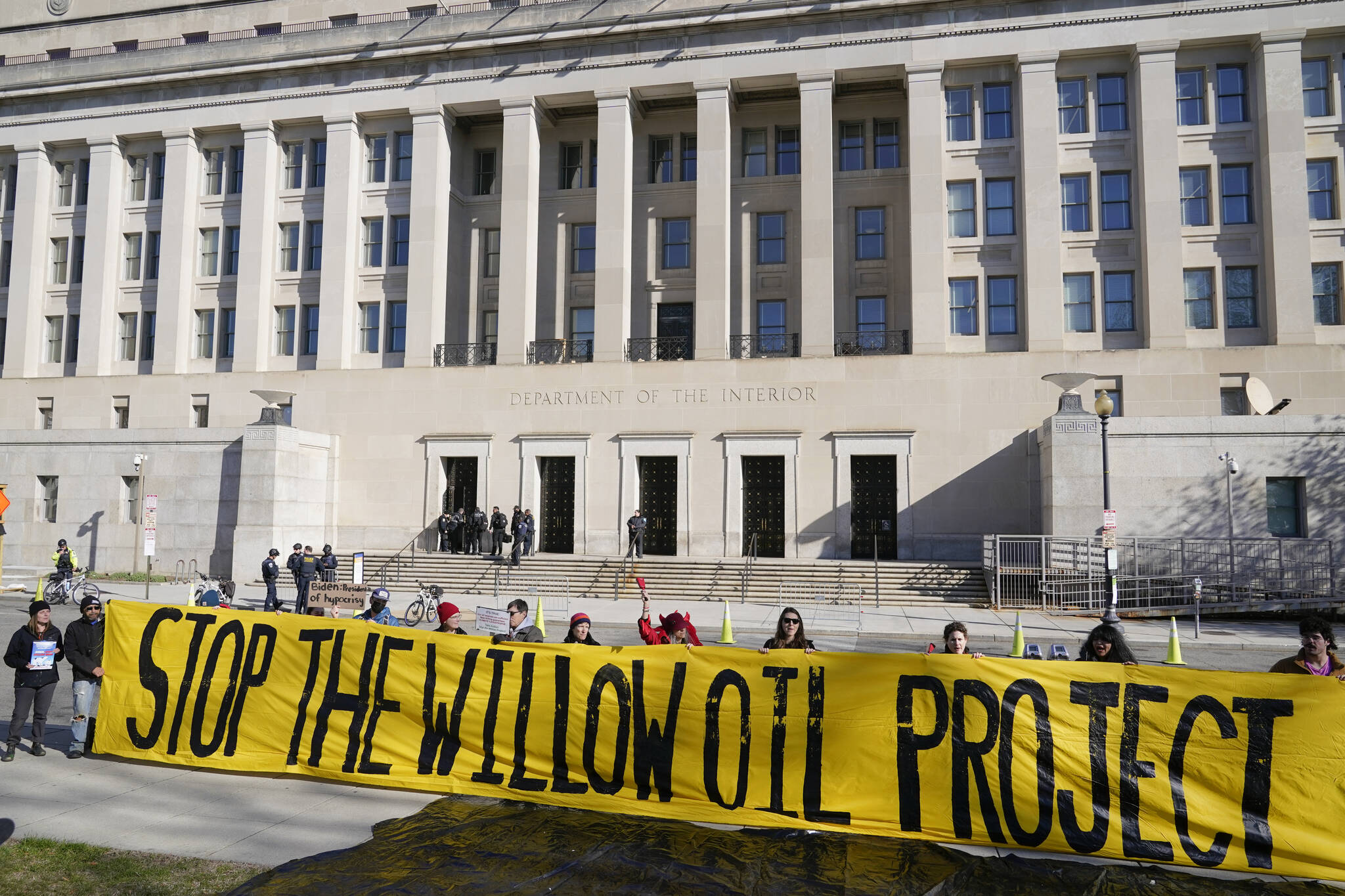
A federal judge on Thursday upheld the Biden administration’s approval of the massive Willow oil-drilling project on Alaska’s remote North Slope, a decision that environmental groups swiftly vowed to fight.
U.S. District Court Judge Sharon Gleason rejected requests by a grassroots Iñupiat group and environmentalists to vacate the project approval, and she dismissed their claims against Willow, which is in the federally designated National Petroleum Reserve-Alaska. The administration’s approval of Willow in March drew the ire of environmentalists who accused the president of backpedaling on his pledge to combat climate change.
The company behind the project, ConocoPhillips Alaska, has the right to develop its leases in the reserve “subject to reasonable restrictions and mitigation measures imposed by the federal government,” Gleason wrote. She added that the alternatives analyzed by the U.S. Bureau of Land Management as part of its review were consistent with the policy objectives for the petroleum reserve and the stated purpose and need of the Willow project.
The groups that sued over the project raised concerns about planet-warming greenhouse gas emissions from Willow and argued that federal agencies failed to consider how increased emissions from the project could affect ice-reliant species such as the polar bear, Arctic ringed seals and bearded seals, which already are experiencing disruptions due to climate change.
Gleason said an agency environmental review “appropriately analyzed the indirect and cumulative” greenhouse gas emissions impacts of the project.
Erik Grafe, an attorney with Earthjustice, which represents several environmental groups in one of the cases, called the ruling disappointing and said an appeal was planned.
Bridget Psarianos, an attorney with Trustees for Alaska, which represents Sovereign Iñupiat for a Living Arctic and environmental groups in the other lawsuit, called Gleason’s decision “bad news not just for our clients but for anyone who cares about the climate and future generations.”
“There is too much at stake to gloss over the harm this project will do,” Psarianos said. “We will remain standfast in working with our clients to protect the Arctic from this devastating project today and in the weeks, months, and years ahead.”
The project has widespread political support in Alaska. But climate activists said allowing it to go forward marked a major breach of President Joe Biden’s campaign promise to stop new oil drilling on federal lands. The administration’s action alienated and outraged some supporters, particularly young activists who launched a TikTok campaign to oppose the project ahead of its approval.
ConocoPhillips Alaska had proposed five drilling sites, but the Bureau of Land Management approved three, which it said would include up to 199 total wells. The project could produce up to 180,000 barrels of oil a day at its peak. Using that oil would produce the equivalent of at least 263 million tons (239 million metric tons) of greenhouse gas emissions over Willow’s projected 30-year life.
The administration has defended its climate record, and Interior Secretary Deb Haaland earlier this year called Willow “a very long and complicated and difficult decision to make,” noting that ConocoPhillips Alaska has long held leases in the region and that regulators tried to balance drilling rights with a project that was narrower in scope.
Interior declined to comment on Gleason’s decision Thursday.
Connor Dunn, vice president of the Willow project for ConocoPhillips Alaska, said in court documents that it was “highly unlikely” that Willow would proceed if the administration’s approval were to be vacated.
Many of the company’s leases in the area date to 1999 and are at risk of expiring by Sept. 1, 2029, if oil hasn’t been produced by then, Dunn said. There is no guarantee the company, which through July had invested about $925 million in Willow, would get an extension on its leases, he said.
In April, Gleason rejected efforts to halt cold-weather construction work by ConocoPhillips Alaska while litigation was pending, including mining gravel and using it for a road toward the project. That work ended in May.
Following Gleason’s decision Thursday, the company said it intends to proceed with plans for construction work this winter.
Erec Isaacson, president of ConocoPhillips Alaska, said Willow “underwent nearly five years of rigorous regulatory review and environmental analysis, including extensive public involvement from the communities closest to the project site. We now want to make this project a reality and help Alaskan communities realize the extensive benefits of responsible energy development.”
The project has been mired in litigation for years.
A prior authorization of Willow, issued in 2020 during the Trump administration, called for allowing ConocoPhillips to establish up to three drill sites, with the potential for two more proposed by the company to be considered later.
But Gleason set that aside in 2021 after finding that the federal review underpinning the decision was flawed and did not include mitigation measures for polar bears. The ruling led to a new environmental analysis and the Biden administration’s greenlight in March for what Justice Department attorneys had said was a scaled-back version that resolved concerns raised by Gleason.
Many Alaska Native leaders on the North Slope and groups with ties to the region have argued that Willow is economically vital for their communities. Republican Gov. Mike Dunleavy, the state’s bipartisan congressional delegation and labor unions have touted Willow as a job creator in a state where major existing oil fields are aging and production is a fraction of what it once was.
“Today’s ruling gives us hope for our collective future on the North Slope and in Alaska,” said Nagruk Harcharek, president of Voice of the Arctic Iñupiat, a group whose members include leaders from across much of the North Slope region. “Going forward, we hope that key decision makers in the Biden administration and in Congress listen to the voices of those who know these lands better than anyone else: the North Slope Iñupiat.”
Some Alaska Native leaders in the community nearest the project, Nuiqsut, have expressed concerns about impacts to their subsistence lifestyles and have said their concerns were ignored.
