
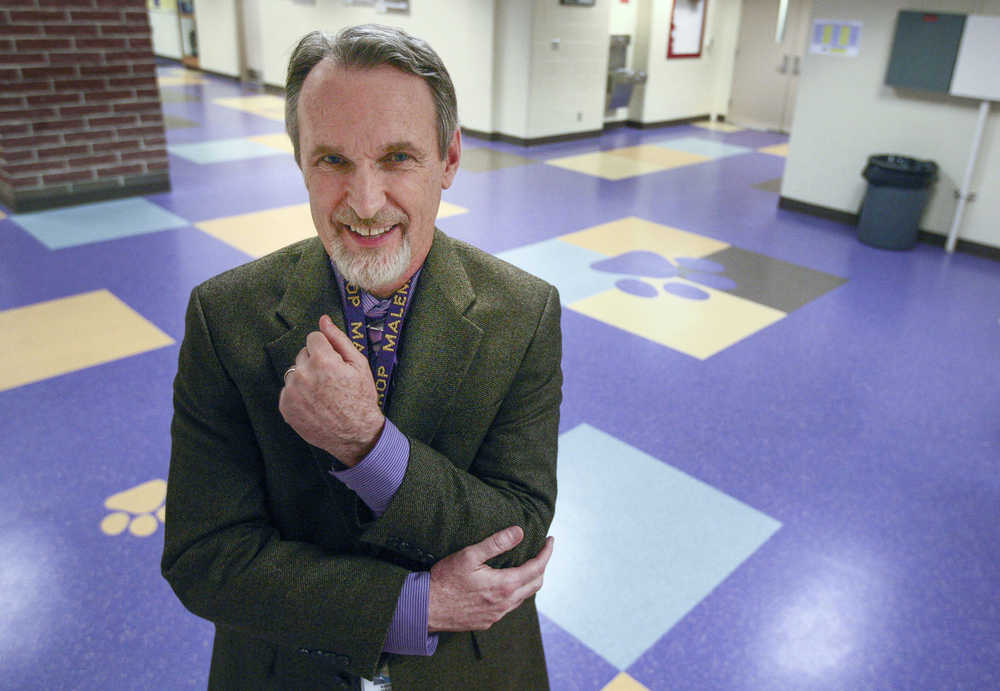
FAIRBANKS — In 2014, Robert Meade moved from the North Slope to Fairbanks to take over as principal at Lathrop High School.
To the students at the high school, Meade was an unknown quantity, but for Meade, returning to Lathrop was a homecoming of sorts. The school served as his launching point into Alaska as well as teaching in public schools.
When Meade joined the Lathrop staff the first time around, most of the students currently attending the high school had not yet been born. It was the late 1990s, and Meade, who had been teaching for 17 years at a Catholic school in Kansas City, was looking to make a change. He had dreams of shifting from classroom teaching to administrating.
He attended a job fair that featured many of Alaska’s rural school districts. At the time, he admits, he knew practically nothing about Alaska. While looking at a map of the state, he asked where all the roads were.
“Of course, they all laughed,” Meade said.
After attending the job fair, Meade got a call and a job offer to be the principal at the school on Little Diomede, an island in the Bering Sea with a population of about 100 that’s often accessible only by helicopter.
He turned down the offer and, with it, his chance of moving to Alaska, he thought. But, a short time later, he received a call from then-principal of Lathrop Jim Holt, who told him they were in desperate need of someone to teach English and Latin.
Meade put his administrative hopes on hold. He accepted the job.
The move to Lathrop was a shift for Meade, not only geographically but also pedagogically. Meade had spent the first 17 years of his career teaching at a Catholic School and, despite growing up without much money, spent almost the entirety of his own education in private school. According to Meade, his parents worked hard to give each of their 11 children the best education they could afford.
So when Meade came to Lathrop in 1996, he quickly discovered the many differences between private and public school. It was then that he experienced firsthand the apathy many students have toward school. Having taught most of his career at a college-prep school families paid money to attend, Meade had never worked in an environment where many of his students would routinely skip class or ignore their work.
He could have given up on his public school students at that moment, but instead he did the opposite and began thinking of all the ways he could engage more of his students.
“How do we change some of those dynamics,” Meade said. “Changing the dynamics of students who walk away, in terms of how do we make it possible for every student to be successful here.”
When Meade was starting his teaching career in the 1980s, a now-famous report, “A Nation at Risk,” that was highly critical of public schools was released by the Reagan administration. That report and the combined opinions of the private school educators Meade had worked with led him to be wary of public school quality for much of his career.
After a few years at Lathrop, immersed in the public environment and seeing the lengths his peers would go through to reach failing and chronically absent students, Meade had become a convert.
From 1999-2001, Meade served as activities director of Lathrop. In 2001, he left the school to become principal of Kodiak High School. He worked there for four years before taking the same position at Nuanmiut School in Anaktuvuk Pass. From there, he took a position directing activities and refereeing at Barrow High School when its football program was starting.
Even though Meade knew next to nothing about Alaska when he moved here 20 years ago, its people and culture have grown into part of his own identity. In a way, his move to Alaska reminds him of his move as a child from a rural Midwest farm to inner city Kansas City.
“This is, I think, where I was really meant to be,” Meade said. “Becoming familiar with a culture and a way of life I didn’t really even know existed.”
The call to return to Fairbanks was strong, though, and eventually Meade felt the desire to come back to where it all began.
“I feel very fortunate to have gotten to see, within the United States, such diversity within our country as opposed to seeing one point of view or one way of life,” Meade said. “I think Lathrop represents the best of folks coming together and wanting to learn and wanting to grow.”
