
Late summer, and the long drought reduced my home pond to little more than a mud puddle. Even so, two broods of mallards visit every day, no doubt drawn by the seed spilled from the feeder that hangs over the erstwhile pond. The young ones are well-feathered and nearly as big as their mothers. The hordes of pine siskins that monopolize the feeder are very messy and lots of seeds fall down where the ducks gobble them up. The two duck families don’t mix at all and typically push each other around.
There weren’t many fish in the pond earlier in the season—just a few juvenile salmon and some sticklebacks. They probably weren’t doing very well in the shallow, warm, and turbid water. I watched a mallard grab a young salmon from the shore and walk off with it before gulping it down. Fish-eating by mallards is not as odd as it might seem: When I worked at the hooligan run in Berners Bay, I often saw ducks eating dead or moribund hooligan.
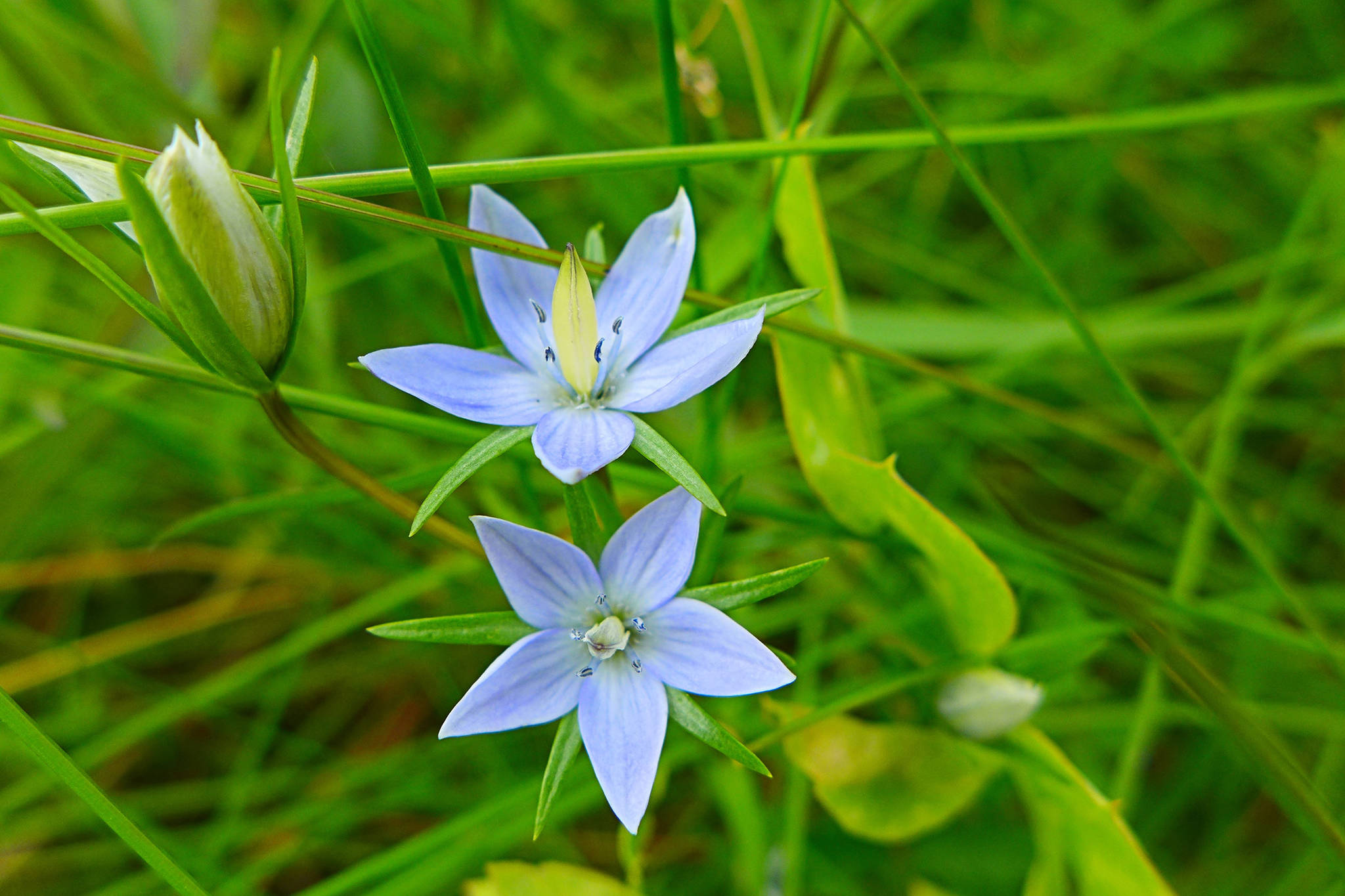
Late summer, and at low elevations the fireweed is finished blooming. Purple asters are now on show in many places. In some of the meadows near Eagle River there have been nice displays of long-blooming grass-of-Parnassus and—a special treat—some lovely stands of felwort with its small, blue, star-shaped flowers, just starting to bloom. Felwort always seems to bloom late in the summer, when most other flowers are done. It’s something I look forward to.
Oh deer
All summer long, I’ve had a pot full of the little pansies called johnny jump-ups near my door. One day in July, I came out that door and said “I’ve been robbed!” The two deer that mutilated the fireweed in the front yard, nibbling the upper leaves down to ragged stumps, had come round and mowed down my little johnnies to a height of about three inches. No flowers left. Well, I nursed those plants back to something like their sprightly selves and they again flowered briskly. But the deer came back and this time they left only one-inch stubs. After some considerable time for recuperation, now the johnnies are trying again, but there are many few flowers this time.
One August day I watched a young buck demolishing more fireweed in front of the house. He slowly wandered along the edge of the drying pond where I have some poorly tended terraces. As I watched, he started chomping on the Canterbury bells. That was just too much. I eased my way slowly toward him and when he finally noticed me — he being much too busy eating! — he went the other way, with determined sedateness and his dignity intact, and so disappeared into the woods. But I reckon the deer are not done with my flowers!
The fish and the flies
Up at Cropley Lake the fish were rising. These are resident Dolly Varden that mature at a small size, much smaller than the sea-run dollies. There are also resident dollies in the creek that flows from the lake, but I’ve been told that the population in the lake is probably quite separate from the one in the creek, with little or no genetic mixing. The lake population is thought to have been there a long time.
In mid-August, on North Douglas, I happened to notice an alder shrub whose leaves had been reduced to skeletons. Some critter had eaten the blades and left just the veins. A closer look found some of the perpetrators—a cluster of fuzzy white caterpillars. These turned out to be woolly alder sawfly larvae. Later, driving out the road, I noticed other alder stands that were nearly leafless.
In consultation with the helpful FSL entomologist, Liz Graham, I learned that there are at least three kinds of sawflies working on alder leaves. The striped alder sawfly is a native species. The woolly alder sawfly and the green alder sawfly are not native here, although the woolly one seems to be naturalized and the green one has been in this area for several years. Heavy sawfly infestations are patchily distributed, nothing like the widespread swaths of browned hemlocks, whose previous-years’ needles are being decimated by the hemlock sawfly this summer.
Sawflies are not true flies; they are related to bees and wasps. They get the first part of their common name from the long, serrated tube through which females deposit their eggs. I’ve read that the three species deposit eggs in somewhat different parts of the leaf: woolly ones on the underside of the leaf and in the midrib, green ones on the upper leaf surface, and striped ones along the leaf petiole. The eggs take one or two weeks to hatch. The green alder sawfly burrows into bark and wood when it is ready to pupate, but the other two species pupate in the soil; the adults emerge the following year. It takes more than one year of defoliation to kill an alder, but defoliation by the insects means that there is less nitrogen from decaying leaves put into the soil. The nitrogen-fixing bacteria that live in alder roots put lots of nitrogen into the plant, and this gets recycled back to the soil when the leaves decay. I wonder about possible ecological consequences of breaking that nitrogen-recycling pattern.
• Mary F. Willson is a retired professor of ecology. Her essays can be found online at www.onthetrailsjuneau.wordpress.com
