
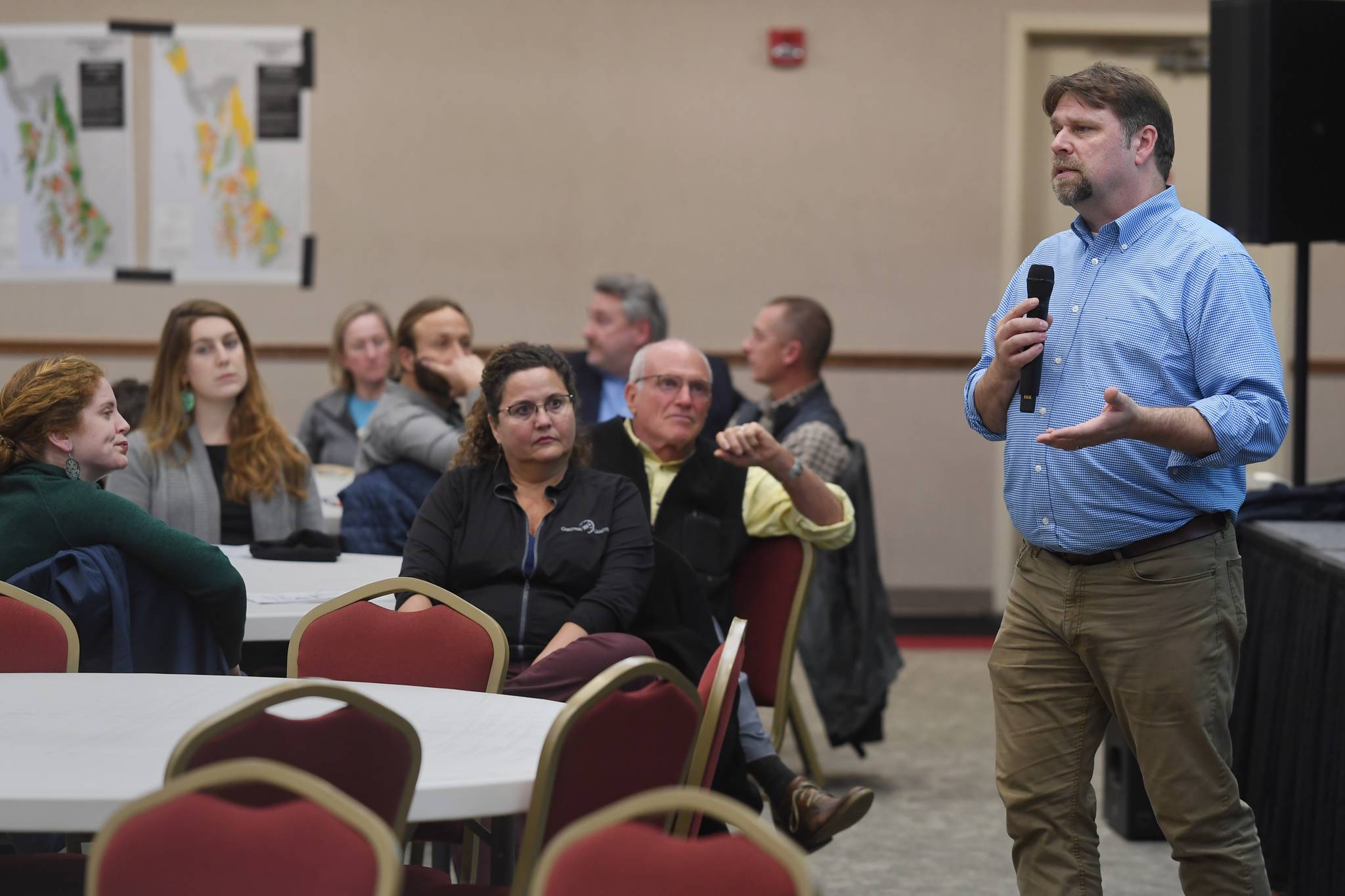
Summary: While much of the question and answer section was more public statement, it was quite clear that a majority of the audience supported the “no action” alternative. The meeting became somewhat heated at times, with members of the audience shouting out of turn and criticizing the Forest Service representatives for not adequately answering their questions. Forest Service staff maintained that public comment was still open and that public opinion would be taken into account.
How much recognition did the Forest Service give to Alaska Native tribes?
This is the first time the Forest Service has invited local tribes to be cooperating agencies, consultation is ongoing, we’re going to continue that dialogue.
Chris French says there are a broader set of things that are addressed in the EIS. The Alternatives to the Roadless Rule were meant to address a range of issues including community connectivity and renewable energy development.
An Alaska Native man stands up to ask a question. “On whose lands will these roads that you’re building be on,” he asks, pointing the microphone in the direction of the panelists gesturing for an answer.
We’re looking at the opinions of cooperating agencies and I respect your opinion.
Can all of this change with a change in the administration in 2020?
Yes. Rule making is an expression of policy from a current administration.
Out of all the public comments you’ve received, how many prefer keeping the Roadless Rule?
I can’t say for sure, it was fairly high, roughly 90 percent.
It was reported President Trump ordered Secretary Perdue to select Alternative 6, are any of those comments going to change anything?
We take our orders from the secretary, and he ordered us to select Alternative 6.
6:30 p.m.
How can you rationalize not recording any verbal public comment, one man asks, saying the Forest Service is shirking their responsibility to listen by accepting only written comments.
If you think you’re not being heard, we’ll work on that. We want to make sure everyone’s voice is heard.
What is the current budget for eradicating invasive species from the Tongass, and what is the plan for mitigating the impacts that new roads will have for invasive species?
I’ll have to get in touch with some of the specialist on the Tongass, Tu says.
6:20 p.m.
This exemption is not a temporary exemption. Each time you mention the 2016 forest plan, will you say ‘for the duration of the 2016 forest plan?’ someone asks. The Roadless Rule will shape future forest plans.
Rules like the Roadless Rule are shaped by various administration, and each of those sets the guides for future forest plans. It takes us 6-8 years to change a forest plan, and it takes a lot of public input.
Lack of clarity has led to a lot of divisiveness, Rober Venables of Southeast Conference says. Venables asks about means of amending various elements in the scoping period based on community feedback.
That’s the kind of thing we want to hear from you, French says.
6:10 p.m.
Meredith Trainor, of the Southeast Alaska Conservation Council, interrupts the question and and asks people in the audiences to stand up if they care about the Tongass. – Most of the audience stands up.
She then asks the crowd to raise their hands if they prefer the “no action” alternative, most of the crowd starts to cheer.
“You’re professionals, we’re locals,” one man yells when the Forest Service representatives say they want to conduct the meeting in a professional manner.
How did the deliberative process take into account the ecological benefits of the natural capital of the forest?
Again, there is no change
Why isn’t climate change on this analysis?
The Roadless Rule doesn’t change the harvest level, it only changes the potential locations that one could harvest timber.
The floor is now open to public questions.
6 p.m.
Chris French says there was “a host of other issues” that brought these alternatives forward. You can just look at the Roadless Rule through the lens of timber.
The Roadless Rule creates certain barriers to economic development, which was one of the driving factors behind seeking to lift the Rule.
5:55 p.m.
The Draft Environmental Impact Statement lays out in a table the six options and various factors and shows levels of impact across the alternatives.
As he’s walking through the effects, he says there would be no change in the amount of timber harvest allowed in the Tongass.
“If there’s no change, then why are we here?” someone shouts from the audience.
“We’ll get to that,” Tu says.
The representative is walking the audience through the various alternatives.
The Forest Service used comments gathered in the 2018 scoping period to develop its six alternatives.
Many local communities, for example, want infrastructure development without turning over the entire region to the timber industry, he says.
5:35 p.m
Ken Tu from the Forest Service is running through a brief history of the Alaska Roadless Rule.
The Roadless Rule was created in 2001 to protect inventoried roadless areas, areas that are “generally undeveloped, without timber harvest, and roughly 5,000 acres,” he says.
In 2018, Gov. Walker petitioned USDA to exempt the Tongass from the Roadless Rule to help diversify the economy of Southeast Alaska.
Once the state petitioned, Secretary of Agriculture Sonny Perdue reviewed and began the process to lift the Roadless Rule.
“Activities on the Tongass would be guided primarily by the 2016 forest plan (for the Tongass),” he says.
These minor changes that are needed would not have to go through the laborious process we go through now, Tu says.
5:30 p.m.
Chris French, Deputy Chief for National Forest Systems at the U.S. Forest Service, takes to the stage. He says this is an attempt to resolve some of the conflict between the state and the federal government when it comes to the Roadless Rule.
“For today’s meeting we really want to step you through what each of those options are,” French said, referring to the six proposed alternatives to the Roadless Rule.
French says the U.S. Department of Agriculture is holding them to a strict timeline, which is something he wants people to keep in mind.
5:15 p.m.
It’s already a packed house at Elizabeth Peratrovich Hall. The Forest Service is proposing lifting the Alaska Roadless Rule on all 9.2 million acres of the Tongass National Forest and converting 185,000 acres of forest into suitable timber lands.
Environmentalists, Alaska Native groups and the tourism industry have already come out in opposition to the proposal but others, certain municipalities and the timber industry support it.
