
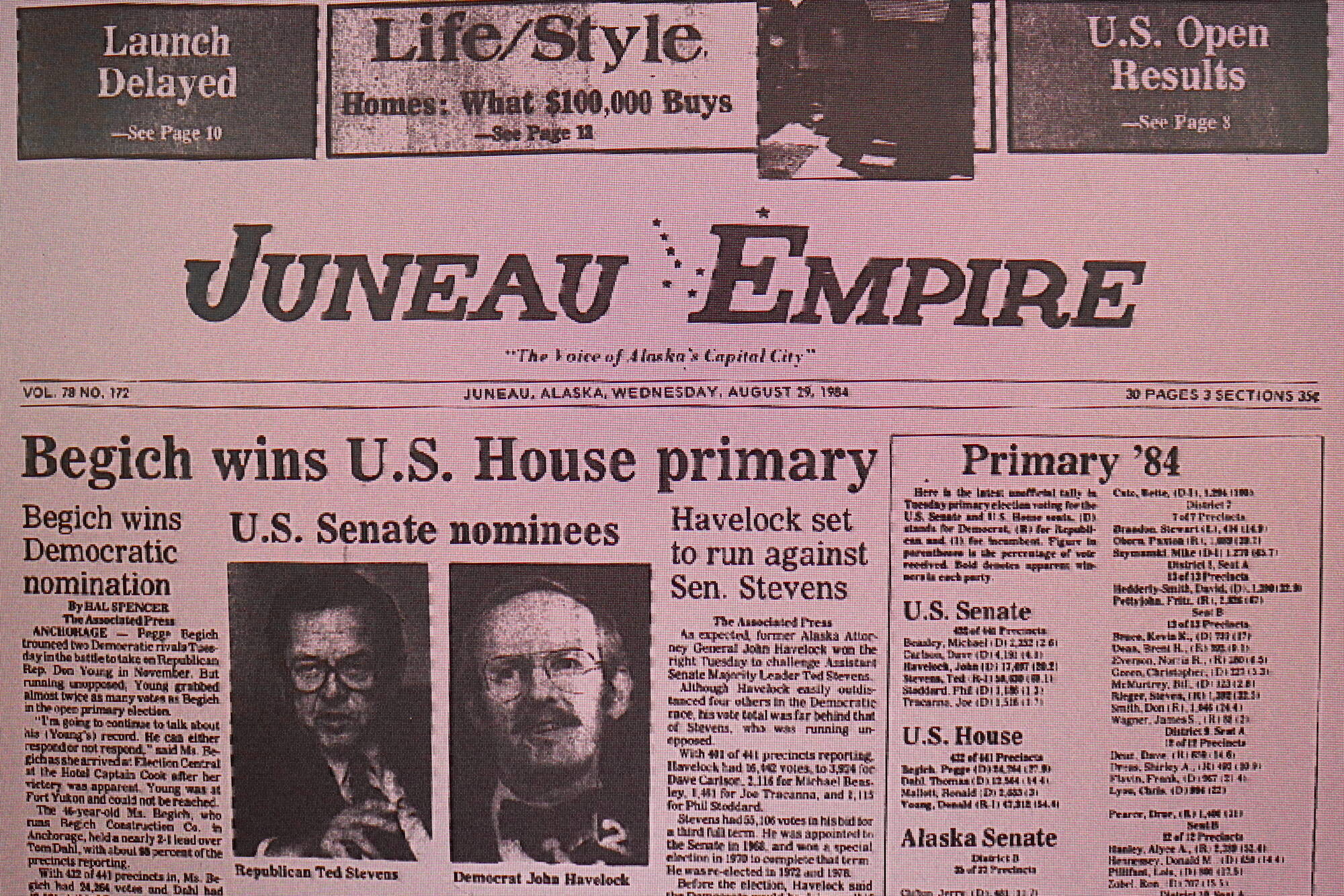
Empire Archives is a series printed every Saturday featuring a short compilation of headline stories in the Juneau Empire from archived editions in 1984, 1994 and 2004.
This week in 1984, Pegge Begich trounced two Democratic rivals Tuesday in the battle to take on Republican Rep. Don Young in November. But running unopposed, Young grabbed almost twice as many votes as Begich in the open primary election. The 46-year-old Begich, who runs Begich Construction Co. in Anchorage, held a nearly 2-1 lead over Tom Dahl with about 98% of precincts reporting. A third Democrat, Ron Mallott, finished a distant third. The Democratic campaign waged by Begich and Dahl was almost polite in tone. They usually saved their best shots for Young, a Fort Yukon riverboat captain and former state lawmaker. Dahl, a gracious loser, congratulated Begich and vowed to help her campaign against Young.
Today a similar situation with a different Begich exists, as Nick Begich III was the top-finishing Republican in the primary for Alaska’s lone U.S. House seat. But he is far behind incumbent Democrat Mary Peltola who received slightly more than 50% of the primary vote, more than her 11 challengers combined. The third-place finisher in the primary was Republican Lt. Gov. Nancy Dahlstrom, who dropped out of the race in an attempt to boost support for Begich in the November election. Alaska’s statewide general elections are now decided by ranked choice voting, which means Dahlstrom could have remained in the race, which some Republicans feared would result in people supporting her and refusing to rank Begich second on their ballots.
Original Story: “Begich wins U.S. House primary,” by Hal Spencer. 8/29/1984.
This week in 1994, there’s no shortage of candidates for municipal elections this year, giving voters their longest list of choices in many years. The mayor’s race has drawn three hopefuls; eight candidates have filed for three city-borough assembly seats; and seven people have filed to run for three positions on the school board. On the final filing day two new candidates joined the mayor’s race, two the race for assembly and one for school board. Running for mayor are Byron Mallott, former president and chief executive officer of Sealaska Inc.; Genji League, a coffee business employee; and Alan Wicks, a youth worker. Mark Farmer, a self-employed investigative photojournalist, withdrew from the mayor’s race on the final day and joined the crowded contest for two assembly seats representing District 1. Farmer said he dropped out because Mallott stand the best chance of leading the fight against the capital move on the statewide ballot.
Today there are two candidates for mayor, six for two Assembly seats and six people seeking three school board seats in the Oct. 1 municipal election.
Original Story: “Eighteen crowd municipal ballot,” by Tim Huber. 8/26/1994.
This week in 2004, 17 of 23 state ferry system employees have retired, quit or transferred to another area of state government rather than move to new ferry headquarters in Ketchikan. Alaska Marine Highway System General Manager John Falvey said it is the first leg of some 40 ferry system jobs that will be transferred to the administrative building at Ward Cove, about four miles north of downtown Ketchikan. He said eight more positions will move at the end of September, and another seven are slated to move at an unspecified date. Eight other employees will stay in Juneau. The state estimated earlier this year that 21 employees would make the move to Ketchikan. The controversial decision to move the ferry system administrators was announced in March by Gov. Frank Murkowski, who said it would create efficiencies in the system and result in substantial savings. Those claims have been hotly contested by local lawmakers and many within the ferry system. On Thursday, ferry system offices in Juneau were cluttered with moving boxes and various office equipment, as workers prepared to head to Ketchikan or on to another job. “I had nothing against going to Ketchikan myself,” said ferry system safety officer Larry Kotila, one of the six who will head to Ketchikan this weekend. “The frustrating part about it was not being confronted.”
Original Story: “Few ferry workers move to Ketchikan,” by Timothy Inklebarger. 8/27/2004.
• Contact Mark Sabbatini at mark.sabbatini@juneauempire.com or (907) 957-2306.
