
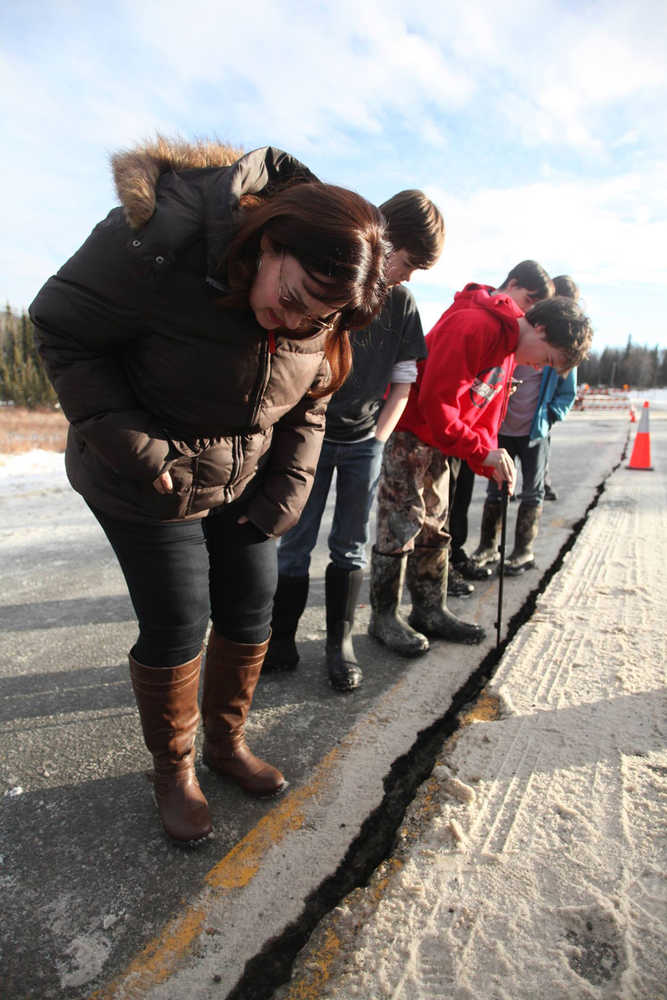
ANCHORAGE — A massive weekend earthquake in Alaska cracked a road, broke natural gas lines and destroyed four homes. But the magnitude-7.1 quake wasn’t the first or even the biggest temblor to rock the state.
Four of five U.S. earthquakes occur in Alaska, a state more than twice the size of Texas. But they often are overlooked because most occur in remote regions.
Here’s a look at why Alaska has so many earthquakes and what’s in store for the state:
What makes Alaska prone to earthquakes?
The Earth’s outermost shell is made up of tectonic plates that move, and Alaska is near the intersection of two great plates: the Pacific Plate, beneath the Pacific Ocean, and the North American Plate, which covers most of North America.
The Pacific Plate is being subducted, or pushed below, the North American Plate at a rate of 2 inches per year. The subduction zone stretches from Prince William Sound to Japan along the Aleutian Trench.
According to prevailing models, friction locks up the two plates, building elastic energy until the strain is too great and there’s an earthquake.
The largest releases come in the form of megathrust earthquakes such as the magnitude-9.2 Great Alaska Earthquake of 1964. They tear hundreds of miles of earth near the surface and can create tsunamis that send killer waves as far as Hawaii and California. Sunday’s quake was not that kind.
What caused Sunday’s quake?
Tectonic plates don’t move neatly below each other. U.S. Geological Survey research geologist Peter Haeussler compares it to bending a Snickers bar and producing cracks on the top.
Tectonic plates stretch, strain and contort as they dive beneath another plate, Alaska state seismologist Michael West said.
Sunday’s earthquake originated 75 miles below ground and 53 miles offshore in a part of the Pacific Plate long ago subducted beneath the North American Plate.
The twisted tectonic plate continues to adjust by earthquakes as it’s pushed toward the Earth’s mantle.
Why wasn’t there more damage?
Sunday’s quake was about one-fifteenth the size of the shallow, magnitude-7.9 Denali Fault quake in 2002 that ruptured the Earth’s surface for 209 miles in interior Alaska.
This one tore tens of miles. It also was deep, and there was no rupture in the seafloor that could cause a tsunami.
The earthquake at 1:30 a.m. Sunday rattled beds in Anchorage, Alaska’s largest city, but it was far enough away not to crack most buildings.
Credit Alaska building codes for requiring commercial structures that roll with the punches caused by shifting tectonic plates. Most Alaskans live in wood-frame houses that flex with quakes but retain their integrity.
What does the future hold?
Alaska’s earthquake susceptibility does not affect California, Utah or other earthquake-prone states, which have their own fault lines.
Alaska will see more large earthquakes, but the USGS says scientists have never predicted one. The agency instead calculates probabilities and focuses on long-term mitigation of earthquake hazards by helping improve structures’ safety.
Alaska sees so many large quakes, West said, the state is often written off as a land of log cabins that can fend off major shakers. Besides the Denali Fault quake 90 miles south of Fairbanks, Alaska in June 2014 saw a magnitude-7.9 earthquake, but it was in the remote Aleutians 1,400 miles southwest of Anchorage.
West fears a magnitude-6 quake directly under a major Alaska city. “It’s all a function of proximity,” he said.
More than homes, an earthquake in the wrong place could damage Alaska infrastructure, such as ports or power transmission, rail or communication lines, which have far less redundancy than other states.
