
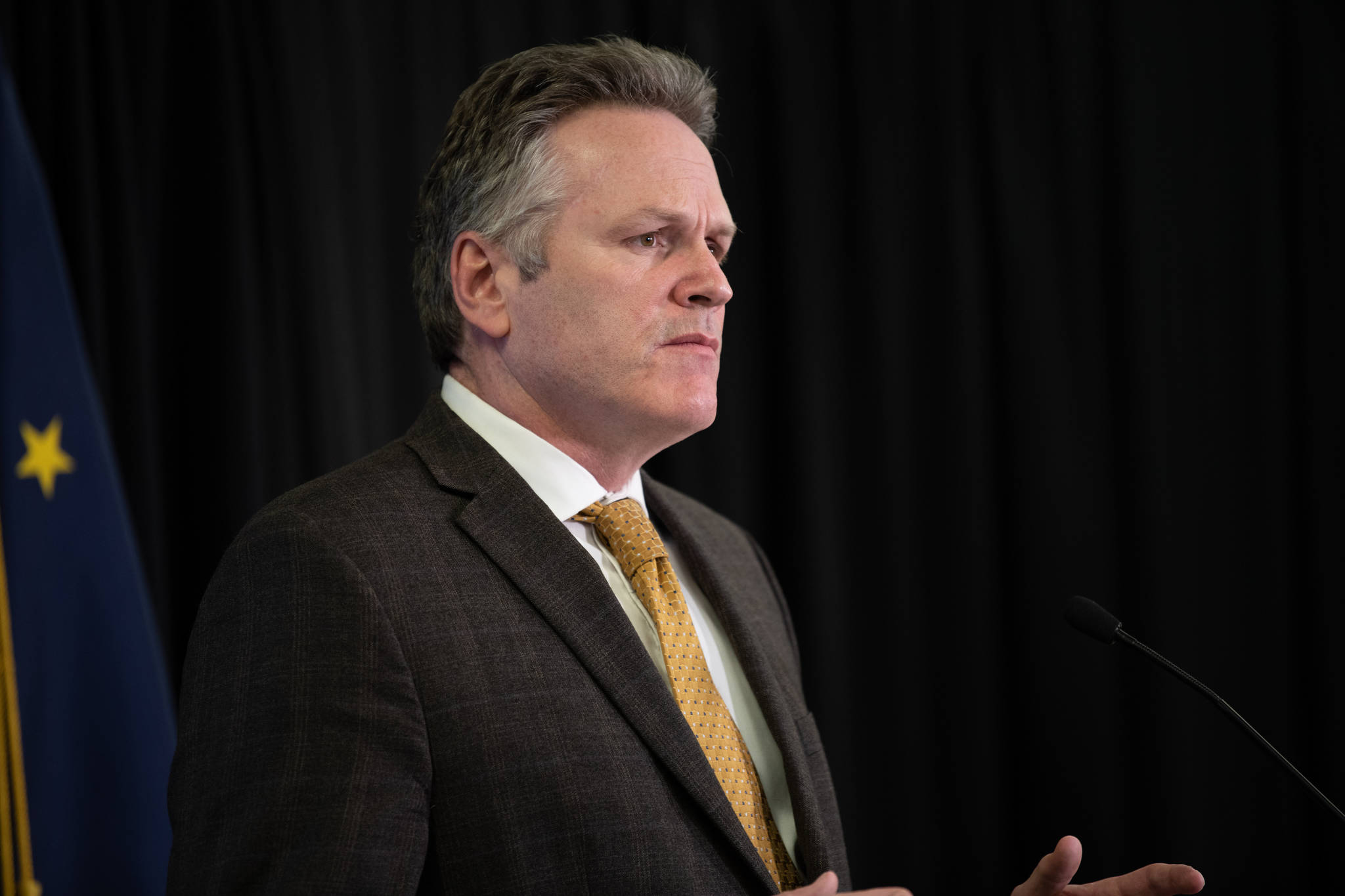
Gov. Mike Dunleavy and members of his administration Friday released a proposed budget for Fiscal Year 2022 meant to reinvigorate Alaska’s economy after being “hammered” by the coronavirus pandemic. The governor proposed a reduced budget, roughly $5,000 in permanent fund dividends and $300 million or more in infrastructure bonds.
“Our economy is in trouble, folks are out of work, businesses are desperate,” Dunleavy said Friday at an Anchorage news conference. “We have to get our economy off its knees and on its feet.”
[Dunleavy: PFD checks are going out early]
Dunleavy said getting money into the hands of Alaska is essential to kick-starting the economy and proposed a supplemental Permanent Fund Dividend of $1,916 for Fiscal Year 2021 and a dividend of $3,056 for the next fiscal year.
The governor’s plan relies on a $3.1 billion transfer from the Earnings Reserve Account of the Permanent Fund for both 2021 and 2022. Between continued growth of the fund and continued low oil prices, the Permanent Fund transfer is now the state’s largest source of revenue, contributing 65% of unrestricted general fund revenue in the past fiscal year and projected to contribute at least 67% for each of the next 10 years, according to a Department of Revenue news release.
Such a large draw from the ERA is not something he expects to become normal for his administration, Dunleavy said, but said the pandemic had created extraordinary circumstances both for the state and globally.
In addition to the budget, Dunleavy said he intends to introduce legislation for $300-350 million in general obligation bonds for yet-to-be-determined infrastructure projects to be put to a vote in a special election. The governor said he also wants to put three constitutional amendments to a vote of the people — a government spending cap, a vote of the people for all new taxes and an established formula for the PFD.
[Dunleavy backs off cuts, looks to Legislature to rework state spending]
The budget proposes $4.3 billion in unrestricted general fund spending, a roughly 5% decrease from last year.
The $294 million in reductions to state departments were all carefully made in consultation with staff and commissioners, said Neil Steininger, director of the Office of Management and Budget.
“We worked with every commission in every department to determine where those efficiencies could be made,” Steininger said.
The governor’s proposals did not decrease spending for many state programs, but also didn’t add any additional requested funds to entities affected by the pandemic which requested them. University of Alaska President Pat Pitney said in a statement she would advocate to the Legislature for additional funding for deferred maintenance in the capital budget.
Dunleavy said he wants to have a conversation with lawmakers and Alaskans about how the state should be managed, and the three constitutional amendments are a way to bring a permanent solution to intractable political issues like the size of the PFD.
“Legislators don’t have to go to the people for taxes, and they don’t have to. But I think they should,” Dunleavy said. “Because we’re governing on the people’s behalf. We shouldn’t take a position that you can do things to people.”
House Speaker Bryce Edgmon, I-Dillingham, in a statement criticized the governor for reductions to public schools and for taking such a large transfer from the Permanent Fund.
“The governor’s proposal calls for spending $3 billion more than what the Alaska Permanent Fund Corporation considers sustainable, and there is no plan for how we will make ends meet beyond next year,” Edgmon said. “However, the inclusion of a general obligation bond package is promising.”
Presented to the public correctly, the governor said he believed the people of Alaska would approve bonding for infrastructure projects. If rejected, that would be the will of the people, Dunleavy said. The governor said he hoped his budget would be a tool to help turn Alaska’s economy around.
“We’re all in this together,” he said. “It’s an extraordinary time, it’s going to take us all working together.”
The proposed budget and additional information can be found at OMB’s website, www.omb.alaska.gov.
• Contact reporter Peter Segall at psegall@juneauempire.com. Follow him on Twitter at @SegallJnuEmpire.
