
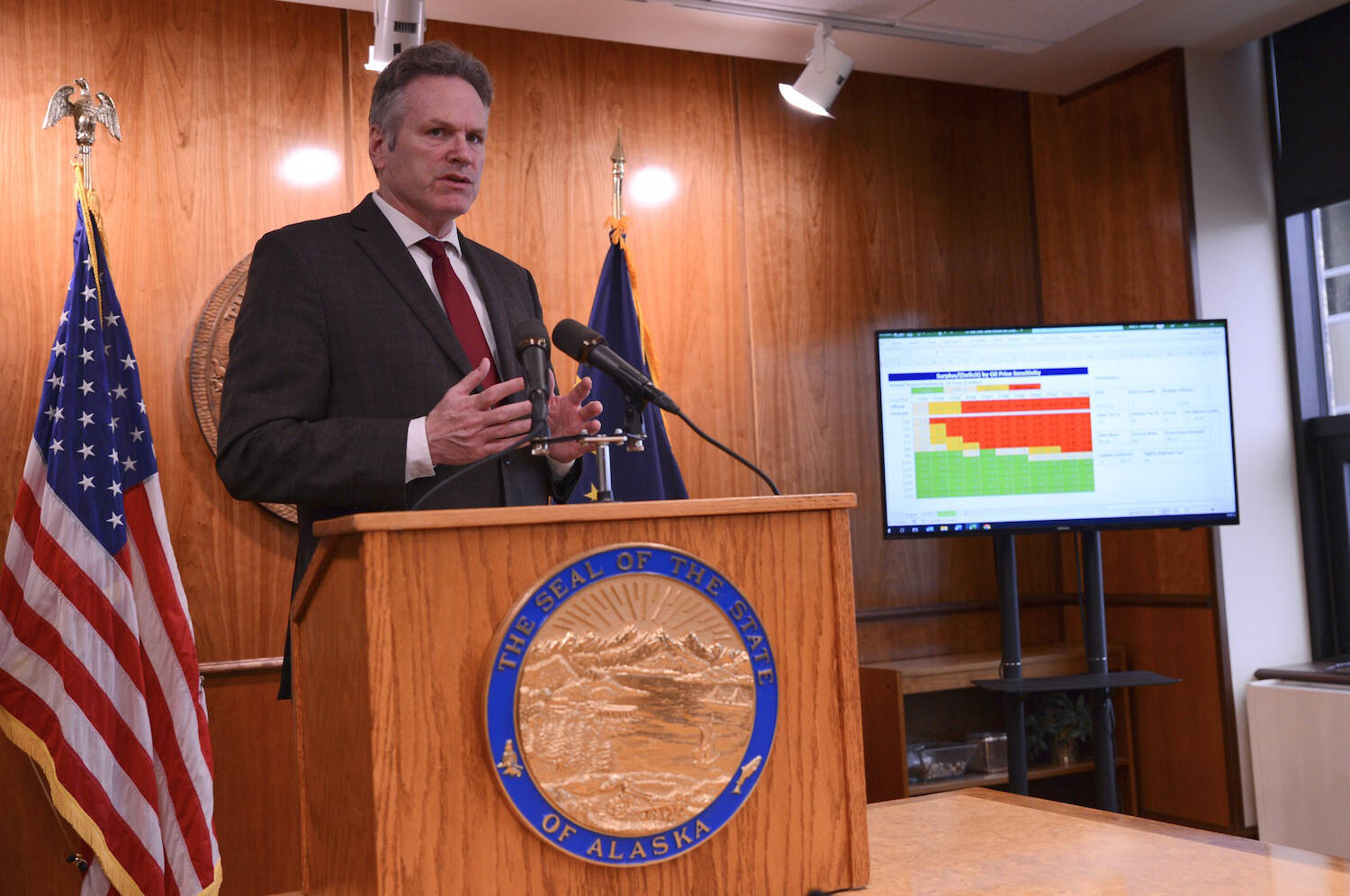
Alaska Gov. Mike Dunleavy is proposing to spend more than $1.8 billion from the state’s principal savings account to balance a first-draft spending plan that would cover Alaska’s response to recent disasters, the state’s annual expenses in the next fiscal year, and a 2026 Permanent Fund dividend worth about $3,800 per recipient.
The governor unveiled his plan Thursday, ahead of the Dec. 15 deadline to submit a first-draft state budget for the fiscal year that begins July 1, 2026.
The governor’s $7.75 billion draft budget is similar to what he proposed last year, but this year’s proposal also includes a substantial supplemental budget intended to compensate for unforeseen costs in the current state budget.
That supplemental budget includes a large amount of transportation spending caught in a dispute with the Alaska State Legislature, and an additional $40 million for the state’s disaster response fund, a figure that could rise if President Donald Trump fails to approve a 100% reimbursement rate for the Typhoon Halong disaster requested by the state.
Thursday’s proposals won’t become final unless approved by the Legislature, and legislators have revised each of Dunleavy’s prior budget proposals before they became law.
Alongside his annual budget proposal, the governor unveiled a draft 10-year plan that appears to call for billions of dollars in tax increases to avoid deficits in future years.
Alaska has no statewide personal income tax or sales tax; more than 60% of general-purpose revenue comes from an annual transfer from the Alaska Permanent Fund, and about 30% generally comes from oil.
The long-term plan published by the governor’s Office of Management and Budget is required by state law, and both Dunleavy and previous governors have used prior plans to demonstrate their ideas.
Dunleavy did not hold a news conference to answer questions about his plan on Thursday, but members of the governor’s administration said he intends to unveil his long-term approach in January, before state legislators open their regular session in Juneau.
“As many of you know,” the governor said in a prerecorded video released Thursday, “oil prices are down … that negatively impacts our budget, and so we will have to fund the budget from savings this year. We all understand that spending from savings and spending the PFD is not a sustainable way to support a budget.”
Dunleavy, who is term-limited and unable to run for governor again, is entering his final year in office. Elected in 2018, he has proposed a variety of ideas each year but has thus far been unable to garner sufficient legislative support for them.
Simultaneously, he has vetoed incremental legislation to address the state’s fiscal problems, most recently with a bill that would have shifted tax revenue from other states to Alaska.
On Thursday, legislators said they were skeptical but hopeful that 2026 might bring a different result to the perennial debates over how to balance the state’s budget in the long term. “It’s probably doubtful,” said Sen. Mike Cronk, R-Tok and a member of the Senate Finance Committee. “But I’m going to stay on the hopeful side, because I know that’s really where we need to be. I’m always going to think that other people will finally say, ‘enough’s enough.’”
In all but one year during his time in office, Dunleavy has proposed a dividend paid under a disregarded but still-on-the-books formula that dates from the 1980s.
In 2017, the Alaska Supreme Court ruled that lawmakers may ignore that formula because it is not in the state Constitution. Since then, legislators have typically reduced the dividend to what is payable without spending from savings.
Entering his last year in office, Dunleavy is proposing to spend $2.4 billion on the dividend. Divided among 624,000 recipients — the number of eligible Alaskans in recent years — that’s roughly $3,800 per person.
Dunleavy proposed a similar dividend last year; legislators ultimately approved a $1,000 PFD that could be paid without spending from savings.
Rep. Andy Josephson, D-Anchorage and co-chair of the House Finance Committee, said that at first glance, the governor’s proposal is “very much a status quo budget” when it comes to state services, albeit with some changes.
The governor plans funding for a separate Alaska Department of Agriculture, though the creation of that department has been challenged in court by the Legislature.
Funding for the Alaska Department of Corrections is up by 3%, while funding for the state’s Medicaid program is down. No money has been earmarked for the state program that pays for major maintenance and renovations at schools, and funding for public school operations is flat.
Dunleavy is proposing to refill the state’s higher education investment fund — used to pay for college scholarships — after it was drained last year during a budget dispute with the Legislature.
At the same time, the Alaska Department of Revenue is forecasting lower oil revenue due to a declining price forecast. The state Department of Natural Resources expects higher production in fiscal year 2027, but it isn’t enough to fully offset the lower prices.
To balance the budget despite the expected decrease in oil revenue, the governor is proposing to spend from the Constitutional Budget Reserve, which is the state’s principal savings account and contained about $3 billion as of Thursday.
Between supplemental spending and the upcoming fiscal year 2027 budget, Dunleavy is proposing to spend over $1.8 billion from the reserve.
Taking money from the reserve requires three-quarters of the House and three-quarters of the Senate to agree.
In previous years, that’s been a difficult task: The House and Senate are each controlled by coalitions that have taken a skeptical and at times critical view of many of the governor’s policies.
Sen. Lyman Hoffman, D-Bethel and co-chair of the Senate Finance Committee, said on Thursday that the Senate Majority’s position is that the reserve should never be used for recurring expenses.
One-time expenses, like refilling the disaster response fund and the higher education investment fund could be acceptable, he said.
House Minority Leader DeLena Johnson, R-Palmer, said it’s too early to say what members of the 19-person, all-Republican House Minority caucus might want in exchange for voting to spend from the budget reserve.
“That’s still unfolding,” she said.
She also cautioned that the governor’s proposal is just a first draft and that it could change significantly before lawmakers convene in January. If oil prices or production fall below what’s forecast, the state might need to spend more from savings.
If additional disasters occur, that might mean another draw from savings.
“We’re just looking at the very beginning, but it’s not going to get better,” she said. “It’s just going to get worse, most likely.”
James Brooks is a longtime Alaska reporter, having previously worked at the Anchorage Daily News, Juneau Empire, Kodiak Mirror and Fairbanks Daily News-Miner. A graduate of Virginia Tech, he is married and has a daughter, owns a house in Juneau and has a small sled dog named Barley.
Alaska Beacon is part of States Newsroom, the nation’s largest state-focused nonprofit news organization.
