
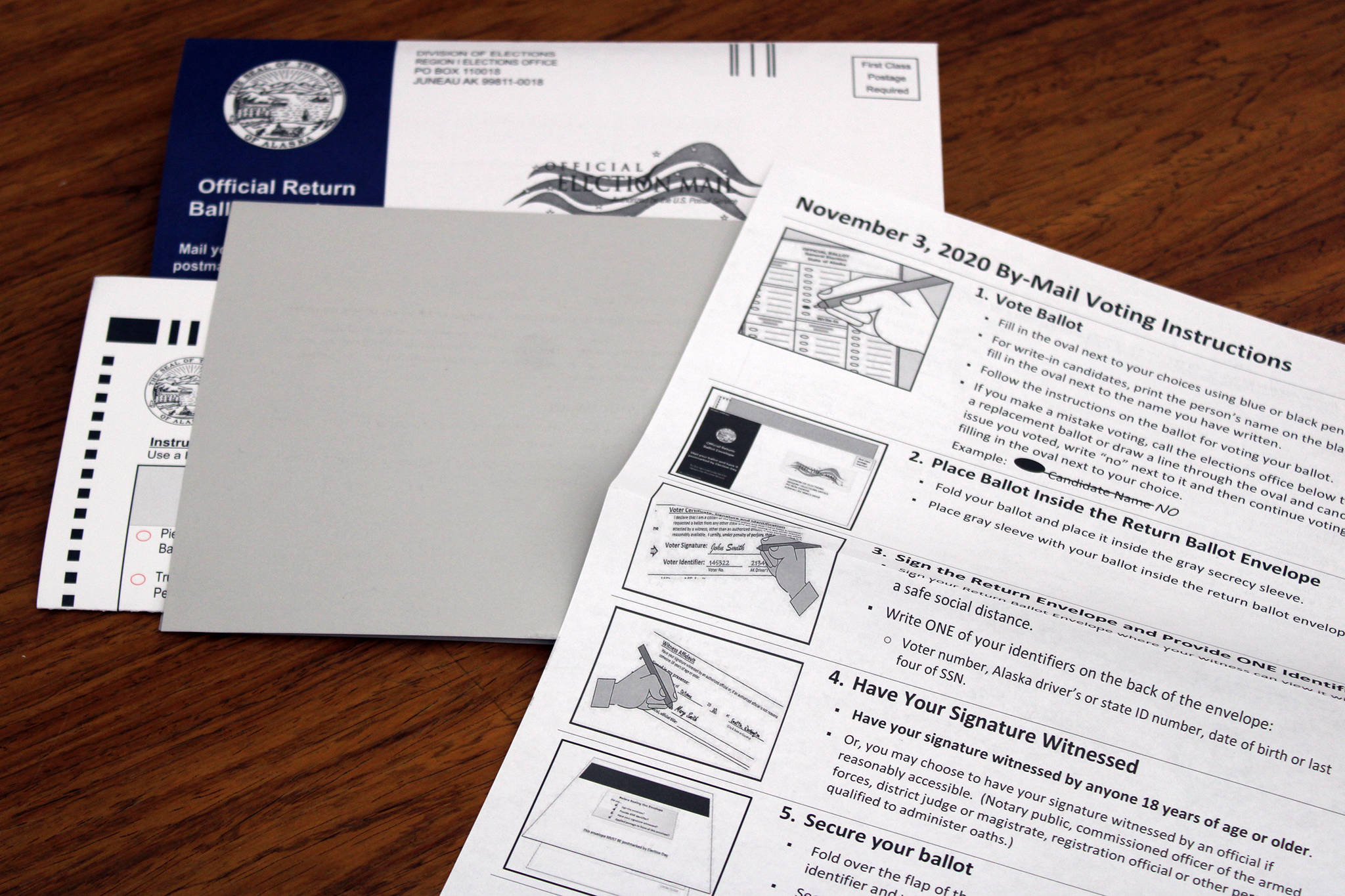
This photo shows an Alaska ballot, return envelope and by-mail voting instructions. Step No. 4, having a signature witnessed, is being debated with opponents saying requiring a witness creates an unnecessary hurdle for voters who do not live with someone 18 or older. (Ben Hohenstatt / Juneau Empire)

This photo shows an Alaska ballot, return envelope and by-mail voting instructions. Step No. 4, having a signature witnessed, is being debated with opponents saying requiring a witness creates an unnecessary hurdle for voters who do not live with someone 18 or older. (Ben Hohenstatt / Juneau Empire)

Court waives signature requirement for absentee ballots

By BECKY BOHRER

Associated Press

The Alaska Supreme Court on Monday affirmed a lower court ruling eliminating witness requirements for absentee ballots for the general election.

The brief decision came shortly after the state Supreme Court heard arguments in the case. A full opinion is expected later.

Last week, Superior Court Judge Dani Crosby ruled enforcement of the witness requirements during the coronavirus pandemic “impermissibly burdens the right to vote.” She waited to put the order into effect, to allow the Supreme Court to weigh in.

The two sides in the matter had agreed to a stay pending Supreme Court review, with the understanding the Division of Elections would make preparations to carry out the order should the state lose the case.

Department of Law spokeswoman Maria Bahr said the department respects the court’s decision.

Laura Fox, an attorney for the state, had asked the Supreme Court to keep in place the witness requirements, arguing that a change in rules, when voting is already underway, “will cause confusion and distrust.”

More than 110,000 absentee ballots have been sent to voters who requested them, with nearly 11,000 already returned, the division says.

During arguments, Fox said the division typically is engaged in voter outreach for months but in this case faces having to “re-educate voters in direct contradiction of the printed materials and past practice in just a few weeks.”

“This is telling the voters, yeah, we know you have all of these printed materials saying that you have to do it one way but … just ignore that,” she said.

Justice Susan Carney responded: “Isn’t that the message, ‘ignore it?’ How hard is that?”

The case was brought by the Arctic Village Council; League of Women Voters of Alaska; and two individuals. Their attorneys have argued the witness requirement is unconstitutional during the pandemic and a bar to voting for those who don’t live with someone who is at least 18 and able to serve as a witness.

Natalie Landreth, an attorney for the plaintiffs, noted the unusual circumstances, with arguments held via video conferencing.

“One year ago, none of us could imagine that I would be in what is frankly my kitchen arguing an Alaska Supreme Court case. And this is how radically the world has changed and how quickly,” she said.

The witness requirement is “creating a burden that doesn’t need to be there,” Landreth said.

More in News

Map showing approximate location of a 7.0-magnitude earthquake on Saturday, Dec. 6, 2025. (Courtesy/Earthquakes Canada)
7.0-magnitude earthquake hits Yukon/Alaska border

Earthquake occurred about 55 miles from Yakutat

A commercial bowpicker is seen headed out of the Cordova harbor for a salmon fishing opener in June 2024 (Photo by Corinne Smith)
Planned fiber-optic cable will add backup for Alaska’s phone and high-speed internet network

The project is expected to bring more reliable connection to some isolated coastal communities.

Gustavus author Kim Heacox talked about the role of storytelling in communicating climate change to a group of about 100 people at <strong>Ḵ</strong>unéix<strong>̱</strong> Hídi Northern Light United Church on Wednesday, Dec. 3, 2025. (Mari Kanagy / Juneau Empire)
Author calls for climate storytelling in Juneau talk

Kim Heacox reflects on what we’ve long known and how we speak of it.

The Juneau road system ends at Cascade Point in Berners Bay, as shown in a May 2006 photo. (Michael Penn / Juneau Empire file)
State starts engineering for power at proposed Cascade Point ferry terminal

DOT says the contract for electrical planning is not a commitment to construct the terminal.

Members of the Alaska Air and Army National Guard, Alaska Naval Militia, and Alaska State Defense Force work together to load plywood onto a CH-47 Chinook helicopter, in Bethel, Alaska, Nov. 2, 2025, bound for the villages of Napaskiak, Tuntutuliak, and Napakiak. The materials will help residents rebuild homes and restore community spaces damaged by past storms. (U.S. Army National Guard photo by Spc. Ericka Gillespie)
Gov. Dunleavy approves Alaska National Guard assisting ICE in Anchorage

The National Guard said five service members will assist with administrative support; lawmakers and civil rights advocates worry that the move signals a ramping up of immigration enforcement operations in Alaska

A cruise ship, with several orange lifeboats visible, is docked in downtown Juneau. (Laurie Craig / Juneau Empire file photo)
CBJ seeks input on uses for marine passenger fees

Public comment period is open for the month of December.

Browsers crowd into Annie Kaill’s gallery and gift shop during the 2024 Gallery Walk. (Juneau Empire file photo)
Gallery Walk guide for Friday, Dec. 5

The Juneau Arts & Humanities Council announced community events taking place during… Continue reading

The Alaska State Capitol is seen on Tuesday, Nov. 25, 2025. (Photo by James Brooks/Alaska Beacon)
Alaska Senate Republicans confirm Rauscher, Tilton and open two vacancies in state House

The Alaska Republican Party is moving quickly after Republicans in the Alaska… Continue reading

Downtown Skagway, with snow dusting its streets, is seen in this undated photo. (Photo by C. Anderson/National Park Service)
Skagway’s lone paramedic is suing the city, alleging retaliation by fire department officials

This article was reported and published in collaboration between the Chilkat Valley… Continue reading

Most Read