
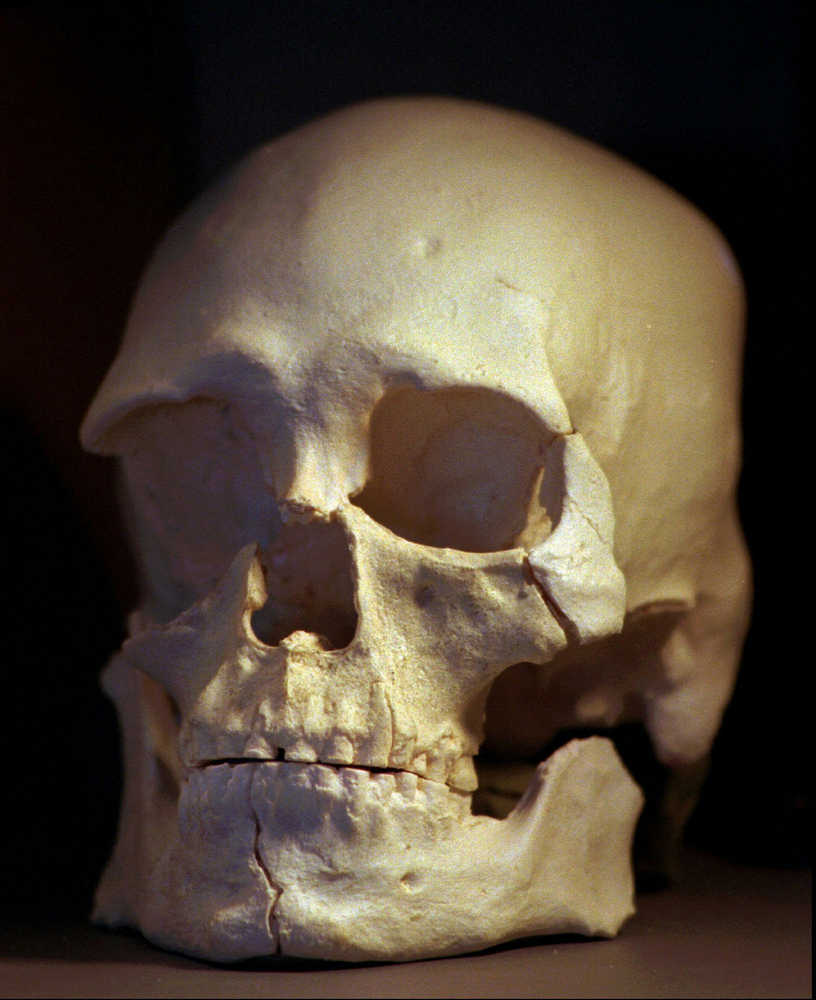
FILE - This July 24,1997 file photo a plastic casting of the skull from the bones known as Kennewick Man, is shown in in Richland, Wash. A bill has been introduced in the U.S. Senate to require the federal government to give the bones of the Kennewick Man back to the Indian tribes from which he descended. The bipartisan bill was introduced Tuesday, April 26, 2016 by Sen. Barbara Boxer and Sen. James Inhofe. (AP Photo/Elaine Thompson,File)

FILE - This July 24,1997 file photo a plastic casting of the skull from the bones known as Kennewick Man, is shown in in Richland, Wash. A bill has been introduced in the U.S. Senate to require the federal government to give the bones of the Kennewick Man back to the Indian tribes from which he descended. The bipartisan bill was introduced Tuesday, April 26, 2016 by Sen. Barbara Boxer and Sen. James Inhofe. (AP Photo/Elaine Thompson,File)

Corps determines Kennewick Man is Native American

SPOKANE, Wash. — The ancient skeleton known as Kennewick Man is related to modern Native American tribes, the U.S. Army Corps of Engineers said Wednesday, opening the process for returning to tribes for burial one of the oldest and most complete set of bones ever found in North America.

The Northwestern Division of the corps said its decision was based on a review of new information, particularly recently published DNA and skeletal analyses.

The corps, which has custody of the remains, said the skeleton is now covered by the Native American Graves Protection and Repatriation Act.

The 8,500-year-old remains were discovered in 1996 in southeastern Washington near the Columbia River in Kennewick, triggering a lengthy legal fight between tribes and scientists over whether the bones should be buried immediately or studied.

The bones will remain at the Burke Museum in Seattle until the corps determines which tribe or tribes will receive them.

The next step is for interested tribes to submit a claim to acquire the skeleton for burial, said Michael Coffey, a spokeswoman for the corps in Portland, Oregon.

Determining which tribe receives the bones is likely to be a lengthy process, Coffey said. In the past, the Colville, Yakama, Umatilla, Nez Perce and Wanapum Indians have claimed a connection to them.

“We still have a lot of work to do,” Coffey said.

However, a spokesman for the Confederated Tribes of the Umatilla Indian Reservation in Oregon said the tribes plan to cooperate to hasten the burial.

“We will send in our joint request for disposition for the reburial of the Ancient One,” Sams said.

Last year, new genetic evidence determined the remains were closer to modern Native Americans than any other population in the world. Following that, the corps began to re-examine Kennewick Man’s status.

“I am confident that our review and analysis of new skeletal, statistical, and genetic evidence have convincingly led to a Native American Determination,” said Brig. Gen. Scott A. Spellmon, commander of the corps’ Northwestern Division.

Sams said the corps’ finding was correct.

“After 20 years, it acknowledges what we already knew and have been saying since the beginning,” Sams said.

Most scientists trace modern native groups to Siberian ancestors who arrived by way of a land bridge that used to extend to Alaska. But features of Kennewick Man’s skull led some scientists to suggest the man’s ancestors came from elsewhere.

Researchers turned to DNA analysis to try to clarify the skeleton’s ancestry. They recovered DNA from a fragment of hand bone, mapped its genetic code and compared that to modern DNA from native peoples of the Americas and populations around the world.

The results showed a greater similarity to DNA from the Americas than from anywhere else.

More in News

The northern lights are seen from the North Douglas launch ramp late Monday, Jan. 19. A magnetic storm caused unusually bright northern lights Monday evening and into Tuesday morning. (Chloe Anderson/Juneau Empire)
Rare geomagnetic storm causes powerful aurora display in Juneau

The northern lights were on full display Monday evening.

teaser
Juneau activists ask Murkowski to take action against ICE

A small group of protesters attended a rally and discussion on Wednesday.

A female brown bear and her cub are pictured near Pack Creek on Admiralty Island on July 19, 2024. (Chloe Anderson for the Juneau Empire)
Pack Creek permits for bear viewing area available now

Visitors are welcome from April 1 to Sept. 30.

Cars pass down Egan Drive near the Fred Meyer intersection Thursday morning. (Clarise Larson / Juneau Empire file photo)
Safety changes planned for Fred Meyer intersection

DOTPF meeting set for Feb. 18 changes to Egan Drive and Yandukin intersection.

Herbert River and Herbert Glacier are pictured on Nov. 16, 2025. (Mari Kanagy / Juneau Empire)
Forest Service drops Herbert Glacier cabin plans, proposes trail reroute and scenic overlook instead

The Tongass National Forest has proposed shelving long-discussed plans to build a… Continue reading

A tsunami is not expected after a 4.4-magnitude earthquake northwest of Anchorage Wednesday, Feb. 4, 2026. (U.S. Geological Survey)
No tsunami expected after 4.4-magnitude earthquake in Alaska

U.S. Geological Survey says 179 people reported feeling the earthquake.

ORCA Adaptive Snowsports Program staff member Izzy Barnwell shows a man how to use the bi-ski. (SAIL courtesy photo)
Adaptive snow sports demo slides to Eaglecrest

Southeast Alaska Independent Living will be hosting Learn to Adapt Day on Feb. 21.

Cars drive aboard the Alaska Marine Highway System ferry Hubbard on June 25, 2023, in Haines. (Photo by James Brooks)
Alaska’s ferry system could run out of funding this summer due to ‘federal chaos problem’

A shift in state funding could help, but a big gap likely remains unless a key federal grant is issued.

Photo by James Brooks/Alaska Beacon
U.S. Sen. Dan Sullivan stands with acting Coast Guard Commandant Adm. Kevin Lunday during the after the commissioning ceremony for the Coast Guard icebreaker Storis on Sunday, Aug. 10, 2025, in Juneau, Alaska.
Coast Guard’s new Juneau base may not be complete until 2029, commandant says

Top Coast Guard officer says he is considering whether to base four new icebreakers in Alaska.

Most Read