
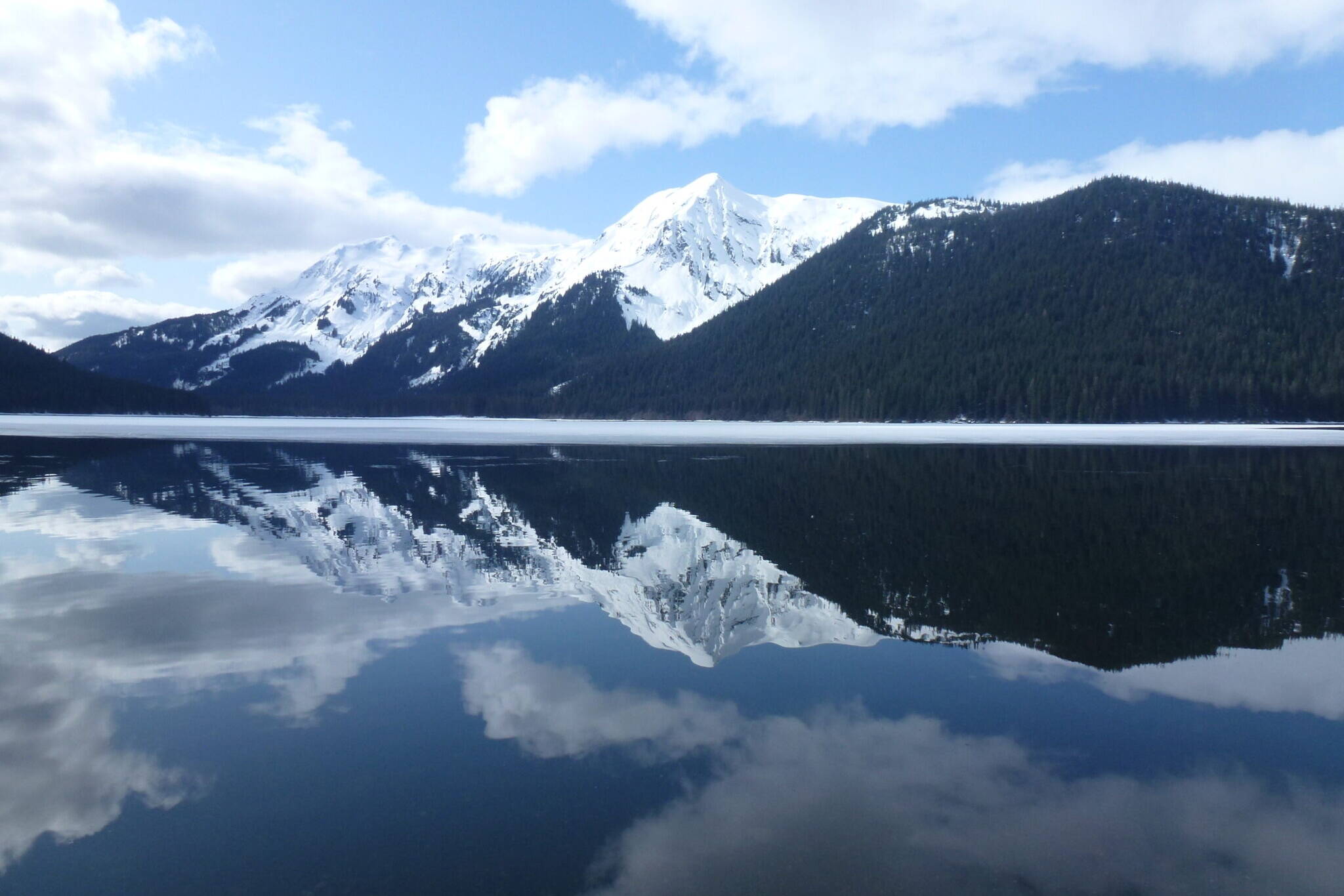
The sky and mountains are reflected in the water on April 5, 2012, at the Kootznoowoo Wilderness in the Tongass National Forest’s Admiralty Island National Monument. Conservation organizations bought some private land and transferred it to the U.S. Forest Service, resulting in an incremental expansion of the Kootznoowoo Wilderness and protection of habitat important to salmon and wildlife. (Photo by Don MacDougall/U.S. Forest Service)

The sky and mountains are reflected in the water on April 5, 2012, at the Kootznoowoo Wilderness in the Tongass National Forest’s Admiralty Island National Monument. Conservation organizations bought some private land and transferred it to the U.S. Forest Service, resulting in an incremental expansion of the Kootznoowoo Wilderness and protection of habitat important to salmon and wildlife. (Photo by Don MacDougall/U.S. Forest Service)

Conservation groups’ purchase preserves additional land in Alaska’s Tongass National Forest

A designated wilderness area in Southeast Alaska’s Tongass National Forest, the largest U.S. national forest, is now a little bit bigger, thanks to a land purchase and transfer arranged by two conservation organizations. ‘

Five acres of land that was formerly privately owned has been added to the forest’s Kootznoowoo Wilderness area on Admiralty Island, one of the organizations, The Wilderness Land Trust, said in a news release issued on Thursday.

The project, a partnership with the Juneau-based Southeast Alaska Land Trust, is the latest in a series of land purchases or conservation transactions aimed at preserving sections of the Southeast Alaska rainforest.

The 5-acre parcel, at a site called Wheeler Creek, was purchased in 2022, The Wilderness Land Trust said in its announcement. The organizations worked since then to transfer it to U.S. Forest Service ownership.

The Wheeler Creek site is valuable for multiple reasons, said Margosia Jadkowski, director of marketing and communications for The Wilderness Land Trust.
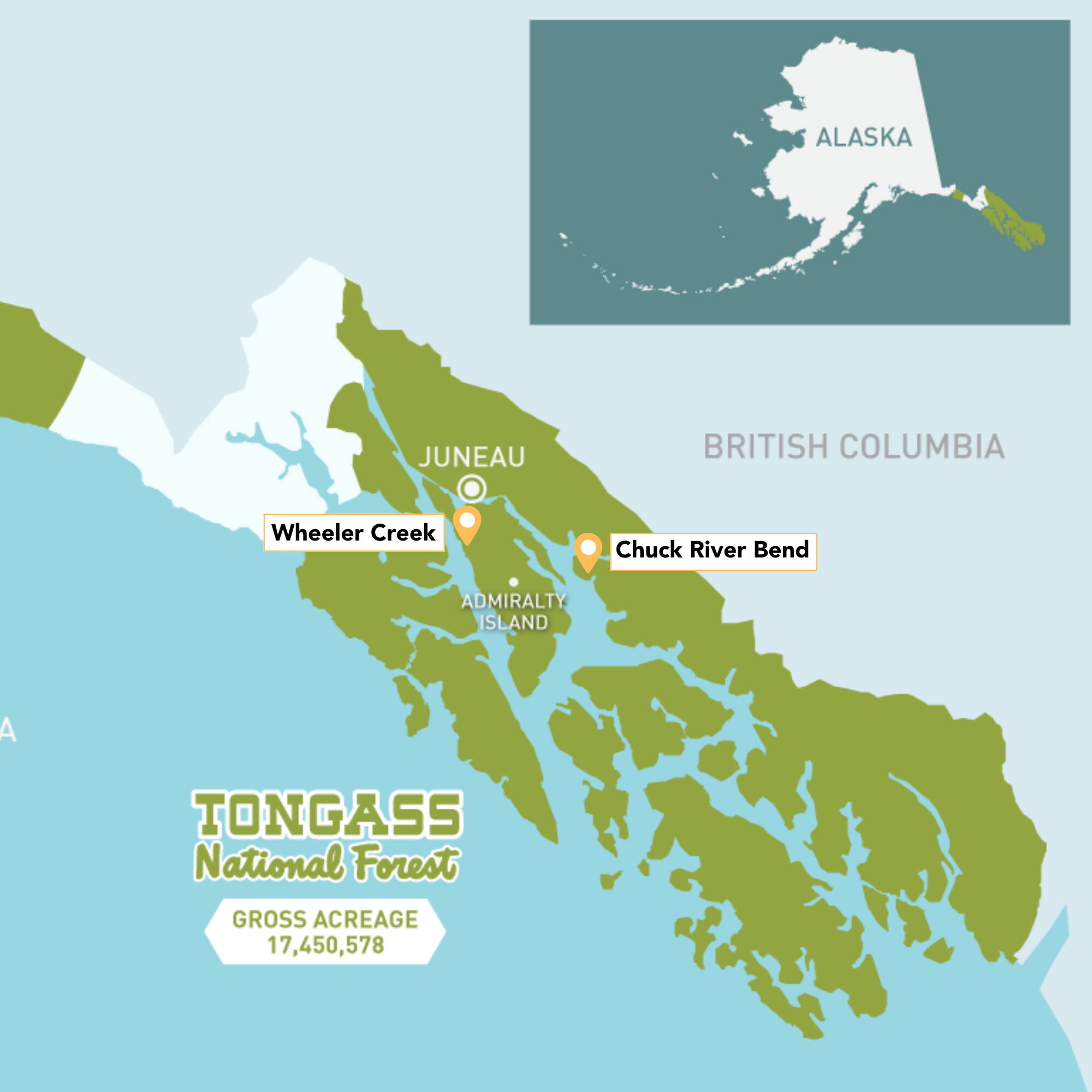
A map shows the sites in the Tongass National Forest where the Wilderness Land Trust has purchased privately owned land for conservation in designated wilderness areas. (Map provided by The Wilderness Land Trust)

A map shows the sites in the Tongass National Forest where the Wilderness Land Trust has purchased privately owned land for conservation in designated wilderness areas. (Map provided by The Wilderness Land Trust)

It holds important salmon and wildlife habitat, and as part of an old-growth forest, it absorbs atmospheric carbon, making it a buffer against climate change, Jadkowski said. When considering land parcels to buy for conservation, “climate resilience is definitely one of the functions we look at,” she said.

The Wilderness Land Trust is a national organization that is dedicated to purchasing inholdings — a term for private land within publicly owned, protected land — and transferring them to public ownership for conservation. It has protected 586 properties over about 58,000 acres and began working in Alaska in 2017. It has two prior projects in Southeast Alaska totaling about 180 acres, both in the Chuck River Wilderness area of the Tongass, Jadkowski said.

The Southeast Alaska Land Trust has already preserved 3,600 acres of wetlands, recreation sites, wildlife habitat, open space and subsistence areas in the region, according to its website.

Other Southeast Alaska rainforest sites have been conserved through a different process.

Sealaska Corp., a regional Native for-profit corporation, in 2018 struck the first deal in Alaska to issue carbon-offset credits through the California cap-and-trade program. Through that program, Sealaska has preserved about 165,000 acres of forest, about half of its land, for 100 years, according to the corporation’s website.

• Yereth Rosen came to Alaska in 1987 to work for the Anchorage Times. She has reported for Reuters, for the Alaska Dispatch News, for Arctic Today and for other organizations. She covers environmental issues, energy, climate change, natural resources, economic and business news, health, science and Arctic concerns. This story originally appeared at alaskabeacon.com. Alaska Beacon, an affiliate of States Newsroom, is an independent, nonpartisan news organization focused on connecting Alaskans to their state government.

More in News

Brenda Schwartz-Yeager gestures to her artwork on display at Annie Kaill’s Gallery Gifts and Framing during the 2025 Gallery Walk on Friday, Dec. 5. (Mari Kanagy / Juneau Empire)
Alaska artist splashes nautical charts with sea life

Gallery Walk draws crowds to downtown studios and shops.

Downtown Juneau experiences its first significant city-level snow fall of the season as pictured on Saturday, Dec. 6, 2025. (Mari Kanagy / Juneau Empire)
Sub-zero temperatures to follow record snowfall in Juneau

The National Weather Service warns of dangerous wind chills as low as -15 degrees early this week.

A truck rumbles down a road at the Greens Creek mine. The mining industry offers some of Juneau’s highest paying jobs, according to Juneau Economic Development’s 2025 Economic Indicator’s Report. (Hecla Greens Creek Mine photo)
Juneau’s economic picture: Strong industries, shrinking population

JEDC’s 2025 Economic Indicators Report is out.

Map showing approximate location of a 7.0-magnitude earthquake on Saturday, Dec. 6, 2025. (Courtesy/Earthquakes Canada)
7.0-magnitude earthquake hits Yukon/Alaska border

Earthquake occurred about 55 miles from Yakutat

A commercial bowpicker is seen headed out of the Cordova harbor for a salmon fishing opener in June 2024 (Photo by Corinne Smith)
Planned fiber-optic cable will add backup for Alaska’s phone and high-speed internet network

The project is expected to bring more reliable connection to some isolated coastal communities.

Gustavus author Kim Heacox talked about the role of storytelling in communicating climate change to a group of about 100 people at <strong>Ḵ</strong>unéix<strong>̱</strong> Hídi Northern Light United Church on Wednesday, Dec. 3, 2025. (Mari Kanagy / Juneau Empire)
Author calls for climate storytelling in Juneau talk

Kim Heacox reflects on what we’ve long known and how we speak of it.

The Juneau road system ends at Cascade Point in Berners Bay, as shown in a May 2006 photo. (Michael Penn / Juneau Empire file)
State starts engineering for power at proposed Cascade Point ferry terminal

DOT says the contract for electrical planning is not a commitment to construct the terminal.

Most Read