
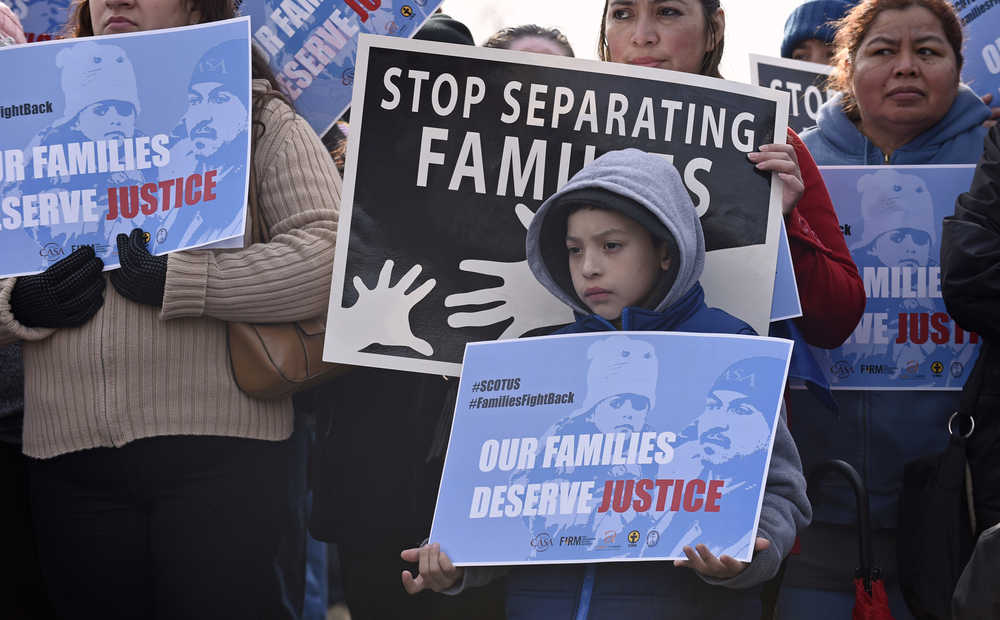
WASHINGTON — The Supreme Court stepped into a boiling political dispute over immigration Tuesday, setting up a likely decision in the middle of a presidential campaign marked by harsh rhetoric about immigrants.
The justices agreed to review whether President Barack Obama, acting without congressional approval, has the power to shield from deportation up to 5 million immigrants living in the U.S. illegally and make them eligible to work without fear of being rounded up.
Underscoring the political dimension, the case will be argued in April and decided by late June, about a month before both political parties gather for their nominating conventions.
If Obama prevails against opponents led by Republican governors, there would be roughly seven months left in his presidency to implement plans that would affect the parents of U.S. citizens and lawful permanent residents, as well as some people who arrived in the United States before they turned 16.
“We are confident that the policies will be upheld as lawful,” White House spokeswoman Brandi Hoffine said after the court’s announcement Tuesday.
At issue is the Deferred Action for Parents of Americans program, which Obama said in late 2014 would allow people who have been in the United States more than five years and who have children who are in the country legally to “come out of the shadows and get right with the law.” He also announced the expansion of a program that affects people who came here illegally as children.
That earlier program, Deferred Action for Childhood Arrivals, is not being challenged and has resulted in more than 720,000 young immigrants being granted permission to live and work in the United States.
When he announced the measures 14 months ago, Obama said he was acting under his own authority because Congress had failed to overhaul the immigration system. The Senate did pass legislation on a bipartisan vote, but House Republicans refused to put the matter to a vote.
Texas quickly led a legal challenge to Obama’s program on behalf of 26 states and has won every round in court so far. Most recently, in November, the 5th U.S. Circuit Court of Appeals ruled in favor of the states, prompting the appeal to the Supreme Court.
Texas actually asked the Supreme Court not to hear the case challenging those rulings, but state Attorney General Ken Paxton said he was pleased the justices will examine the president’s constitutional power to intercede without congressional approval. “In deciding to hear this case, the Supreme Court recognizes the importance of the separation of powers,” Paxton said.
The U.S. solicitor general, Donald Verrilli Jr., said in his Supreme Court filing that allowing the lower court rulings to stand would force millions of people “to continue to work off the books, without the option of lawful employment to provide for their families.”
The administration said Texas and the other states don’t even have the right to challenge the plan in federal court. The lower courts decided that Texas does have the right, or standing, to sue because at least 500,000 people living in Texas would qualify for work permits and thus become eligible for driver’s licenses, the costs of which are subsidized by the state. “Texas would incur millions of dollars in costs,” the state said in its brief.
The justices also said they would consider whether, if the states can pursue their lawsuit, Obama exceeded his authority under federal laws and the Constitution.
Some court observers saw in the court’s decision to look at Obama’s power under the Constitution a potentially ominous sign. “It suggests that the court is willing to engage President Obama’s entire use of executive orders,” said Jeffrey Rosen, president and CEO of the nonpartisan National Constitution Center.
Still, Democratic officials and immigrants’ advocates praised the court’s action. Senate Democratic Leader Harry Reid of Nevada said that “law-abiding men and women continue to live in constant fear of being separated from their children. These families must be allowed to step out of the shadows and fully contribute to the country that they love and call home.”
The future of the estimated 11 million immigrants living in the country illegally has been much discussed by Republican and Democratic presidential candidates. Democratic front-runner Hillary Rodham Clinton has pledged to go further than Obama to protect large groups of immigrants from deportation.
Republican Donald Trump has proposed deporting all people who are living in the U.S. illegally, an idea embraced by some other GOP candidates and dismissed by others.
While immigration activists generally have been supportive of Obama, they have criticized his administration for raids this month that resulted in the arrests of more than 120 immigrants from Central America who came to the country illegally since 2014. Those recent arrivals are not among immigrants who would benefit from Obama’s plan.
The raids are part of a shift in the administration’s enforcement actions to focus on criminals, those who pose a threat to national security or public safety, and recent border-crossers.
The change means that people who are here illegally but who are not otherwise violating the law are less likely to face deportation.
About 235,000 people were deported in the fiscal year that ended Sept. 30, according to the Department of Homeland Security.
That was the smallest number since 2006 and a 42 percent drop since a record high of more than 409,000 in 2012.
___
Associated Press writer Josh Lederman contributed to this report.
