
Efforts to obtain millions of dollars of federal funds to protect public and private property from Mendenhall River flooding are being made by the city and other agencies, three months after a record release of water from Suicide Basin damaged or destroyed dozens of homes, according to presentations made this week.
The efforts come after federal disaster relief was denied by the Federal Emergency Management Agency, leaving many private property owners facing enormous bills to repair or replace homes and other possessions following the Aug. 5 flooding. An overview of the situation, including efforts to secure other funding, was presented to the Juneau Assembly’s Committee of the Whole on Monday.
Among the ongoing requests is a $5.5 million for a four-year project that would “build flood resistance and improve fish habitat,” from the National Oceanic and Atmospheric Administration, with the City and Borough of Juneau a partner applicant. Another is a request for the U.S. Army Corps of Engineers to conduct an emergency streambank and shoreline protection feasibility study, which could provide up to $10 million for public infrastructure protection if the city provides 35-50% in matching funds.
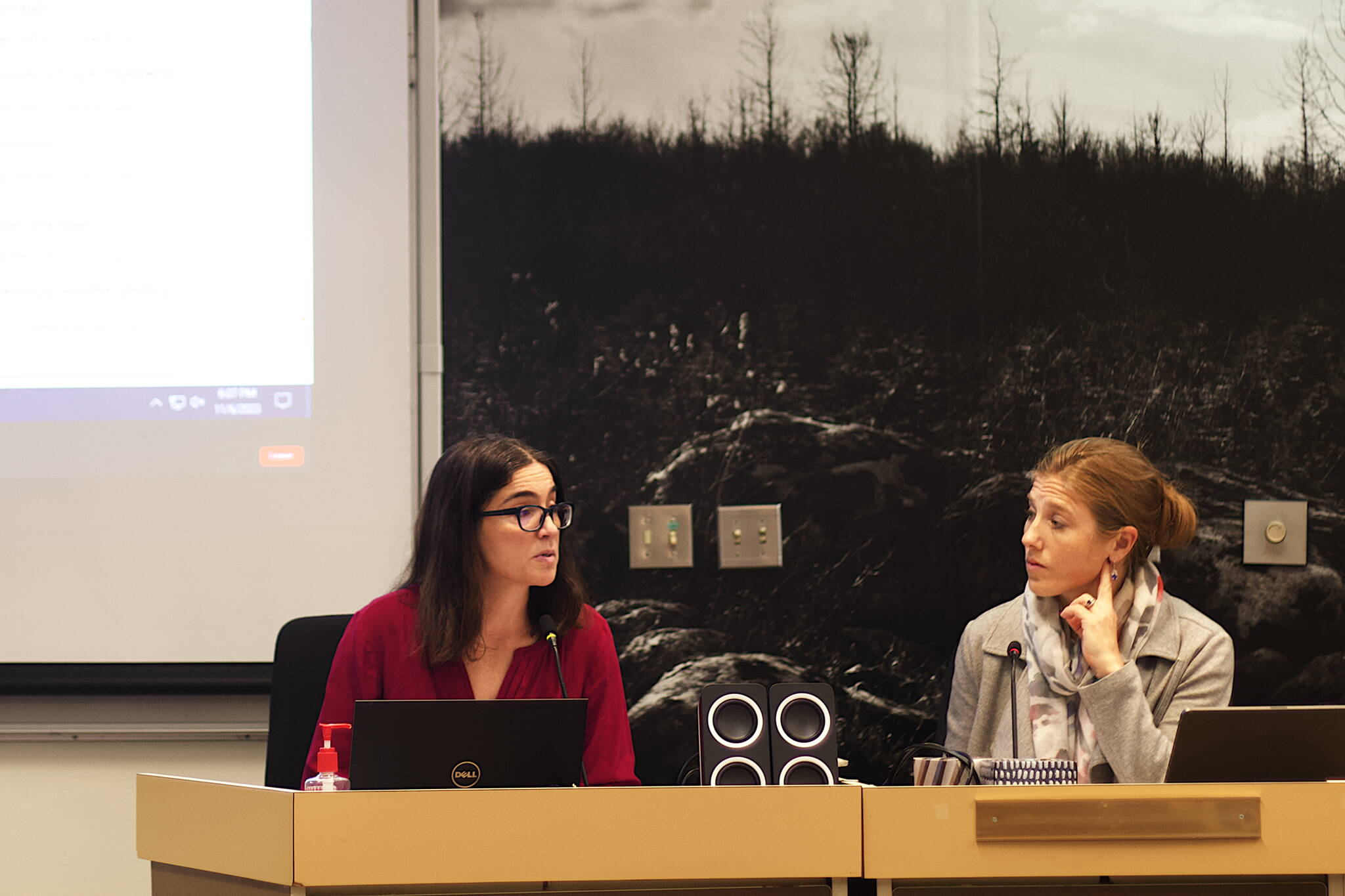
“I think the thing to leave you all with is when we find some good opportunities to apply with partners for grants like NOAA we are doing that,” Denise Koch, CBJ’s director of engineering and public works, told Assembly members as well as residents who showed up to testify about their concerns at Monday’s meeting. “When we have opportunities to work with experts like the Army Corps of Engineers and NRCS we are invited them in, and we are asking them what’s possible.”
Although FEMA turned down a federal disaster aid request, the city is still seeking a Hazard Mitigation Program Grant, plus Building Resilient Infrastructure & Communities flood mitigation assistance, from the agency, Koch said. Both could end up benefiting both public and private property, although the latter would involve a 25% local cost share.
Several residents testifying at Monday’s meeting expressed a mixture of frustration at what they felt was lack of sufficient past action by the city, concern about the potential for future floods that cause significant damage and hope the current efforts will help prevent such incidents.
Steve Bradford, a resident at Riverside Condominiums — where two buildings sustained damage that left them uninhabitable until repairs could be made — said he’s encouraged by efforts such as bringing experts from the Army Corps of Engineers in. But he also noted he’s a civil engineer with more than 40 years of experience who has lived in Juneau for nearly 50 years, and thinks the city needs to take steps beyond safeguards for when major floods happen.
“I believe we should be taking some proactive steps to control the outflows from these future events,” he said. “We should not just be standing by and advising the public of impending floods.”
Bradford said the city should seek federal funds to construct an overflow tunnel from Suicide Basin to the Nugget Creek area, a distance of about 2,300 meters, which would ensure the water level in the basin remains low and thus not a flood threat.
Annual releases of water from Suicide Basin have occurred annually since 2011, and experts have stated large-scale flows are possible for the next few decades as climate change increases the rate of glacier melt and other natural factors.
Local-level boosts in preventative research funding
While the city is waiting to hear more about many of its large-scale funding requests, the Assembly last month gave initial approval to a five-fold increase in annual monitoring funds to the U.S. Geological Survey — to $35,000, up from $7,000 — to allow for additional cameras, sensors and other data collection. Final approval is scheduled for consideration at its meeting Monday, Nov. 13.
Meanwhile, the University of Alaska Southeast is requesting $150,000 in its budget for the coming fiscal year for “Improving Hazard Prediction for Glacial Lake Outbursts in Juneau and Across Alaska,” according to a draft budget document submitted to the University of Alaska’s Board of Regents this week.
“Funding is requested to restore monitoring of the basin in order to collect and analyze data that would better enable flood prediction for Suicide Basin as well as for other similar glacial areas in Alaska and in the world,” a summary of the request notes. “Funding would support the purchase of drone mapping accessories, computational equipment, helicopter access to field sites, faculty research time, and the training of undergraduate research assistants.”
UAS researchers “are already receiving national recognition in this field because of the past monitoring conducted by faculty on glacial flooding events,” the summary asserts, adding it will also increase the ability to gain more external grant funding.
Businesses and residents affected by the flooding also have until Dec. 5 to apply for a U.S. Small Business Administration disaster loan, according to a notice sent this week by Jeffrey Lusk, director of the agency’s center-west region field operations office. The low-interest federal disaster loans are available in Juneau, plus the neighboring areas of Chatham REAA, Haines and Petersburg.
”Businesses of all sizes and private nonprofit organizations may borrow up to $2 million to repair or replace damaged or destroyed real estate, machinery and equipment, inventory and other business assets” the notice states. “Disaster loans up to $500,000 are available to homeowners to repair or replace damaged or destroyed real estate. Homeowners and renters are eligible for up to $100,000 to repair or replace damaged or destroyed personal property, including personal vehicles.”
Information about disaster loan applications is at SBA.gov/disaster.
• Contact Mark Sabbatini at mark.sabbatini@juneauempire.com or (907) 957-2306.
