
Some Alaska cities can expect slightly more federal COVID-19 relief money after Gov. Mike Dunleavy revised his proposal for distribution of CARES Act money. When local governments might actually see that money is an open question as politicians debate the best mechanism with which to allocate funds.
The Legislative Budget and Audit Committee will meet Wednesday to consider the governor’s revised proposal after approving only $125 million of the $1.25 billion plan last week. Still waiting for legislative approval are funding for communities and small businesses — many of whom are in dire need.
In April, the governor chose the revised program legislative requests, or RPL process, as the most efficient way to get federal dollars to recipients. But Legislative Legal Affairs Director Megan Wallace cautioned lawmakers using the RPL process would severely limit the flexibility of the funds.
Some lawmakers wanting to come back to Juneau having the Legislature make appropriations.
For many municipalities, regardless of how the money’s appropriated, federal guidelines say it can’t be used for their biggest problem; the loss of revenue caused by the pandemic.
“I think there’s an interest in moving funds out quickly,” said Nils Andreassen, executive director of the Alaska Municipal League. “I can’t comment on the appropriateness of the RPL process, but the restrictions on CARES act funding wouldn’t change through appropriation.”
Dunleavy vetoed community assistance grants and school bond debt reimbursement from the budget passed by the Legislature, saying at the time federal funds would be able to make up for the vast majority of funds cut from the budget. But that proved not to be true.
Now, some cities are looking at holes in their budget and money they can’t use to fill it.
“Unless somebody comes and flat out tells us we can use CARES Act for bond debt, we’re going to feel that hard,” said Debra Schnabel, Haines Borough Manager.
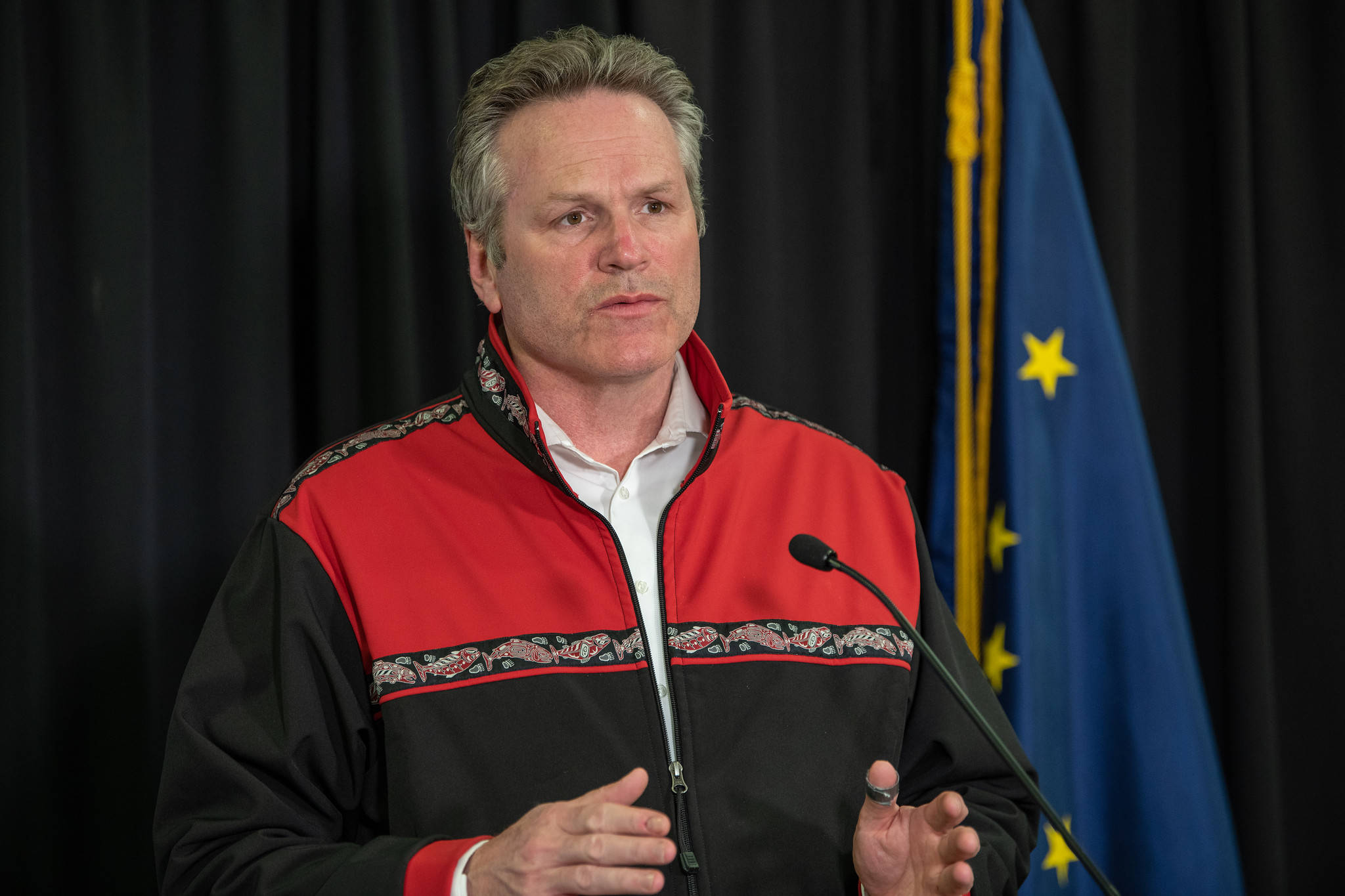
Gov. Mike Dunleavy at a press conference in Anchorage on April 27, 2020. (Courtesy photo | Office of Gov. Mike Dunleavy)
Faced with a need for cash, cities are looking to the few sources of revenue they have, namely property taxes. Schnabel said without community assistance and bond reimbursement the borough was looking at trying to raise $2-3 million in property taxes. Local leaders previously told lawmakers that revenue replacement must be a part of any recovery program.
How those funds are spent is determined by the U.S. Treasury.
“Really our issue is more of a congressional issue,” Schnabel said.
After hearing from local leaders last week, Dunleavy raised the total appropriations to Alaskan communities by more than $6 million. In his original proposal on April 21, the total allocation was $562.5 million, but the revised plan released May 1, totals $568.5 million.
Asked where the governor found the additional $6 million, the governor’s office said the original proposal had been conservative to allow for contingencies.
[Cities can’t make it on current revenues]
“The initial plan prepared by the Dunleavy Administration was a conservative proposal that would allow for health responses and other contingencies,” Lauren Giliam, deputy press secretary for the governor wrote in an email. “The revised plan utilized a small part of that contingency set aside to ensure that, in making changes to the distribution, funds weren’t taken from one community to fix the distribution to another.”
At a press conference Monday evening, Dunleavy said many states, including Alaska, are asking for more latitude in how CARES Act funding can be used.
“States are asking for more flexibility with the funding,” Dunleavy said. “We are certainly asking for more flexibility in the funds that we have.”
Even though CARES Act funding can’t be used to replace lost revenue, Dunleavy said, there was broad discretion allowed in how cities could use the money.
Juneau’s allocation was raised roughly $77,000 from an initial appropriation of $53.210,942 up to $53,288,390.
The governor’s office proposed sending funding out in three waves several months apart.
The first payment as proposed by the governor was meant to be paid May 1, but Juneau didn’t receive any money and City Manager Rorie Watt can’t say when it will.
“We need both the Legislature and the governor to agree and guidance from Treasury,” Watt said.
• Contact reporter Peter Segall at psegall@juneauempire.com. Follow him on Twitter at @SegallJnoEmpire.
