
Southeast Alaska Native language teachers are hopeful for the future of its Indigenous languages.
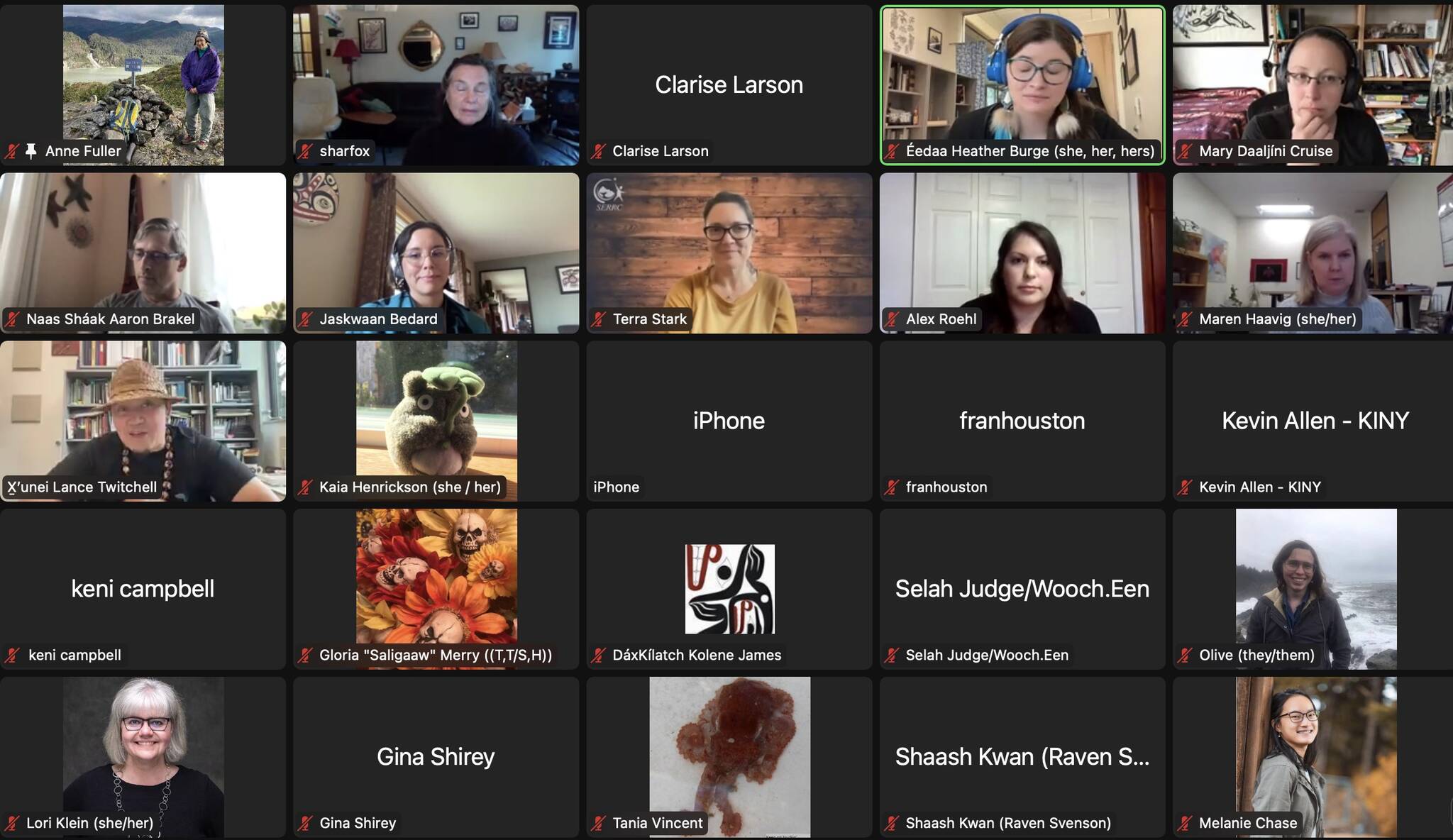
On Monday people gathered for a Zoom panel hosted by the University of Alaska Southeast to celebrate National Indigenous Peoples Day and to participate in an Indigenous Language revitalization class and panel that addressed the future of Lingít, X̱aad Kíl, and Smʼalgya̱x.
The class, Has Du Ítx̱ Yaa Ntoo.át Haa Shuká Aa Hás “Our Journey Forward”, was led by Éedaa Heather Burge, project coordinator for the Haa Yoo X’atángi Deiyí: Our Language Pathway project, who asked a series of questions to speakers Jasḵwaan Bedard with the Haida language community, Daaljini Folletti-Cruise with the Lingít language community and Alex Roehl with the Juneau Sm’algyax learners group.
The trio walked the Zoom participants through what ways Lingít, X̱aad Kíl, and Smʼalgya̱x are being revitalized and what they expect to see for the future of these languages.
Bedard, a Haida language learner and teacher, spoke about the importance of celebrating learning and changing the narrative of learning to be positive rather than pointing out people’s mistakes. She said it’s important to create an atmosphere where anyone can feel welcomed and safe to learn.
“Having an atmosphere of hope is so important in what we’re doing,” she said.
She said one of the steps she is pursuing to change that is by separating the designation of who qualifies as a speaker regardless of how proficient others might see them and choose to “remove that deficiency mindset.”
Bedard said opportunities are open for both adults and children and offer different programs for all types and levels of learners. She said a lot of their first language speakers are no longer with them, and it’s important to keep making space for anyone that wants to learn even when it’s difficult.
“I know our ancestors are with us, and when it feels like it’s too much, there is always something that reminds us why we’re on this path,” she said. “Blessed and grateful to be involved in all this excitement.”
Daaljini Folletti-Cruise agreed and said she had a lot of hope for the Lingít language and the new people that continue to join in on the learning process from any age.
“The state of the language is shifting quickly and I think there is a lot of positive change and I see a lot more interest and a lot more people sticking with it,” she said. “
Cruise is the lead instructor and administrator Haa Yóo X̱ʼatángi Kúdi classroom, which means “our language’s nest,” and is an immersion classroom in Juneau that only speaks Lingit in the classroom and aims to teach the next generation of Lingít speakers. She said teaching the Lingít language to the students has been challenging but also “so rewarding in so many ways.”
She said she and her team have been learning more every day along with the students and said she is astounded by the student’s ability to learn in such a short period of time.
“It always comes back to the kids,” she said. “Watching the development of the kids and the team “shows me that whatever we’re doing is working, and that’s what keeps me going.”
Alex Roehl with the Juneau Sm’algyax learners group said she is inspired most by the children who are learning the Sm’algyax language and said her learning has helped her heal and reaffirm her cultural identity.
She said she hopes to see more connections being made in the language across the U.S.-Canada border where many of the remaining fluent speakers live, and also would like to continue working and strengthening a relationship with SHI.
“We are hopeful for the future of our language, we want to learn more and to be functional in the language,” she said. `We want to share what we’ve learned with other people.”
According to a 2022 study by Ethnologue, it found that of the 7,000 languages spoken around the world, approximately 2,900 (41%) are endangered and have a trajectory rate of nearly 90% of all languages could become extinct in the next 100 years.
“Language embodies the entire culture, the entire history of a community and its worldview, not just for current elders but for generations past it’s been transmitted — language is used to express everything,” said CEO of the Language Conservancy Wil Meya in a phone interview with the Empire.
The Language Conservancy is a nonprofit that works with Indigenous communities across the globe to provide tools to Indigenous communities to collect language information and format it into an app to then be used by anyone who wants to learn the language.
The Southeast Alaska city of Craig’s tribal association is in partnership with the nonprofit and is currently working on developing an app that revitalizes, documents and maintains the Tlingit, Haida and Tsimshian languages by putting their knowledge together to create the apps.
Meya said they are currently in the process of developing apps that aim to revitalize, document and maintain languages and provide materials and resources for people who want to learn the languages but don’t have the means to do so.
He said the Language Conservancy collects language information remotely from the communities it partners with. That includes sending gear like laptops, microphones and recording stations along with sharing special software with the language speakers in the community who then work with a linguist to document the work.
The nonprofit also works with communities near Fort Yukon to revitalize the Gwich’in language, which belongs to the Athabaskan language family. He said they hope to extend their reach across other communities in Southeast Alaska in the future.
“We are always open to new partnerships with different communities,” he said. “There is so much that is needed to be done to maintain languages as more and more speakers pass on and young people need to be involved in learning those languages.
• Contact reporter Clarise Larson at clarise.larson@juneauempire.com or (651)-528-1807. Follow her on Twitter at @clariselarson.
