
Last week, I wrote about the Innoko River. A few savvy readers pointed out that while the Innoko may be the fifth-longest river in Alaska depending on what branches you count, it is not Alaska’s fifth-largest in volume of water. Among others, the Koyukuk and Teedriinjik (Chandalar) move more water.
In the 1820s, painter and naturalist John James Audubon designed an experiment to test if birds had a sense of smell. He dragged a rotten hog carcass into a field, then piled brush on top of it. After none of the local turkey vultures appeared, Audubon concluded that vultures hunted using their eyes alone.
Gabrielle Nevitt has for years pondered the smelling abilities of animals. She has studied salmon finding their way back to their birth streams and “tube-nosed” ocean birds, like albatrosses and shearwaters. The researcher from the University of California, Davis started a recent lecture in Fairbanks by pointing out how Audubon erred in his pig-and-vulture experiment.
[A bad summer for birds on Cooper Island]
Turkey vultures are most sensitive to a gas called ethanethiol, the rotten-egg scent that wafts from a carcass in the first 24 hours after something dies. Audubon, it seems, employed a dead pig that was quite far along in the decomposition process, emitting compounds even turkey vultures found offensive.
Nevitt said she still notices some textbook references to birds’ inability to smell, though scientists have proven the opposite many times.
In Nevitt’s study of the “odor landscape” of the great southern ocean surrounding Antarctica, she and her colleagues examined how albatrosses could find one of their favorite meals, dead squid floating on the surface.
“How do they find prey in a featureless ocean?” she said.
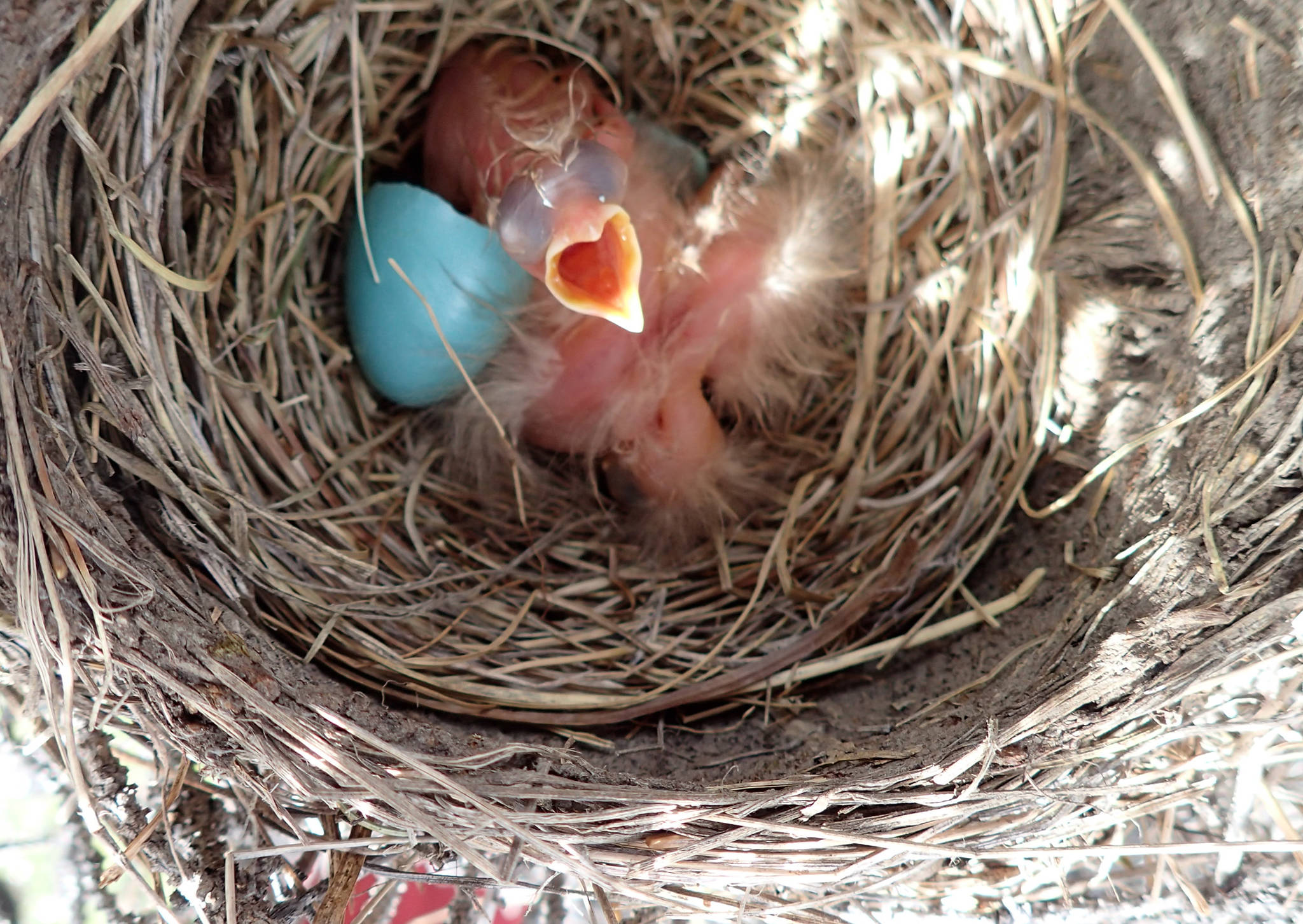
Sense of smell is important for birds, like these robin chicks. (Courtesy Photo | Ned Rozell)
Nevitt discovered that the large seabirds could smell a few molecules of squid from more than 15 miles away. The birds zig-zag up a scent trail to reach their target, much like a Labrador retriever zeroes in on a grouse.
[How birds fly thousands of miles]
A student who worked with Nevitt also discovered a few years ago that seabirds’ attraction to the sulfurous smell of phytoplankton may be a reason people find dead birds with bellies full of plastic.
Matthew Savoca, now a postdoctoral researcher at Stanford, found that plastic discarded in the ocean becomes stinky within a few weeks as algae coats it. Birds may gulp plastic chips down based on this scent alone, which they associate with food. He also tested birds with plastic not soaked in ocean water. Birds did not eat the raw plastic.
While different birds have varying senses of smell, Nevitt has studied species with noses more sensitive than some dogs. Even the smallest land birds use their noses, scientists have found.
[Alaska braces for these invading parasites]
Biologist Julie Hagelin of University of Alaska Fairbanks’ Institute of Arctic Biology recently worked on a study of zebra finches, tiny birds often for sale in pet stores. After a mother finch laid eggs, Hagelin’s colleagues in Germany moved the eggs to the nests of a “foster” mother. When they hatched, chicks begged for food more actively when an experimenter puffed the real mother’s scent in the face of a chick.
“They can smell their genetic mom, even though they have never met her,” Hagelin said of the day-old chicks. “It’s possible that Mom may provide some chemical information in the egg that chicks recognize after hatching.”
Hagelin pointed out how important scent is for zebra finches and other species like dark-eyed juncos, soon to be visitors to many Alaska backyards. Other scientists have shown juncos select their mates based on scent.
Finches and juncos don’t possess the snorkel-like nose of an albatross, nor the large olfactory bulb (devoted to smell) in the brains of albatrosses and turkey vultures.
“The olfactory bulb of a zebra finch or junco is a tiny dot compared to the rest of the brain, proving we have a lot left to learn,” Hagelin said.
• Since the late 1970s, the University of Alaska Fairbanks’ Geophysical Institute has provided this column free in cooperation with the UAF research community. Ned Rozell (ned.rozell@alaska.edu) is a science writer for the Geophysical Institute.
