
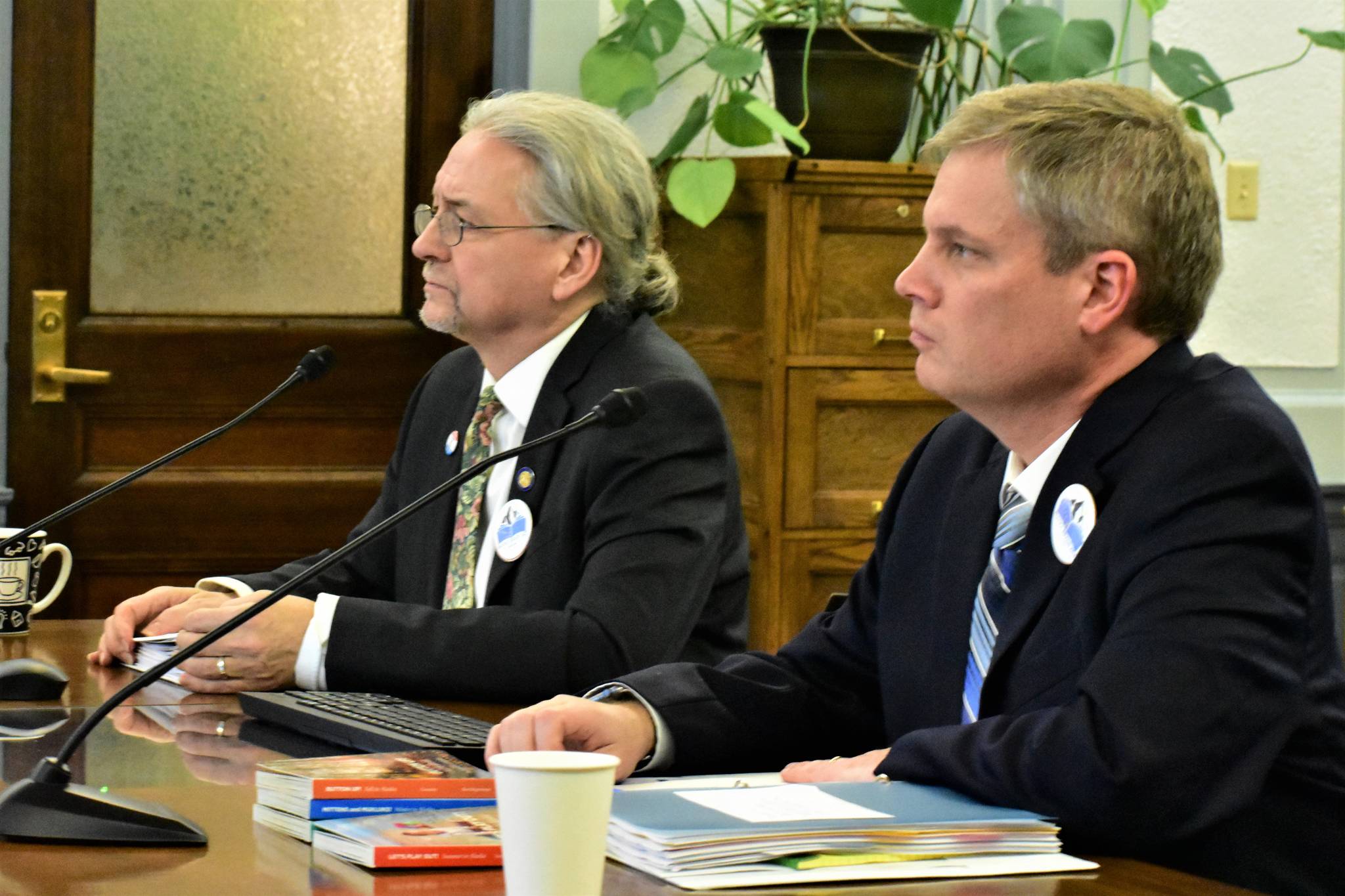
Sen. Tom Begich, D-Anchorage, left, and Education Commissioner Michael Johnson answer questions about the Alaska Reads Act at a Senate Education Committee meeting on Thursday. (Peter Segall | Juneau Empire)

Sen. Tom Begich, D-Anchorage, left, and Education Commissioner Michael Johnson answer questions about the Alaska Reads Act at a Senate Education Committee meeting on Thursday. (Peter Segall | Juneau Empire)

Bipartisan reading bill receives broad support

The Alaska Reads Act, sponsored by Republicans and Democrats, got its first reading Thursday

An education bill meant to bring Alaskan students up to reading proficiency by third grade got its first hearing before the Senate Education Committee Wednesday afternoon.

Known as the Alaska Reads Act, the bill is sponsored by Sen. Tom Begich, D-Anchorage, and Gov. Mike Dunleavy. In his introductory remarks, Begich emphasized the bipartisan nature of the bill’s development.

“We have extensively worked on this bill,” Begich said. “We put aside traditional labels of political right and left and focused on what these kids need.”

Dunleavy approached Begich about early childhood reading programs as early as December 2018, Begich told the committee.

“The governor’s commitment to reading and literacy is a critical component,” Begich said.

There are three main parts of the act, according to Education Commissioner Michael Johnson said: High quality pre-K, comprehensive K-2 reading policy and school improvement.

After opening statements on the importance of early childhood reading skills, staff from Begich’s office and the Department of Education and Early Development dove into the details of the bill.

One of the more critical components of the bill is how it counts students. Students in early education programs would be counted as one-half of a full-time student, according to the bill.

The bill also requires reading intervention programs, including specialized staff, to help students with reading disabilities. Schools must provide written notification to parents within two weeks of a student demonstrating a reading deficiency, according to Erin Hardin, special assistant for DEED.

Students will be judged for reading proficiency in more than one way, including by a teacher’s assessment. This is meant to give students that may not perform well on standardized tests multiple chances to show proficiency, Johnson says.

Lowest performing 10% of schools will be eligible for schools in the first year of the bill, according to Löki Gale Tobin from Sen. Begich’s office. That percentage will increase year to year, she says. Those grants will be used to strengthen the school’s early education programs.

The bill would also define early education programs allow state and federal funding for early education programs for 4- and 5-year-olds, according to Erin Hardin, special assistant for the Alaska Department of Education and Early Development.

The bill includes a literacy program, Hardin says. That program would allow for state intervention and aid for intensive reading programs for eligible schools. DEED would provide materials and staff for reading intervention programs, the bill says.

DEED would hire an independent contractor to determine the effectiveness of the intervention programs, Hardin says in response to a question from Sen. Shelly Hughes, R-Palmer, about transparency in the program.

If passed the bill would take effect July 1, 2020, according to Johnson.

“We don’t want kids to have to wait another year,” Johnson said.

• Contact reporter Peter Segall at 523-2228 or psegall@juneauempire.com.

More in News

Downtown Juneau experiences its first significant city-level snow fall of the season as pictured on Saturday, Dec. 6, 2025. (Mari Kanagy / Juneau Empire)
Sub-zero temperatures to follow record snowfall in Juneau

The National Weather Service warns of dangerous wind chills as low as -15 degrees early this week.

A truck rumbles down a road at the Greens Creek mine. The mining industry offers some of Juneau’s highest paying jobs, according to Juneau Economic Development’s 2025 Economic Indicator’s Report. (Hecla Greens Creek Mine photo)
Juneau’s economic picture: Strong industries, shrinking population

JEDC’s 2025 Economic Indicators Report is out.

Map showing approximate location of a 7.0-magnitude earthquake on Saturday, Dec. 6, 2025. (Courtesy/Earthquakes Canada)
7.0-magnitude earthquake hits Yukon/Alaska border

Earthquake occurred about 55 miles from Yakutat

A commercial bowpicker is seen headed out of the Cordova harbor for a salmon fishing opener in June 2024 (Photo by Corinne Smith)
Planned fiber-optic cable will add backup for Alaska’s phone and high-speed internet network

The project is expected to bring more reliable connection to some isolated coastal communities.

Gustavus author Kim Heacox talked about the role of storytelling in communicating climate change to a group of about 100 people at <strong>Ḵ</strong>unéix<strong>̱</strong> Hídi Northern Light United Church on Wednesday, Dec. 3, 2025. (Mari Kanagy / Juneau Empire)
Author calls for climate storytelling in Juneau talk

Kim Heacox reflects on what we’ve long known and how we speak of it.

The Juneau road system ends at Cascade Point in Berners Bay, as shown in a May 2006 photo. (Michael Penn / Juneau Empire file)
State starts engineering for power at proposed Cascade Point ferry terminal

DOT says the contract for electrical planning is not a commitment to construct the terminal.

Members of the Alaska Air and Army National Guard, Alaska Naval Militia, and Alaska State Defense Force work together to load plywood onto a CH-47 Chinook helicopter, in Bethel, Alaska, Nov. 2, 2025, bound for the villages of Napaskiak, Tuntutuliak, and Napakiak. The materials will help residents rebuild homes and restore community spaces damaged by past storms. (U.S. Army National Guard photo by Spc. Ericka Gillespie)
Gov. Dunleavy approves Alaska National Guard assisting ICE in Anchorage

The National Guard said five service members will assist with administrative support; lawmakers and civil rights advocates worry that the move signals a ramping up of immigration enforcement operations in Alaska

A cruise ship, with several orange lifeboats visible, is docked in downtown Juneau. (Laurie Craig / Juneau Empire file photo)
CBJ seeks input on uses for marine passenger fees

Public comment period is open for the month of December.

Most Read