
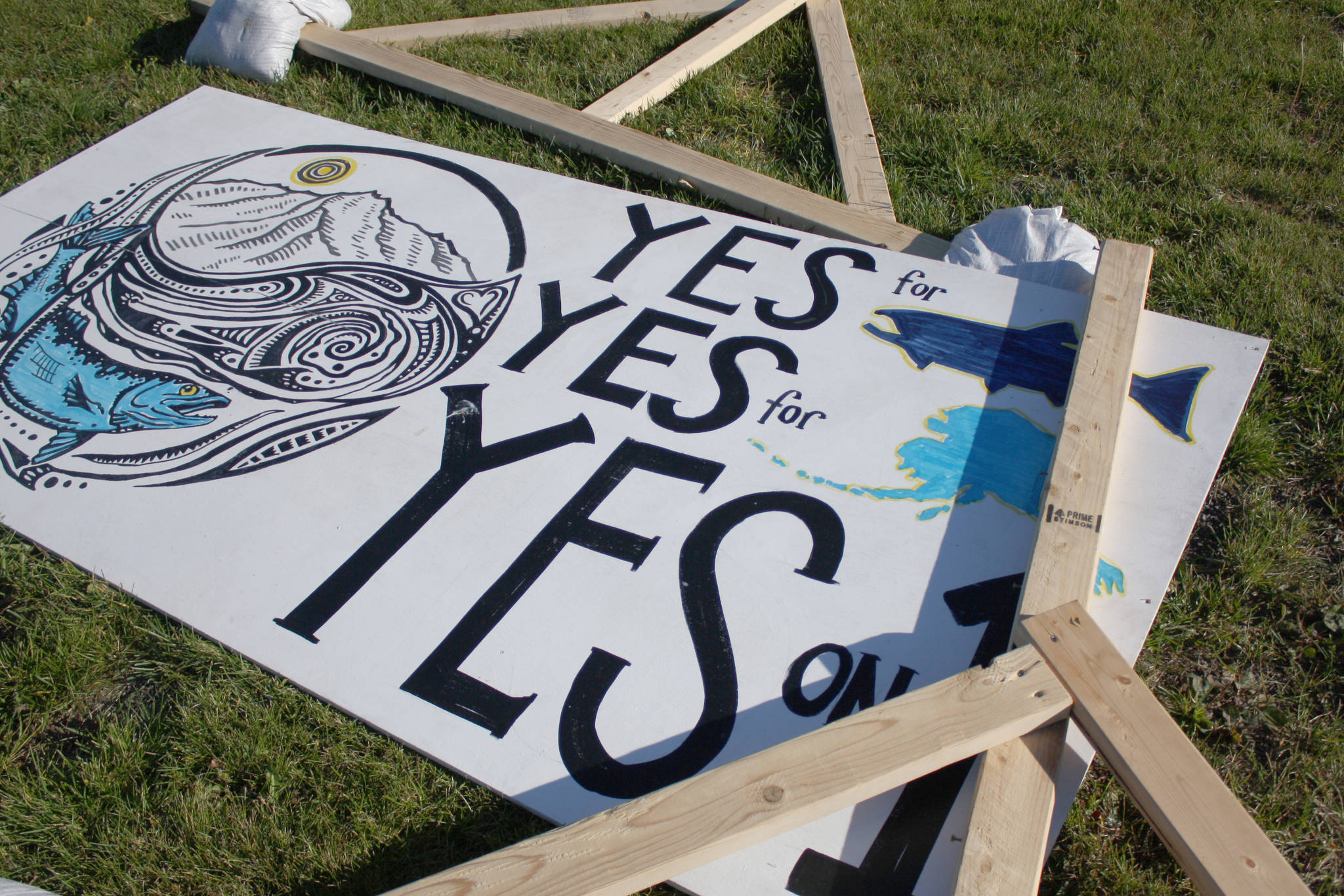
The electoral fight over Ballot Measure 1 is the most expensive state-level campaign in Alaska history, according to new filings from the Alaska Public Offices Commission.
Tuesday was the deadline for campaigns of all kinds to submit their last major financial report before the Nov. 6 general election. According to those filings, the principal group opposing Ballot Measure 1, Stand for Alaska, has received $12 million in cash and in-kind contributions. The principal group supporting the measure, Yes for Salmon, reported $1.7 million in contributions by Oct. 27, then added another $131,000 on Monday. Stand for Salmon, a separate political group that will remain active after the election, reported receiving more than $715,000 in contributions during the campaign.
Campaign fundraising doesn’t always decide elections, but it can be a barometer of support for a particular cause or candidate. It almost always determines the amount of advertising in a campaign.
In 2014, approximately $14 million was spent by proponents and opponents of a referendum attempting to repeal a just-passed reform of Alaska’s oil and gas tax law, setting a record for a state-level campaign. (Federal elections have resulted in more spending: more than $57 million was spent on Alaska’s U.S. Senate race that year.)
Many of the same oil and gas firms that opposed the 2014 referendum are also opposing this year’s ballot measure. Those companies include firms such as ExxonMobil and ConocoPhilips.
In addition to the big fish, a spread of small fry have joined the spending spree ahead of the vote.
A few examples: Mike Chihuly, a Ninilchik retiree who spent $1,860 with his wife on a newspaper ad to support the initiative. In Juneau, the Salmon Project is spending $925 in time and effort on social media, it reported. The Alaska Free Market Coalition, headquartered in Ward Cove, reported spending $2,500 in time and effort opposing the measure. In Haines, a group of local residents got together to spend $701 on advertising and hosting a question-and-answer session about the measure.
“Yeah, we support Stand for Salmon, but we thought it had more weight to create our own group,” said photographer Katie Craney, who organized the effort.
She said Haines is “split down the middle” politically, but the gathering “sparked debate amongst our friends and amongst our neighbors, and they started asking questions. … Those were the kinds of conversations we were hoping to happen.”
Alaska’s neck-and-neck governor’s race is already the most expensive in state history, but it involves much less money, even with the two principal candidates apparently near a tie as they sprint toward the Nov. 6 finish line.
Republican candidate Mike Dunleavy has reported raising $482,308 and spending $309,654 since his campaign began. Democratic candidate Mark Begich has reported raising $731,078 and spending $616,079. Begich trailed Dunleavy in fundraising until a recent surge that coincided with incumbent independent Gov. Bill Walker’s withdrawal from the race. Between Oct. 6 and Oct. 27, Begich raised $334,433 and Dunleavy raised $220,374.
Though Dunleavy’s campaign has received less direct support than Begich’s, Dunleavy is receiving far more help from independent expenditure groups that operate outside a campaign.
The Republican Governors’ Association, Republican State Leadership Committee and a handful of other big donors have given more than $2.8 million to Families for Alaska’s Future, a pro-Dunleavy group. Another pro-Dunleavy group, called Dunleavy for Alaska, has collected nearly $1.8 million in contributions for its campaign. That group has a wide variety of contributors, but most recently received $200,000 from the Pacific Seafood Processors Association and $200,000 from Alaska Frontier Constructors, an Anchorage firm.
Backing Begich is Begich for Alaska, which has received less than $337,000 in contributions; Alaskans Opposing Dunleavy, a group stocked with funds left over from a group that supported Walker for governor; Defeat Dunleavy, which has been funded with a half-million dollars from the Democratic organization in Washington, D.C.; and Educators Against Dunleavy, a group backed by the National Education Association’s Advocacy Fund.
Filings with the Federal Communications Commission show Alaska’s TV and radio stations will be filled with political advertising in the days before the election.
Locally, campaign filings indicate a tight race in the Mendenhall Valley, where House District 34 Democratic candidate Andi Story has almost entirely caught up with Republican candidate Jerry Nankervis, who began his campaign in 2017. The latest campaign filings show Story has received more than $91,000 since her campaign began, while Nankervis has received almost $95,000. Story has just over $23,000 remaining on hand to spend (not counting bills due of $4,800), while Nankervis has more than $15,000 remaining in his campaign accounts (not counting debts of $1,590).
In House District 33, independent candidate Chris Dimond leads Democratic candidate Sara Hannan. Dimond has raised $79,278 and has $13,534 remaining. Hannan has raised $63,132 and has $15,861 remaining.
For Senate District Q, which covers both House districts, Democratic candidate Jesse Kiehl holds a wide lead over independent candidate Don Etheridge. Kiehl has raised more than twice as much money as Etheridge: $118,000 to $52,351, and still has $16,456 on hand, compared to Etheridge’s $13,177.
Election Day is Nov. 6, but early voting continues daily from 8 a.m. to 5 p.m. in the State Office Building downtown and at the Mendenhall Mall annex.
• Contact reporter James Brooks at jbrooks@juneauempire.com or 523-2258.
