
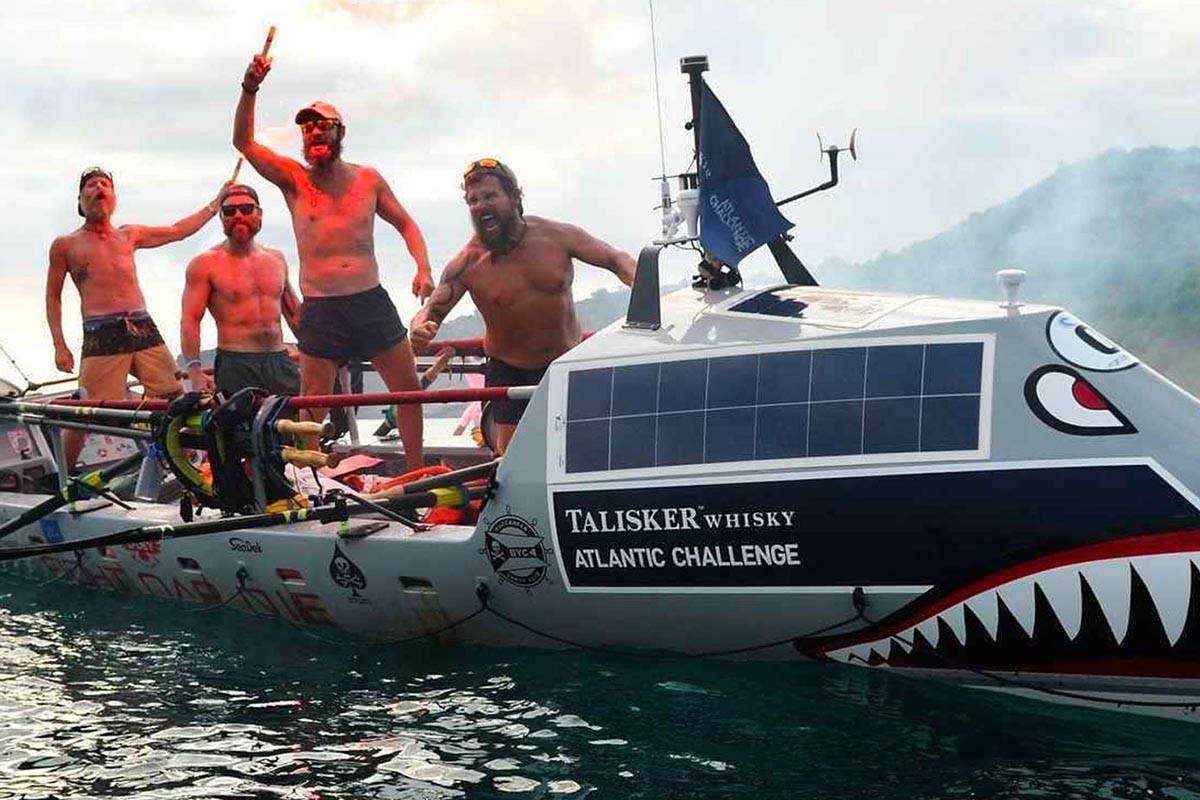
More people have climbed Mount Everest than have rowed across the Atlantic, the Fight Oar Die website roars its defiance.
Fight Oar Die, an all-veteran rowing team, will be one of 33 teams to attempt that crossing this year as part of the Talisker Whisky Atlantic Challenge, a 3,000-nautical mile race from the Canary Islands to Antigua in the Caribbean, kicking off on Thursday.
“It’s about motivating veterans to continue to be better and continue to live,” said Luke Holton, an Auke Bay resident and a former soldier, in a phone interview. “I’ve been out for 10 years, and it’s good to get back into that team environment where there’s one goal in mind.”
Holton got his start kayaking the Inside Passage, going on trips from places like Haines to Ketchikan, and works as a whale boat and charter captain.
“What is true is that military veterans struggle with reintegration. Some struggle to pick up and succeed and thrive in their lives,” said Air Force 2nd Lt. Ethan Bannar, a graduate student in military psychology at the University of Denver working with Fight Oar Die, during a phone conversation from the race’s starting point in the Canary Islands. “We’re trying to send a message that you can pick up and do anything that you put your mind to.”
Eyes on a broad problem
Fight Oar Die was formed to highlight the mental and physical health challenges of veterans in the United States, and to raise money for veterans that have mental health issues but don’t have Veteran Affairs benefits. There are a number of major public health issues stalking the veteran community, including homelessness, opioid addiction, PTSD and veteran suicide. Veteran suicide has exploded as an epidemic across the United States, with an estimated 22 veterans killing themselves a day.
Fight Oar Die is partnered with the University of Denver’s Sturm Program of Military Psychology, a program specifically created to administer to the mental needs of the nation’s 22 million veterans. A seven-person team has worked closely with the four rowers as they ready for the crossing.
“From a research standpoint, what we’re focused on is, how do ocean rowers perform in an isolated, confined, extreme environment,” Bannar said. “Over the last 10 months, we’ve been working with every rower that’s about to get on this boat, and gathering data on these things.”

Members of the veterans group Fight Oar Die will row across the Atlantic in the Talisker Whisky Atlantic Challenge, kicking off Thursday, Dec. 12, 2019. (Courtesy Photo | Fight Oar Die)
Bannar and his team have been studying the Fight Oar Die rowers as they prepare for the crossing, evaluating variables such as how rowers cope with boredom, their grit and resilience and self-mastery of emotions.
The program is created specifically to help deal with the unique mental health needs of veterans, many of whom have spent extended time in situations far more harrowing than many. A large part of that, Bannar said, is teaching the team members about acceptance when the situation or conflict threatens to upset their calm. Bannar hopes that what they’re learning about these techniques can be used to help other veterans out in their lives as they hit stumbling blocks rejoining society.
“Accept the fact that this maybe this isn’t how you expected you life to be post-deployment, on your row, on your journey. Use the energy you have for good. Not for anybody else. For yourself,” Bannar said. “Don’t pick up a .45 and stick it in your mouth. There are an endless amount of things that you can do that can advance you. Pick one of those, not one of those that’ll put you in the ground.”
A brutal crossing
Rowers will undergo brutal challenges in the Atlantic crossing. The boat is big enough for “sleeping cabins” fore and aft, but it’s far from luxurious. Rowers will row and sleep in alternating 2 hour shifts, 2 hours on, 2 hours off, for the entire Atlantic crossing. The fastest crossing was in 29 days, rowing more than 100 nautical miles a day.
“Last year, it was an all-Army team,” Holton said. “This year, it’s Marines, a soldier, and a naval officer. “We already have a team lined up for next year, all 82nd Airborne veterans.”
Holton noted that no former members of the Air Force had applied to be part of the team.
This year’s team includes Carl Christensen as the boat’s skipper, a former naval officer, Holton, a former soldier, and John Fannin and Stratton, both Marines. Stratton was wounded in Iraq by an IED blast that killed a friend and fellow Marine, as well as paralyzing his left arm for two years and leaving him with a Traumatic Brain Injury, wrote DU media specialist Nicole Militello in a press release ahead of the race.
“It’s not supposed to be a cakewalk,” Bannar said. “How do you embrace the fact that every moment of your rowshift seems unbearable? How do you accept the fact that you’re on this journey that you volunteered to be part of but have no real control over?”
Rowers will consume nearly 6,000 calories a day in freeze-dried meals eaten cold and as much peanut butter and honey as they can consume, Holton said. The bathroom is a 5-gallon bucket. A different bucket is the bath. Salt sores, caused by driving salt into exposed pores with repeated friction, are a fact of life for the rowers. So are towering waves, and the storms blowing out of the North Atlantic in the early winter.
“The main concern is salt sores. It’s not a question of if, but when and how many,” Holton said. Their other concern is exposure from long days in the equatorial Atlantic. “We’re bringing several gallons of sunscreen and there’s three times a day when you have to put that on.”
While the attrition rate is relatively low, Holton said, it’s not uncommon for members of teams to be lost due to illness or injury. The biggest concern is staph infections, Holton said, but they have ample antibiotics onboard to handle normal infections. Sea sickness, Holton relates, can also be an issue.
“I enjoy the outdoors and so do these guys,” Holton said. “Every rower I’ve met here, they’ve got a passion for adventure and they want the challenge.”
Watch them go
Their progress as they make their way across the Atlantic can be tracked on YB Races, on their Facebook, or via their website. The team is also accepting donations to help fund their organization as they look toward next year.
• Contact reporter Michael S. Lockett at 757-621-1197 or mlockett@juneauempire.com.
