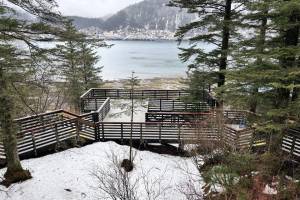
Assembly OKs $3M for flood study as Corps of Engineers experts arrive to consider near-term options
Published 9:30 pm Sunday, September 22, 2024
The Juneau Assembly spent more than $3 million on Monday, a bunch of massive sandbags may be ordered on Tuesday and out-of-town experts may during the next week come up with ideas to help Juneau address its flooding concerns during the coming year.
But there are big unknowns with those and other steps now being considered at levels of government ranging from the Assembly to the White House, according to officials participating in discussions last week in Washington, D.C., and a special Assembly meeting Monday.
One thing that is certain is after two straight years of major flooding from Suicide Basin — with a second year far worse than the first — the matter now has significant federal as well as local government recognition.
“I think the thing that has really broken loose in just the past couple days here is the (U.S. Army Corps of Engineers) is very interested in this as a project,” U.S. Sen. Lisa Murkowski (R-Alaska) said in an interview Sunday. “It is unique, it is different, it is challenging and it is a booming threat. The fact that we are just a month and a half from a full release, and the volume of water is at the level that it’s at, and the weather service posting information daily on this, this has got the attention of the Army Corps of Engineers in a way that I think is going to allow for more early involvement and greater engagement from the Corps.”
Juneau’s situation also was brought to the attention of staff with the U.S. House Appropriations Committee as they worked on a continuing resolution being taken up this week to keep the federal government operating, City Manager Katie Koester told Assembly members Monday.
“What was important about that is that they understood the needs of a small community like Juneau, and can think of us when they’re they’re pulling that together and making sure those programs are plussed up enough to include us,” said Koester, who traveled to D.C. last week, along with Mayor Beth Weldon and delegates from the Central Council of the Tlingit and Haida Indian Tribes of Alaska, to discuss flood issues with federal officials and members of Alaska’s congressional delegation.
Members of the Corps of Engineers flood-fighting team are in Juneau this week to assist local officials with what Koester described as short-, medium- and long-term problems with the threat of glacier outburst floods from Suicide Basin:
• The short-term threat of a second major release during the next month from the ice dam. As of Monday the water level in the basin was at about 1,200 feet and a full release of water would result in the Mendenhall River reaching a level of 11.3 feet, compared to the 15.99-foot peak on Aug. 6 of this summer’s flood.
• The mid-term threat of another major flood next summer.
• The long-term reality that major annual flooding is likely to continue, according to researchers studying the Mendenhall Glacier and climate patterns.
“The Army Corps of Engineers is going to be here all week, and meeting with staff and touring the river, and I think we’re going to have a much better idea of what we need after they’ve spent a week here,” Koester said.
The Assembly at its midday meeting approved $3 million to fund half of a multi-year Corps of Engineers study of long-term mitigation measures, which could include options such as a drainage tunnel through a mountain, plus $100,000 for expanded inundation maps and hydrological modeling of the Mendenhall River. The long-term study will take several years and any proposed remedies will likely involve a complex regulatory process since the basin is on U.S. Forest Service land.
The Assembly has also already approved $1.055 million in emergency flood-related spending, including $150,000 for removal of debris and waste, $400,000 in emergency repairs to the wastewater treatment plant, $355,000 for stormwater system damage, and $150,000 to begin evaluating the feasibility of mitigation measures against future floods.
While some actions and proposals may be months or years away, Koester said she can order enormous six-foot sandbags “tomorrow” that could arrive by barge within three weeks — likely soon enough to deal with a major flood in October — that could be placed with expert guidance from Corp of Engineers officials. But she warned there will also be risks and issues to consider when doing so.
“The bad news part of that is it’s fairly likely these barriers would need to be placed along much of the river, which I don’t know that we have manpower or funding for because they’ll need to be filled with sand,” she said. Furthermore, “if we should end up doing that there’s risk associated with that — and it’s like huge risk that we get it wrong, especially having limited information — but that is the work that we’re doing right now, doing that risk assessment.”
Koester said Gov. Mike Dunleavy has requested President Joe Biden issue a federal declaration of emergency through the Federal Emergency Management Agency, which has the support of the congressional delegation.
A FEMA disaster declaration would essentially double the amount of state disaster aid available to affected residents, which is currently up to $22,000 for damage to residences and $22,000 for belongings inside homes.
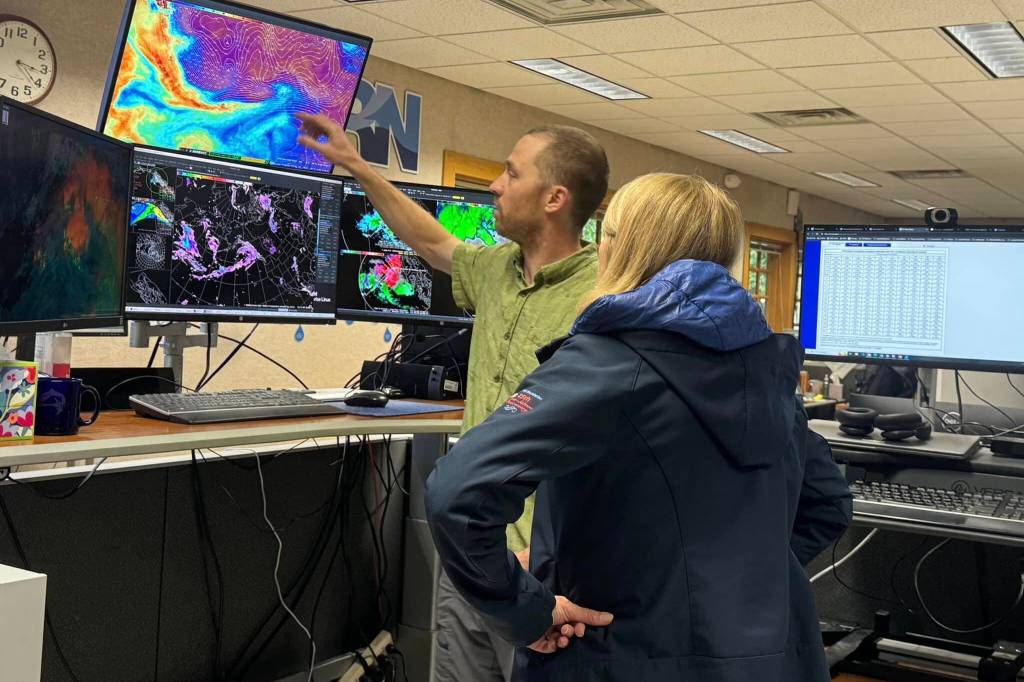
In addition, Murkowski traveled to Juneau on Friday, and visited the National Weather Service Juneau office to discuss the situation with officials who are monitoring the basin and weather conditions affecting the flood risk there. She said there were also discussions about related issues about broader issues such as landslides that have caused fatal damage in Southeast Alaska the past few years, and staffing and monitoring equipment needs.
“I wanted to talk to the weather service about some of what we’re seeing with these more extreme weather events,” she said. “It’s one thing talking about the Juneau event, but just last month I was in Ketchikan to see the landslide and talk with some weather service folks there trying to understand what happened there. And it was less than a year ago in Wrangell having the exact same conversation about why, after all these years, did this side of the mountain come loose when it’s never been viewed as a threat before.”
Murkowski said that in addition to pushing for immediate federal assistance for Juneau — while acknowledging available resources are limited in proportion to the multitude of major incidents nationwide — she is co-drafting a bill with U.S. Sen. Alex Padilla (D-California) to elevate the status of atmospheric rivers as they relate to disasters on a federal scale.
While many of the next steps for local leaders are uncertain, Deputy Mayor Michelle Bonnet Hale said a public meeting should take place next week to update residents, as well as ensure people trying to repair current flood damage and safeguard against future risks aren’t working at odds with each other.
“I know that people in the neighborhoods are forming groups trying to figure out if they need to do things themselves, which then becomes, I think, quite dangerous because then it’s all the sort of the consequences of all the individual actions that might affect the river,” she said.
• Contact Mark Sabbatini at mark.sabbatini@juneauempire.com or (907) 957-2306.