
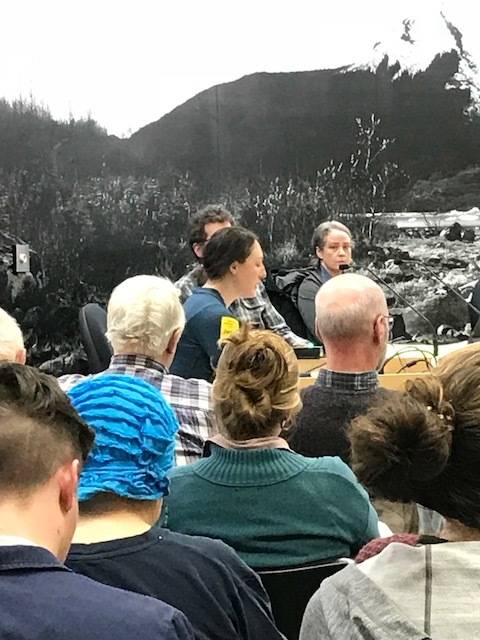
Juneau residents were able to weigh in on proposed changes to the city’s mining ordinance during a public comment session at a completely full City and Borough Juneau Assembly Mining Subcommittee meeting Thursday night. More than 50 people attended.
The forum broke down in two sides: people either wanted to keep the ordinance as is, with just a few revisions from City Attorney Amy Mead with a socioeconomic study included; or they wanted to revise the ordinance, and not require an socioeconomic study but to allow the mining operation to rely on an Environmental Impact Statement (EIS) instead.
The meeting opened with Guy Archibald, staff scientist at Southeast Alaska Conservation Council, who was given time to speak on behalf of the organization. Archibald is in support of keeping the socioeconomic study as a means of making sure the mining areas are safe. Archibald sent in a written response and read a majority of that during his response.He is in favor of keeping the ordinance as Mead revised it, citing issues with state and federal permits.
“No mine has ever had a state or federal permit revoked in Alaska, despite numerous violations, compliance letters and fines,” he said. “The current ordinance gives CBJ additional protection by allowing the (Planning) Commission to suspend or revoke the CBJ permit if (the) operator is in material and substantial noncompliance with a notice or permit issued under the CBJ or by any state or federal agency.”
Arhibald concluded his statement by agreeing with the revised ordinance the way Mead last drew it up and submitted it on Feb. 8. Mead presented a version with notes made in red detailing the changes she had done. There were not any substantive changes, except wording and order.
Jim Clark, who represents a group of businessmen who want to change the ordinance, is against having the socioeconomic study. His request was to allow every proposal to be a case-by-case, or “mine-to-mine,” based situation with studies done and decided by the Planning Commission.
“The applicant would still have to apply with federal and state regulations,” he said. “Should an applicant not comply or violate a regulation, it could lose conditional permits. The Planning Commission will tailor the studies to the mine.”
Clark also said, in his revised edition of the ordinance, there would be protection to the Planning Commission if further studies are needed.
“Should the Planning Commission need further studies, it would come by the costs of the applicant,” he said.
Clark also believed the socioeconomic studies were “discriminatory and unfair.”
“Any employer who would come, who would have to provide a socioeconomic study, would be just relegated to the mines on the ‘roaded’ system,” he said. “Why should they be treated different?”
After Archibald and Clark gave their statements, which were essentially the sides of the issue the community is choosing between, the rest of the meeting’s attendees weighed in. More than half of those in attendance stated their cases, the testimony was nearly split down the middle.
Carly Dennis, a Juneau resident, wanted the commission to consider health and welfare first before making any changes and removing the socioeconomic study.
“Keeping Juneau safe should be the most important part of the ordinance,” she said. “I don’t understand removing the socioeconomic part of the ordinance if we aren’t 100 percent sure it will protect the citizens of Juneau.”
Neil MacKinnon, one of the original five businessmen proposing a change to the ordinance, said costs and repetitiveness were his main concerns.
“It is the duplication in the socioeconomic portion where (the mines) have to go through state and federal regulations and then do the same thing for city regulations,” he said. “It is expensive for the city and for everybody involved. The city may not have the expertise or staff to perform (the studies).”
MacKinnon, and others in favor of removing the socioeconomic study, believe mining companies are less likely to want to come to Juneau if they have to go through the extra studies because of time and costs. Mines only have to go through the socioeconomic study if they are not in rural areas, according to the ordinance.
Sarah Davidson, SEACC Inside Passage Waters Program Manager, is in favor of keeping Mead’s revised ordinance, but would also like to see more added about the importance of safety.
“I am strongly opposed to removing the three most important parts of the ordinance: the socioeconomic study, the feasibility study, and conditional use,” she said. “I would like to consider further additions about the health, safety and well-being of the residents.”
Public comments were taking in written form before Thursday’s session. More than 60 comments were submitted and the comments were reflective of Thursday’s forum. Elaine Schroeder, an organizing member of “350 Juneau,” a grassroots climate change group, sent in a postcard stating, “I and others spent countless hours crafting regulations to protect Juneau not for businessmen.” James Wilson, a Juneau resident of more than 50 years, wrote in that the mining ordinance “should be clarified to eliminate duplicative permitting processes and bonding already covered by Federal and State statutes, regulations and permits.”
The Committee agreed at the end that it needed more time to consider all options. The committee will also decide within in the next couple days on when the next meeting on this ordinance will take place.
• Contact reporter Gregory Philson at gphilson@juneauempire.com or call at 523-2265. Follow him on Twitter at @GTPhilson.
