
Your local government spent more than $450 million without much discussion Monday night following months of in-depth scrutiny. Nearly all of the amount is for next year’s city, schools and hospital budget, with the remainder including a $6.3 million “down payment” on a new or renovated city hall, plus an assortment of other projects and programs.
While there was some debate about the city hall funds by City and Borough of Juneau Assembly members at their meeting, the most-contentious issue of the evening was an essentially zero-budget “housekeeping” update of the election code that changes the rules for gathering ballot petition signatures.
The budget totalling $439.6 million passed unanimously with no public testimony and no discussion by Assembly members, the final step in more than two months of detailed review by politicians and administrators.
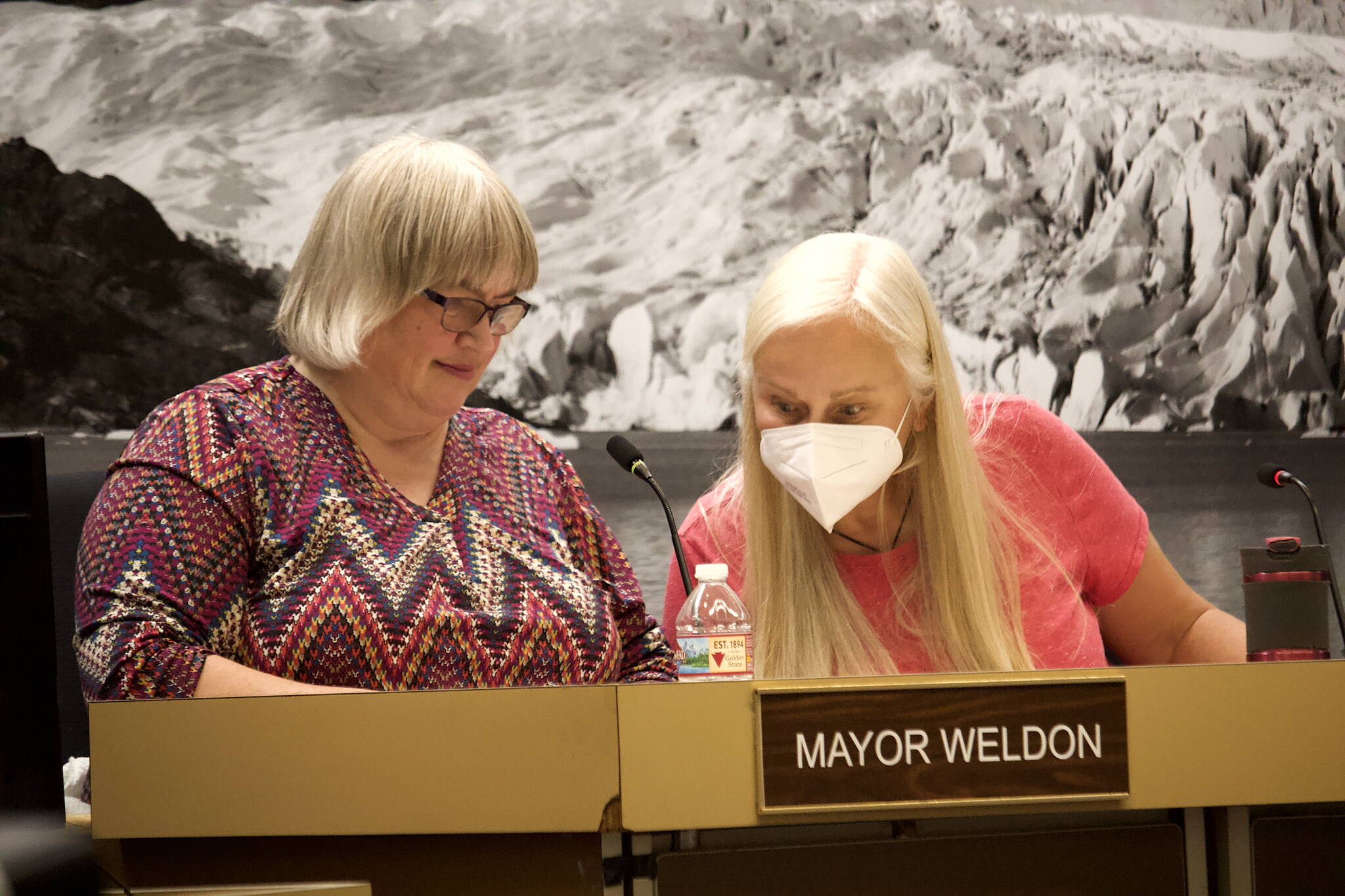
There’s a few different sets of numbers referring to the amount of revenue and spending (i.e. the city’s $172 million general fund budget that excludes school and hospital spending was the Assembly’s primary focus the past two months). But the bottom line is total revenue for next year is about $426.4 million, which means a deficit of about $13.2 million, although Mayor Beth Weldon noted after the vote the city has sufficient reserve funds to cover the shortfall — and using the funds for that purpose was deliberate.
“We were left with a very healthy fund balance from previous Assemblies and we have tried to spend that fund balance down,” she said. However, “we will have to be very careful from now on and be prudent. We will look forward to more excitement next year.”
Assembly members also unanimously approved without discussion to keep the existing property tax rate at 10.56 mills for the coming year.
[City budget: More last-minute spending, no new taxes]
The Assembly is legally required to pass the budget by June 15, but some unknowns remain that could significantly alter the actual amount of revenue and spending during the coming year.
Among those unknowns are ongoing collective bargaining negotiations for municipal employees and whether Gov. Mike Dunleavy will veto some or all of a $16 million allocation approved by the Alaska Legislature to compensate for five years of short-funded school bond debt reimbursement.
The latter unknown in particular emerged as a concern in the discussion about the final approval of $6.3 million in general funds for a yet-to-be-determined city hall upgrade. The current options are either $12 million in upgrades to the existing, aging building or a new building costing roughly $40 million, and the Assembly is likely to ask voters this fall to approve a bond that would fund the remaining cost for the new building.
Assembly members favoring the allocation said it will reduce the amount of the bond voters are asked to approve, show a commitment to the long-debated project and rid the city of the need to spend roughly $1 million a year renting overflow space for employees. But Assembly member Maria Gladziszewski, who with Greg Smith were the dissenters in a 7-2 vote, said the general fund portion isn’t necessary until more is known about the will of the governor and local voters.
“I’m concerned about the governor’s vetoes and what we plan to have in our reserve or not,” she said. “We can always do this after voters approve the bond, or if they don’t this money will still be in the fund.”
Smith, repeating an argument from earlier meetings, noted voters will also be asked to approve other revenue measures including extending a “temporary” 1% sales tax that’s been in effect for the past 40 years and “there may be some revolt” about approving too many such requests.
Assembly member Wade Bryson, also repeating earlier discussion, emphasized approving the “down payment” before putting a bond question on the ballot is essential so residents have accurate knowledge of what they’re being asked to approve. Furthermore, he said, after debating and studying the issue for nearly two years, and agreeing the current city hall is inadequate, it would be a tremendous waste of time and money not to proceed with efforts to fund a new building.
“We’ve found a simplistic design that will give us a 100 years of use that will absolutely save us money,” he said.
Other spending receiving final Assembly approval without discussion includes:
■ $1.5 million in general funds for information technology infrastructure upgrades to city systems.
■ $2.3 million to replace CT/MRI equipment at Bartlett Regional Hospital.
■ $2.5 million for a deckover along the Marine Park seawalk to improve general and disabled access as part of the Waterfront Seawalk Fund.
■ $1.73 million to Coogan Construction Co. for reconstruction of Harris Street and Seventh Street from the intersection of Harris and Fourth Street to the intersection of Seventh and Gold Street.
■ $333,402 in grant funds to Aiding Women in Abuse and Rape Emergencies (AWARE) for a retaining wall to protect the domestic violence emergency shelter.
■ $146,150 to Channel Construction Inc. for processing and disposing abandoned vehicles.
Debate among Assembly members – and with city administrators — was revived when the modifications to the election code were considered near the end of the meeting.
Much of the ordinance is classified as housekeeping that clarifies procedures for collecting and securing ballots daily from voting centers and from secure ballot drop boxes. But a provision requiring voting petition booklets to be turned in even if there aren’t enough signatures to place a proposal on the ballot has raised questions among Assembly members and people involved in signature gathering.
The debate is largely an issue of privacy — weighing whether allowing signature gatherers to keep incomplete booklets with people’s personal information is more intrusive than turning the booklets over to the city where they’ll become public information after certain sensitive details such as the last four digits of Social Security numbers are redacted. Ultimately, the Assembly opted to approve the ordinance after the city clerk and attorney both asserted it is the more responsible alternative.
“The right to petition the government comes with responsibilities,” Assembly member Michelle Bonnet Hale said. “Just as when somebody offers public testimony they do it very publicly, when somebody petitions the government they are also offering themselves publicly. I do place a great deal of concern on the privacy of citizens, but I believe that responsibility is more important in this case.”
• Contact reporter Mark Sabbatini at mark.sabbatini@juneauempire.com
