
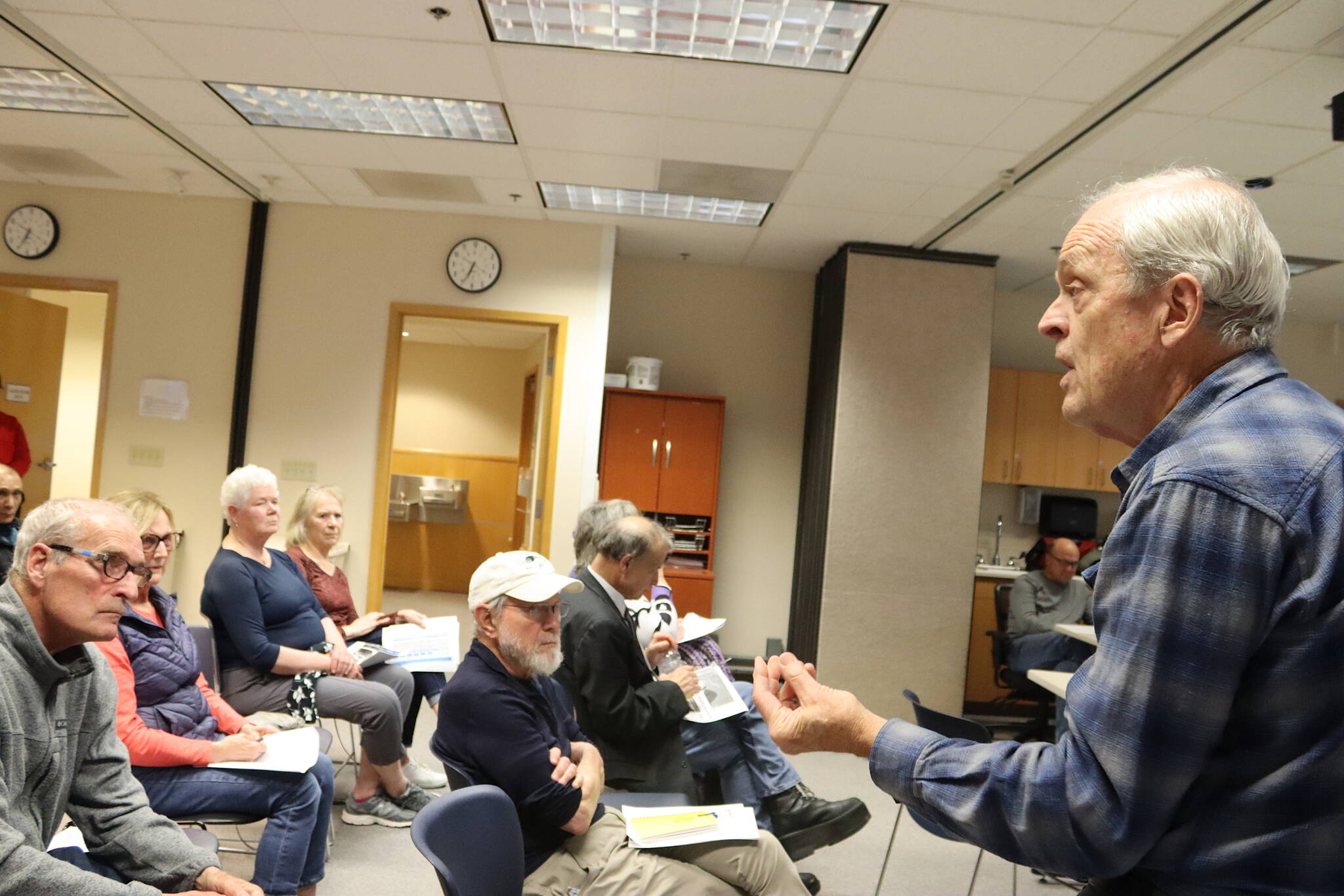
Residents expressing concerns Tuesday about reducing or eliminating programs at Bartlett Regional Hospital such as substance abuse treatment got a sobering diagnosis from officials about the hospital’s ability to exist under current financial conditions while facing competition from the Native nonprofit Southeast Alaska Regional Health Consortium.
About 25 people in-person and 35 online attended the first of two public forums scheduled by hospital leaders to get feedback on proposed cuts to six “non-core” programs including Rainforest Recovery Center, crisis observation and stabilization services, and outpatient psychiatric care.
A second forum is scheduled Monday and online/mail comments are being accepted until June 19, with the hospital’s board of directors scheduled to make recommendations about the program at its June 25 meeting.
[Bartlett seeking help from Assembly and public as program cuts considered to halt huge losses]
Most of the options proposed by hospital leaders during the past couple of weeks involve either reductions, finding additional funding from sources such as the City and Borough of Juneau, or having another entity take over specific programs. Quigley Peterson, a longtime doctor at the hospital now involved with the hospice program Bartlett took over last year, said that approach isn’t being well-received by residents.
“It kind of looks like — the optics of it I’ve heard from several people — it looks like the board is washing their hands of it, saying like ‘If you want to pay for it, that’s great. Otherwise, it’s out of here,’” he said. “I really believe that for sustainability there’s probably a middle ground.”

Bartlett Regional Hospital administrators and board members listen to residents, including current and former medical staff, comment about programs being targeted for possible cuts during a forum Tuesday at the hospital. (Mark Sabbatini / Juneau Empire)
Hospice, which Bartlett took over along with a home health program after Catholic Community Services stopped offering the programs, is an example where support by the hospital can help it perform core services, Peterson said.
“We’ve had a lot of people who should have been at hospice dying in this hospital over the years, holding up beds,” he said. “Meanwhile locals who have pneumonia or sepsis get flown to Anchorage or Seattle because we don’t have beds.”
But the numbers presented by Bartlett officials are stark, with the hospital losing about $1 million a month since mid-2020 and at risk of running out of cash within three years. In addition to the six programs targeted for cuts or elimination losing money — and thus further putting core services at risk — the hospital is increasingly facing competition for services also provided by SEARHC.
“SEARHC has, and I think uniquely in Alaska so far — decided to compete directly against the private providers that are out there, including Bartlett, but also dentists and other providers,” said Max Mertz, chair of the hospital board’s finance committee. “And when your reimbursement rate is significantly higher than what other providers get it creates a very uneven field.”
“Anytime you have a monopoly provider in any market healthcare outcomes go down. And we are very much in danger of having a monopoly here and a lot of what we’re dealing with here is because of that.”
Lisa Petersen, a Bartlett board member, said at a meeting last week between the board and Juneau Assembly that “I had a coworker ask if the hospital is for sale and if SEARHC is going to buy it.” Other hospital leaders have said such comments and uncertainty are common.
SEARHC, established in 1975 and one of the largest Native-run health organizations in the U.S., originally served only Natives at its Southeast Alaska facilities, but has expanded its patient base and operations over the years. It receives funding from the Bureau of Indian Affairs and grants as well as billing.
In response to questions submitted at midday Wednesday by the Empire to SEARHC, spokesperson Kathryn Sweyer sent a reply stating “SEARHC is committed to providing high-quality healthcare services and supporting the health and well-being of communities across Southeast Alaska. Our focus remains on enhancing and improving our existing services to meet the diverse healthcare needs of our patients. We respect the important work Bartlett is doing.”
Bartlett is owned and operated by the City and Borough of Juneau, so the option of “subsidizing” programs such as those being considered for cuts largely rests of the willingness of city leaders to provide additional funds. During last week’s joint Assembly and hospital board meeting, Mayor Beth Weldon suggested the question might be put to voters about funding or scaling back such programs.
Some people speaking at Tuesday’s meeting, including current and former medical staff at the hospital, said the current priority for the board should be ensuring essential services are prioritized.
“Bartlett generally needs to look at doing surgical services, doing what they do and do it well,” said Carlene Conway, who worked at Bartlett for 32 years including as its surgical services director. “Not try to branch out too many places.”
But some attendees — noting Bartlett’s expansion of programs in recent years, including some now targeted for reductions — said it’s also vital to consider what best serves the overall health needs of the community. Aaron Surma, executive director for the National Alliance on Mental Illness’ Juneau office, cited crisis services the hospital started offering in December at its new Aurora Behavioral Health Center as a high-need service without suitable local alternatives.
“My strong hope for you all is that you see that crisis service as something important as something that is worth pursuing instead of some new square footage in a building to do as you see fit,” he said. “I think that you all inherited a financial situation that no individual person here created. But I think you also inherited an obligation to provide that service. Bartlett Hospital said that Bartlett Hospital would be the provider of that crisis stabilization service and to give that up, and to give up the millions of dollars that have been put into it…sets our community back even further.”
Hospital leaders said discussions with third-party providers to take over programs such as hospice and home care are already underway. Beyond that officials are doing more than just hoping for more city funds or making cuts, said Ian Worden, the hospital’s interim chief executive officer.
“We’ve not only opened these conversations to the public as well as the Assembly, but we’ve been in contact with the office of our two (U.S.) senators to make sure that they understand some of the issues,” he said. “We’ve been meeting with other organizations that might have similar services to see whether we can lower costs by using some of those. But what we’re really trying to do is figure out if there’s ways that we can solve this problem.”
• Contact Mark Sabbatini at mark.sabbatini@juneauempire.com or (907) 957-2306.
