
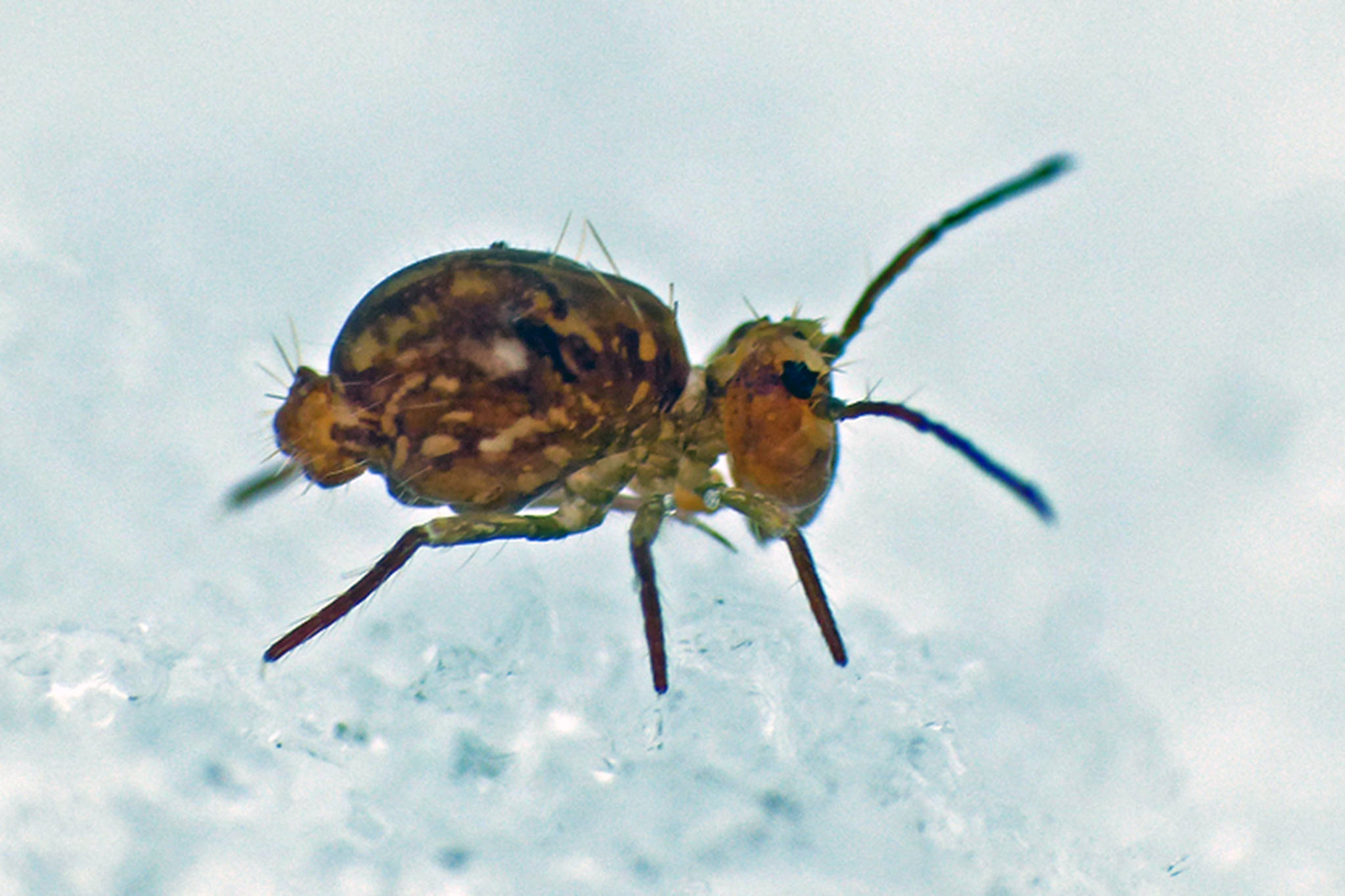
Animals “discovered” land well over 450 million years ago. Arthropods (joint-footed) are the earliest known terrestrial animals. The evidence lies in the fossilized trackways of some type of arthropod creature, possibly something like a horseshoe crab. Scientists speculate that the first land-dwellers may have come up on shore, initially, to feed on invertebrates that lived near the tide line, and then eventually moved inland. Now there are more species of arthropod than all other animals combined.
In addition to being “joint-footed,” arthropods typically have relatively — sometimes very — hard external skeletons. That gives their muscles something to pull against, so they can move. (Contrast that with the vertebrates, which have internal, bony, skeletons that muscles pull on). But having an exoskeleton means that when it comes time to grow, the old exoskeleton must be molted, the body pulled out of the old husk, and the new exoskeleton given time to harden. Nevertheless, this arrangement clearly has proved very successful over geological time.
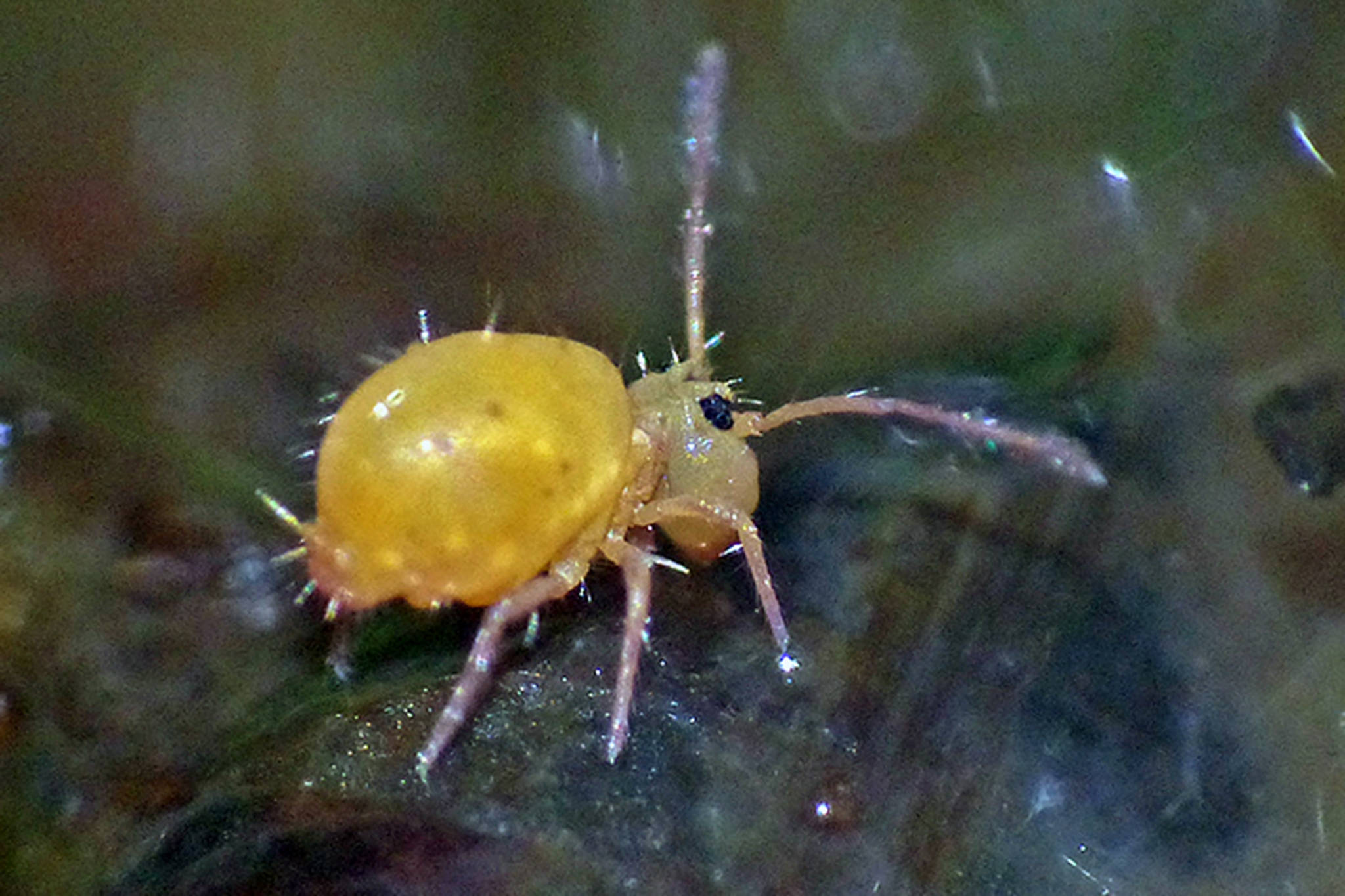
A springtail on bear scat. (Courtesy photo | Bob Armstrong)
Many branches of the arthropod family tree today have terrestrial representatives — the spiders, mites and ticks, centipedes and millipedes, even the mostly marine crustaceans (i.e., isopods), and a major group called “hexapods” (six-footed), which originated from ancestors that were already terrestrial. This group has two main branches that diverged over 400 million years ago. One branch is the insects, which greatly diversified over time, with some representatives re-invading aquatic habitats. The present-day major groups of insects did not arise all at once. The ancestral insects gave rise first to the mayflies, then to the dragonflies; both of these groups are considered to be quite different from other insects. Sometime later, the grasshoppers and stoneflies arose, and then the beetles, almost 300 million years ago. Then the flies, over 250 million years ago, and then two geologically recent groups, the caddisflies and also moths and butterflies.
The other hexapod branch consists of springtails and some quite obscure small critters. Springtails have an unusual fossil record. There is a fossil springtail from Scotland that dates back over 400 million years, already distinct from the insects. Then there is apparently a prodigious gap in the record for about 300 million years. I have to wonder why!
This branch is distinguished from insects by the enclosure of the mouthparts inside the head capsule (insects have unenclosed mouthparts). For feeding purposes, the enclosed mouthparts of springtails and the other non-insect hexapods can be extended and retracted. The species of this hexapod branch are mostly blind or nearly so and have very simple genital arrangements — simply an opening on males for depositing a sperm-containing sac (called a spermatophore) and an opening on females for picking up a spermatophore.
It seems to me that the enclosure of mouthparts might limit the size of food items or the way food can be handled. This anatomical detail may be one reason that most of these little animals feed on very small stuff: detritus, fungi, invertebrate feces, or micro-organisms; only a few feed on living plants. A few (but not springtails) are predatory on small invertebrates, capturing prey — not with just the mouthparts — but with formidable forceps at the rear end.
There are about 6,000 species of springtail, which typically have the unique spring that gives them their common name. On the underside of the abdomen is a little, forked appendage (called a furculum) that is held under tension, up against the body until it is released. Then it snaps backward, lifting the animal into a rather uncontrolled jump, which is thought to be a means of eluding predators. Many springtails live in tree canopies, caves, soil and leaf litter, and even on the surface of ponds. We might see them hopping about on snow on a warm winter day … and wonder what they are doing.
Springtails bear a little peg-like structure under the anterior part of the abdomen. It seems to be sticky, and it is this structure that gives the whole taxonomic group the name of Collembola (meaning glue-peg, in old Greek). Its function is disputed — it may somehow help with jumping or it may have a physiological role, such as excretion or regulation of salt and water content). Living on land brought with it a collection of potential problems. One is desiccation. Terrestrial animals need to protect the water content of their bodies, preventing water loss from the body surface with some kind of skin, regulating salt and water content with some sort of kidney, excreting excess salt from special glands, and so forth. Another potential problem is temperature variation, on a daily or annual basis. Air temperatures generally vary more than water temperatures. Terrestrial animals may endure temperature extremes by having antifreeze in the blood, or evaporating water to lose excess heat, for example. Or they may just escape the temperature extremes by hiding in cool, damp places for varying period of time or moving to a different place altogether. Meeting those potential problems contributed to great diversity of body form, physiology, behavior and ecology.
• Mary F. Willson is a retired professor of ecology. “On The Trails” is a weekly column that appears every Friday. Her essays can be found online at onthetrailsjuneau.wordpress.com.
