
Triston Chaney, a Yupik and Athabaskan resident of Dillingham, began fishing on his grandpa’s gillnetter in Bristol Bay when he was 9 years old. He was too young to be on the deck picking salmon from the net, so his grandpa had him count fish as they came aboard. The two have been fishing together every season since.
Chaney is now 21 years old, and commercial fishing is only one aspect of his relationship with salmon. His dad taught him how to fly-fish when he was young, and he fell in love with the sport early in high school. Before the commercial fishing season, Chaney and his family put out a beach set-net to gather food for the year to come. First, they target kings and, then, sockeyes. Triston’s grandma splits the fish and the family helps hang them in the smokehouse.
“When the salmon are running, we can catch all we want pretty quickly. We keep what we need and then share the rest with some of the old-timers and people not as fortunate as us,” Chaney said over the phone when he was taking a break from mending nets and getting his grandpa’s boat ready for the 2020 sockeye season.
Sockeyes are commonly called “reds” due to the color their skin turn shortly before they spawn. The flesh of sockeye is also the reddest of all species of salmon—and its high oil content and delicious taste makes it many folks’ favorite fish to eat. More than that, though, sockeye are a living metaphor telling of a connection to the people of Bristol Bay that goes back beyond memory. Sometimes, when the sockeye spawn in the clear water of lakes, rivers and streams, they look like blood moving through veins made of water.
“Everything revolves around fish here,” Chaney said.
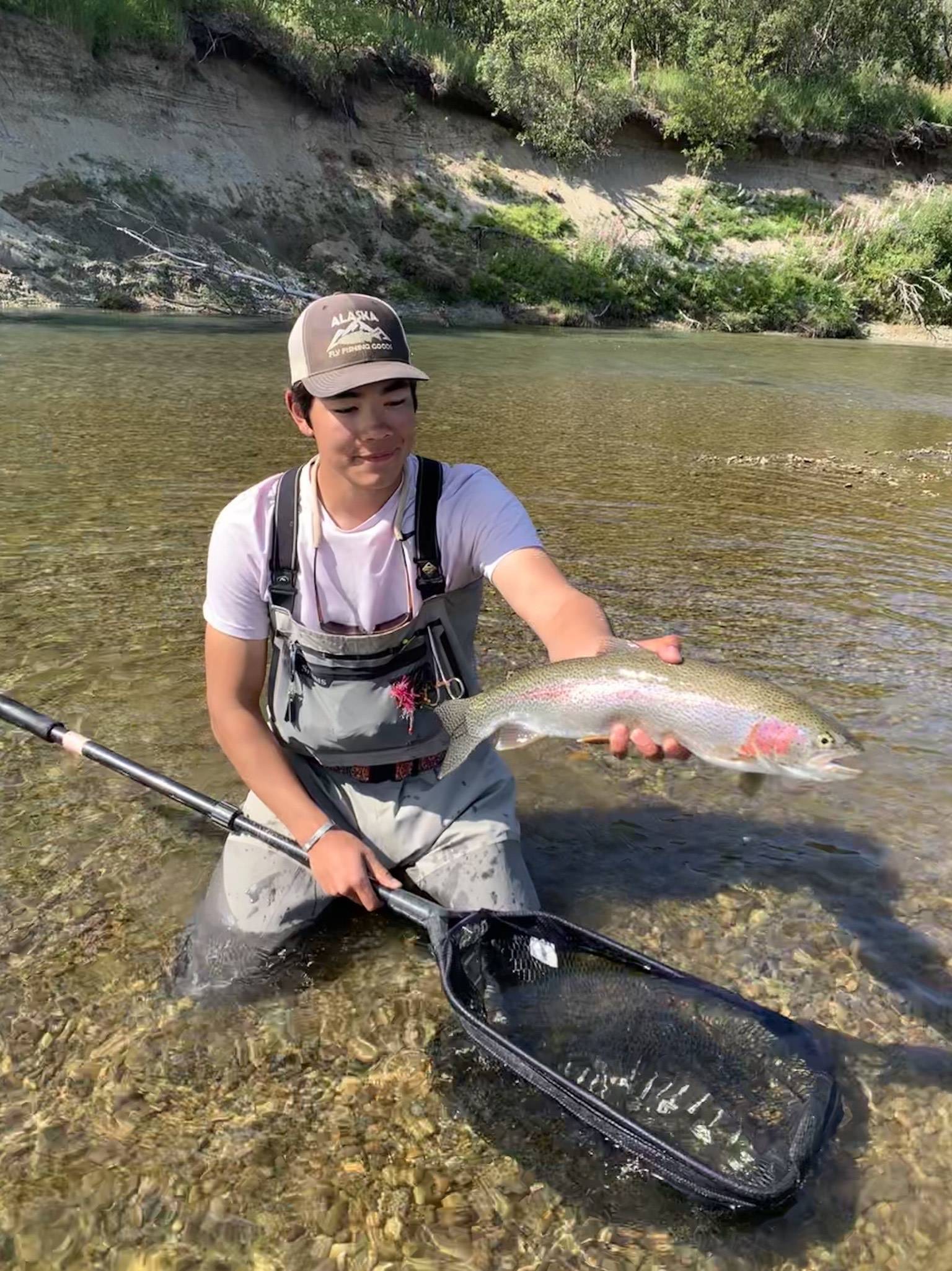
Courtesy Photo | Triston Chaney Triston Chaney holds a Bristol Bay rainbow trout.
Chaney is tied to his family and the land in a way that is becoming rarer in our ever-increasingly industrialized world. His first memories are of hunting spruce chickens (spruce grouse) with his grandpa — from his beginning he was harvesting wild food that he would share with family and others in his community. During the fall and winter, he studies Diesel/Heavy Duty Mechanics at the University of Alaska Southeast. After he graduates, he plans to live in Bristol Bay year-round and do what he loves most: fish. Chaney’s favorite fish to eat is king salmon, especially the smoked bellies, though sockeye comes in a close second. His favorite fish overall is the grayling. His favorite fish to catch is a rainbow trout while using a mouse fly.
“A rainbow will demolish a mouse fly,” Chaney said, reflecting on his love of fly fishing. “So much goes into fly fishing. It’s all about the intricacies. The choices. The cast. The fight is better on a fly rod.”
Last year, after the commercial sockeye season, Chaney began guiding visiting anglers for Bear Trail Lodge in King Salmon — a community on the east side of Bristol Bay, about 50 miles from Dillingham. King Salmon attracts multitudes of visitors who want to experience the region’s incredible fishing, bear viewing and hunting opportunities. For many of his clients, Bristol Bay represents the fulfilment of the Alaskan dream. Whether people want to watch brown bears or catch giant rainbows, it’s a special experience.
“There’s such a diversity of life here. It’s wild how many different species of fish you can catch in a day,” Chaney said.
Chaney plans to further his career guiding fly-fishing trips and to chase fish on his free time. For him, there’s no better place than his people’s homeland, and that’s a big reason he’s a vocal opponent to the Pebble Mine, a massive, open-pit gold and copper mine, toxic waste dump and industrial complex proposed to be built near the headwaters of critical rivers draining into Bristol Bay.
“We don’t like Pebble. We don’t want it. They couldn’t have picked a worse spot to dig a big hole. This could damage our whole lives. Life here revolves around fish and if that went away…” Chaney said, his voice trailing off into silence.
Chaney has been to Washington, D.C., twice to lobby against Pebble. Both times were nerve-wracking experiences — Chaney likened it to having to speak in front of a large group of people but 10 times more intense, “because the people you’re trying to show how bad the mine could be to the region can actually make a difference. I met a lot of cool people and learned a ton. I’m glad I did it and would do it again in a heartbeat to protect Bristol Bay.”
On June 16, Chaney and his grandpa launched their boat in the Nushagak River to be ready when the sockeye fishery opens. The boatyards are bustling, though Bristol Bay fishermen face even more uncertainties than normal. Chaney is concerned with low water in lakes, rivers and streams coupled with the forecast for a hot summer. Last summer the region, and much of Alaska, experienced similarly unusual patterns, and there was a massive die off of fish that were “cooked” by how warm the water became. Chaney and other fishermen noted the tide rips were full of unspawned dead salmon. There’s the pandemic, too. Fish process workers, vital to Bristol Bay’s $1.5 billion fishery, live and work in close quarters that make them more susceptible to contracting the virus. And then, there’s the Pebble Mine, which is on track to be permitted, against scientific findings and against the will of the majority of Alaskans, right in the middle of the commercial fishing season.

Triston Chaney holds a Bristol Bay rainbow trout. (Courtesy Photo | Triston Chaney)
One thing’s for sure, though — come rain, shine or whatever fate has in store, Chaney will be fishing. He hopes to guide fly-fishermen for Bear Trail Lodge after the commercial season but, if that doesn’t work out, Chaney didn’t have to think long about his alternative plans.
“I think I’d like to go on some sort of long fishing trip,” he said.
• Pride of Bristol Bay is a free column written by Bjorn Dihle and provided by its namesake, a fisherman direct seafood marketer that specializes in delivering the highest quality of sustainably caught wild salmon from Bristol Bay to your doorstep. It appears monthly in the Empire.
